

What buying email lists actually means in modern B2B outreach
Buying email lists means purchasing access to business contact data collected and maintained by third-party data providers for use in targeted cold outreach. The practice exists primarily in B2B environments where outreach to business contacts is permitted under certain regulatory frameworks.
The phrase “buy email lists” often creates confusion because it blends two very different practices: bulk marketing and targeted business prospecting. Bulk marketing involves sending promotional campaigns to large numbers of contacts, while B2B prospecting involves personalized, one-to-one outreach designed to initiate conversations. The distinction determines legal risk, deliverability outcomes, and platform compatibility.
Modern email list purchasing is best understood as acquiring structured contact intelligence rather than acquiring permission to send marketing campaigns. The purchased data typically includes job titles, company firmographics, and business email addresses used for professional communication.
Why organizations still purchase email data despite the risks
Organizations purchase email data because outbound prospecting remains one of the fastest ways to reach new markets and validate demand. Internal lead generation takes time, and many companies use purchased data to accelerate pipeline creation.
Several business realities explain the continued demand:
- Sales teams require consistent pipeline growth
- New products often launch before organic channels mature
- Geographic expansion requires new market entry lists
- Niche industries lack high search demand
- Partnerships and enterprise sales rely on direct outreach
The appeal lies in speed and scalability. Building a list organically can take months or years, while a data provider can supply thousands of targeted contacts in hours.
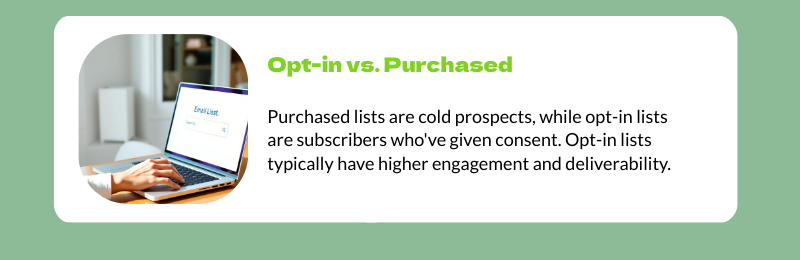
Differences between buying email lists and building opt-in audiences
Purchased lists provide access to cold prospects, while opt-in audiences represent permission-based subscribers. The distinction affects engagement rates, deliverability, and campaign strategy.
The comparison below highlights the operational differences.
| Factor | Purchased Lists | Opt-In Lists | |
| Relationship | No prior relationship | Subscriber consent exists | |
| Campaign Type | Cold outreach | Email marketing campaigns | |
| Deliverability Risk | Higher | Lower | |
| Engagement | Lower initial response | Higher engagement | |
| Platform Compatibility | Cold email tools | Marketing automation tools |
Purchased lists function best as a sales prospecting channel rather than a marketing channel. Treating purchased contacts as subscribers creates performance and compliance problems.
Situations where purchasing email lists can make business sense
Purchasing email lists makes sense when outreach requires precision targeting and rapid market entry. Companies often use purchased data to support outbound sales, partnerships, recruiting, and research.
Typical use cases include:
- Launching into new geographic regions
- Prospecting niche industries with limited inbound demand
- Supporting account-based marketing initiatives
- Building partnership pipelines
- Testing product-market fit with new audiences
- Recruiting candidates for specialized roles
The value comes from speed and targeting accuracy rather than long-term audience building.
Why Reach Marketing stands out as a provider of purchased B2B email lists
Reach Marketing delivers B2B email list building as a strategy-driven lead generation service rather than a simple data purchase. The approach prioritizes targeting accuracy, compliance, and outreach readiness so purchased data can be activated safely and effectively.
Strategy-first targeting improves lead quality
Reach Marketing defines the ideal customer profile before sourcing contacts, ensuring targeting drives list creation instead of generic database filters. This process focuses on industry alignment, company size, job seniority, geography, and growth signals to reduce wasted outreach and improve relevance.
Human verification strengthens accuracy and deliverability
Reach Marketing combines automated data sourcing with manual verification to improve contact accuracy and role relevance. Human validation helps reduce bounce rates, improve personalization, and protect sender reputation.
Key benefits of manual research include:
- Higher email accuracy
- Better role alignment
- Stronger personalization potential
- Lower deliverability risk
Segmentation built for outbound campaigns
Reach Marketing structures lists for messaging and campaign execution rather than raw export. Contacts are segmented by role, department, buying stage, and account priority to support personalized outreach and faster campaign launch.
Compliance-focused sourcing reduces risk
Reach Marketing prioritizes transparent, compliance-conscious data sourcing designed for responsible B2B outreach. This approach helps organizations maintain deliverability while reducing regulatory exposure.
Built to support long-term outbound growth
Reach Marketing treats list building as an ongoing pipeline strategy. Continuous enrichment, refinement, and campaign alignment turn purchased data into a repeatable outbound engine.
Risks that determine whether buying email lists succeeds or fails
Buying email lists introduces reputational and technical risks that must be managed carefully. Poor execution damages sender reputation and reduces long-term email performance.
The most significant risks include:
- High spam complaint rates
- Invalid or outdated email addresses
- Blacklist exposure
- Low engagement signals
- Legal compliance gaps
- Brand reputation damage
Mitigation requires careful provider selection, careful targeting, and disciplined outreach practices.
How reputable data providers collect and verify contact data
Reputable providers aggregate contact data through multiple sources including public records, corporate filings, professional profiles, and voluntary submissions. Data is continuously validated through verification processes.
Typical verification methods include:
- Email server validation checks
- Human research and verification teams
- Real-time bounce monitoring
- Data refresh cycles
- Cross-referencing multiple sources
- Behavioral data enrichment
Data freshness determines list performance. Providers differentiate themselves through verification frequency and update cycles.
What determines the quality of a purchased email list
List quality is defined by accuracy, relevance, recency, and compliance transparency. High-quality lists prioritize targeting precision over raw volume.
Quality indicators include:
- Recent verification timestamps
- Detailed targeting filters
- Clear data sourcing explanations
- High deliverability guarantees
- Replacement or credit policies
- Transparent compliance documentation
Large databases do not guarantee high performance. Precision targeting produces better outcomes than scale alone.
Steps required to buy email lists responsibly
Buying email lists responsibly requires a structured process that protects deliverability and compliance. Each step reduces risk while improving targeting precision.
The process typically follows this sequence:
- Define ideal customer profile and targeting criteria
- Research and vet potential data providers
- Request sample data for validation
- Purchase a small test segment
- Verify email addresses before sending
- Launch controlled pilot campaigns
- Scale gradually based on performance
Testing before scaling protects sender reputation and budget.
Choosing the right data provider for outreach campaigns
Provider selection determines the success of purchased list initiatives. Vendors differ in targeting capabilities, verification processes, and compliance practices.
Evaluation criteria should include:
- Data sourcing transparency
- Verification methodology
- Geographic coverage
- Filtering capabilities
- Pricing structure
- Compliance documentation
- Customer support responsiveness
Long-term partnerships with reliable providers often outperform one-time purchases.
Pricing models used by email list providers
Email list pricing reflects data depth, targeting complexity, and verification level. Understanding pricing models helps set realistic expectations.
Common pricing approaches include:
- Pay-per-contact pricing
- Subscription database access
- Credit-based purchasing systems
- Tiered pricing based on data enrichment
- Enterprise licensing agreements
Higher pricing often reflects stronger verification and richer data attributes.

How targeting criteria determine outreach success
Targeting precision determines response rates and deliverability outcomes. Broad targeting leads to poor engagement and increased risk.
Effective targeting typically includes:
- Industry or vertical focus
- Company size or revenue range
- Job title and seniority level
- Geographic region
- Technology usage
- Hiring or growth signals
Precise targeting improves relevance and reduces spam complaints.
Data enrichment and segmentation after purchase
Purchased data requires enrichment and segmentation before outreach begins. Raw data rarely performs well without additional refinement.
Segmentation activities often include:
- Removing duplicates
- Verifying company fit
- Grouping by role or department
- Adding company insights
- Identifying priority accounts
- Scoring lead relevance
Segmentation enables personalized outreach rather than generic messaging.
Deliverability safeguards that protect primary domains
Cold outreach should never originate from a company’s primary domain. Dedicated infrastructure protects core communication channels.
Essential safeguards include:
- Secondary sending domains
- Dedicated inboxes for outreach
- Domain warming processes
- Gradual sending volume increases
- Technical email authentication setup
- Ongoing deliverability monitoring
Infrastructure separation protects brand reputation and operational email reliability.
Messaging strategies that reduce spam complaints
Cold outreach success depends heavily on message quality and relevance. Personalized messaging reduces risk and improves response rates.
Effective outreach messaging typically:
- References recipient role or industry
- Focuses on business value
- Avoids promotional language
- Maintains conversational tone
- Provides clear opt-out options
- Limits sending frequency
Relevance and respect determine long-term outreach viability.
Metrics that determine whether purchased lists deliver ROI
Performance measurement determines whether purchased lists generate meaningful results. Tracking must focus on sales outcomes rather than vanity metrics.
Key performance indicators include:
- Reply rate
- Positive response rate
- Meeting booking rate
- Opportunity creation rate
- Cost per opportunity
- Pipeline contribution
Open rates alone provide limited insight due to tracking limitations.
Common mistakes that undermine purchased list campaigns
Poor execution frequently causes purchased list campaigns to fail. Avoiding common mistakes improves success probability.
Frequent mistakes include:
- Sending bulk marketing campaigns
- Ignoring compliance requirements
- Using primary domains
- Purchasing overly broad lists
- Scaling too quickly
- Neglecting personalization
Discipline and patience determine long-term success.

When organic list building becomes the better strategy
Organic list building becomes preferable when long-term audience engagement is the primary goal. Permission-based audiences deliver stronger engagement and retention.
Organic strategies typically include:
- Content downloads
- Newsletter subscriptions
- Webinar registrations
- Product signups
- Event participation
- Referral programs
A hybrid approach combining outbound prospecting and organic growth often produces the strongest pipeline.
Why Choosing the Right Email List Provider Matters More Than Ever
Email remains one of the highest-ROI marketing and sales channels. It’s fast, scalable, personalized, and measurable. But the performance of your email campaigns depends entirely on the quality of the data you use.
Sending cold emails to inaccurate or unverified data is a recipe for disaster. High bounces lead to domain blacklisting. Irrelevant contacts lead to low engagement. And poor segmentation wastes your sales team’s time.
On the other hand, a high-quality business email list provider can help you:
- Accelerate outbound pipeline creation
- Target high-intent and ICP-aligned prospects
- Support ABM and personalization efforts
- Reach decision-makers faster
- Fuel multi-channel strategies (email, LinkedIn, cold calling, retargeting)
- Scale efficiently without increasing headcount
But the inverse is also true. The wrong provider can cost you far more than the list itself:
- Damaged domain reputation
- Spam-trap hits
- Legal non-compliance issues
- Inflated bounce rates
- Revenue loss
- SDR burnout
Not all data providers are created equal, and many rely on scraped, outdated, or purchased-from-third-party data that is neither compliant nor reliable.
This guide helps you avoid those pitfalls so you can confidently build a clean, compliant, targeted outreach engine.
What Makes a Business Email List Provider Truly Trustworthy
A trustworthy email list provider is transparent, compliant, consistent, and customer-centric, operating with a level of openness that gives you confidence in both the data you’re buying and the long-term partnership you’re forming. High-quality providers do not rely on vague marketing buzzwords like “proprietary data collection methods,” “exclusive databases,” or “AI-powered enrichment” without providing concrete, verifiable explanations of what those processes actually involve. Instead, they walk you through their sourcing methods, verification workflows, data update cycles, and compliance procedures with clarity and precision.
A reputable provider understands that data is only as valuable as the trust behind it, so they prioritize transparency at every stage of the buyer journey. They clearly explain whether their data comes from public records, opt-in forms, partnerships, event registrations, first-party enrichment, or third-party aggregators, and they provide documentation to back it up. They’re willing to break down exactly how they collect, validate, and refresh their databases rather than hiding behind generic statements designed to sound impressive but ultimately tell you nothing.
Trustworthy providers also demonstrate a deep commitment to compliance. They proactively share GDPR, CCPA, CAN-SPAM, CASL, and PECR alignment details, provide Data Processing Agreements (DPAs), offer opt-out and removal mechanisms, and ensure that all of their data handling processes follow legal and ethical standards. Instead of making you chase them down for compliance proof, they anticipate your questions and supply everything you need upfront.
Consistency is another defining trait. Reliable providers don’t give you one good sample and then deliver something completely different once you purchase. They maintain high data quality across the board, update their databases regularly, and offer bounce rate guarantees backed by real verification systems, not outdated or superficial checks.
And perhaps most importantly, trustworthy providers are customer-centric. They respond to questions promptly, provide ongoing support, offer replacements for invalid contacts, and guide you through integration or onboarding if needed. They care about your long-term success, not just a one-time sale.
Key Signs of a Reliable Provider
- Transparent data sources
- Clear compliance documentation
- Regular database cleansing and verification
- Role-based filters (not just generic emails)
- High accuracy guarantees
- Responsive customer support
- Flexible segmentation
- CRM/ESP integration
- Refund or replacement policy for bad data
- Positive reviews and verifiable reputation
Trustworthiness Checklist
| Feature | Why It Matters | What Good Providers Do |
| Data Transparency | Ensures ethical, accurate sourcing | Provide detailed sourcing documentation |
| Verification Process | Protects deliverability | Multi-step verifications, SMTP checks |
| Compliance | Keeps you legally protected | Provide GDPR, CCPA, and CAN-SPAM compliance details |
| Customer Support | Helps with issues quickly | Offer email, chat, or dedicated reps |
| Segmentation | Ensures relevant targeting | Filters by role, tech stack, region, intent |
| Reputation | Indicates reliability | Reviews, case studies, testimonials |
How to Evaluate Data Accuracy
1. Verification Methods
Good providers use:
- Syntax verification
- Domain validation
- MX record checks
- SMTP handshake pings
- Suppression lists
- Human verification teams
2. Bounce Rate Guarantee
High-quality providers typically guarantee < 5% bounce rate.
3. Frequency of Database Refresh
The best providers update:
- Weekly or monthly (ideal)
- Quarterly (acceptable)
Anything slower than quarterly is usually a red flag.
Questions to Ask Providers
- How often do you update your database?
- What verification methods do you use?
- What is your bounce rate guarantee?
- Do you offer replacements for invalid emails?
- Can you provide a sample before purchasing?
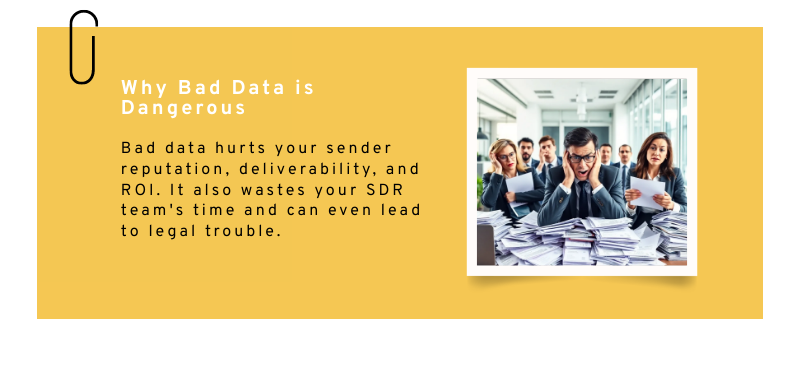
Why Bad Data Is Dangerous
Bad data can:
- Damage your domain reputation
- Reduce deliverability long-term
- Lead to spam-trap hits
- Waste SDR time
- Lower campaign ROI
- Skew analytics
Accuracy is not a “nice-to-have.” It is the foundation of all outbound efforts.
Compliance and Legal Standards to Watch For
Because B2B data involves personal information, compliance is non-negotiable.
Here are the key regulations that reputable providers must follow:
GDPR (Europe)
Focuses on:
- Data transparency
- Right to access or be forgotten
- Lawful collection
CCPA (California & other US states)
Covers:
- Consumer privacy
- Data rights
- Opt-out requirements
CAN-SPAM (United States)
Regulates:
- Unsolicited commercial email
- Opt-out mechanisms
- Sender transparency
CASL (Canada)
One of the strictest anti-spam laws worldwide.
Compliance Proof You Should Request
- Data Processing Agreements (DPAs)
- Consent documentation
- Data origin transparency
- Removal and opt-out policies
If a provider can’t demonstrate compliance, they should not be supplying you with data at all.
Pricing Models, Costs & Hidden Fees to Watch Out For
Pricing varies significantly across the industry. Understanding the different pricing models helps you avoid overspending or paying for features you don’t need.
Common Pricing Models
1. Pay-Per-Record
Simple and predictable, but can get expensive for large lists.
2. Subscription Access
Gives ongoing access to a database, great for continuous outreach.
3. Credit-Based Models
Flexible, but sometimes confusing.
4. Tiered Plans
Offer fixed feature sets at different levels.
5. Custom Enterprise Pricing
For teams needing millions of records or unique integrations.
Hidden Fees That Low-Quality Providers May Charge
- Extra charge for verification
- CRM integration fees
- CSV export charges
- Premium segmentation upsells
- Data refresh charges
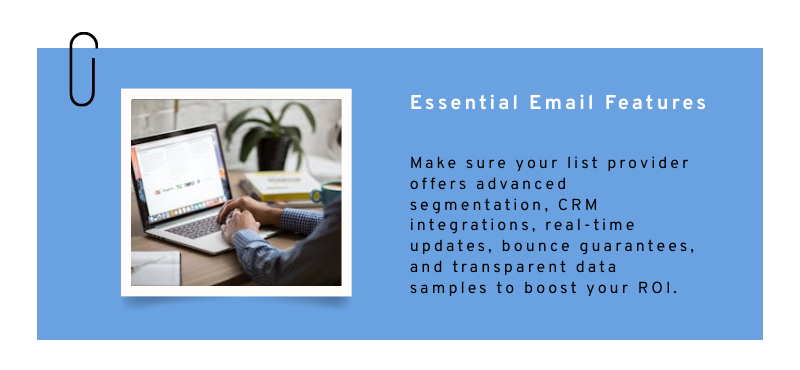
Essential Email List Features to Look For
Before purchasing from any business email list provider, make sure they offer these core capabilities:
1. Advanced Segmentation
You should be able to filter by:
- Industry
- Company size
- Revenue
- Geography
- Seniority
- Tech stack
- Buying intent
- Keywords
2. CRM/ESP Integrations
Look for compatibility with:
- HubSpot
- Salesforce
- Apollo
- Outreach
- Mailchimp
- Lemlist
- ActiveCampaign
3. Real-Time or Near Real-Time Updates
4. Bounce Rate Guarantees
5. Data Replacement Policies
6. Custom Data Builds for Niche Markets
7. Transparent Sample Data
Red Flags That Indicate a Low-Quality Email List Provider
Even if the price is attractive, avoid providers with these major warnings:
Major Red Flags
- No transparency about data origin
- Overpromising accuracy (e.g., “100% verified”)
- No compliance documentation
- Unusually low prices
- No customer reviews
- No sample data
- No refund or replacement policy
- Outdated website
- Difficult or slow customer support
If something feels off, trust your instincts.
How to Compare Multiple Email List Providers (Step-by-Step)
Here’s a systematic way to evaluate and compare your options:
Step-by-Step Comparison Framework
- Define your ICP
- Required segmentation
- Request data samples
- Run SMTP verification on samples
- Compare bounce rate guarantees
- Review compliance policies
- Evaluate available integrations
- Compare pricing transparency
- Read customer reviews
- Test customer support responsiveness
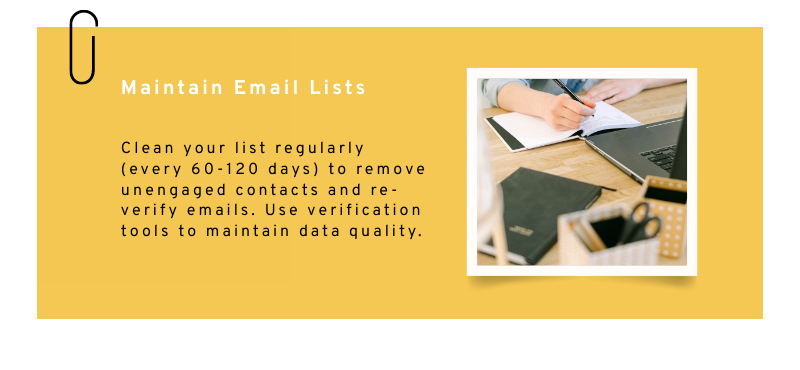
How to Maintain and Clean Your Email List After Purchase
Even the best data degrades, people change roles, companies, and email domains frequently.
Best Practices for List Hygiene
- Re-verify emails every 60–120 days
- Remove unengaged contacts
- Monitor bunce rates
- Use verification tools
- Regularly update CRM fields
- Suppress spam traps
Recommended Tools
- NeverBounce
- ZeroBounce
- MillionVerifier
- Clearout
Maintaining data is just as important as purchasing it.
How Business Email Lists Fit Into a Larger Lead Generation Strategy
A purchased list is not a standalone tool, it’s part of a multi-layered marketing and sales ecosystem.
How Email Lists Fuel This Ecosystem
- Provide contacts for ABM campaigns
- Enable hyper-personalized sequences
- Extend your outbound reach
- Support LinkedIn and phone outreach
- Enhance lookalike audience building
- Improve lead scoring
- Support content syndication
Your email list is a growth asset, but only when integrated strategically.
People Also Ask – Buying Email Lists
Is it legal to buy email lists?
Buying email lists is legal in many regions when used for compliant B2B outreach that includes identification and opt-out mechanisms. Legal risk increases when contacting consumers or sending promotional campaigns without consent.
Is buying email lists a good idea?
Buying email lists can be effective for targeted B2B prospecting when managed carefully. Poor targeting and bulk marketing use typically produce low engagement and deliverability problems.
How much does an email list cost?
Pricing varies widely depending on targeting complexity and verification level. Costs commonly range from a few cents per contact to premium subscription access for enterprise databases.
Can purchased email lists be used with marketing platforms?
Most marketing automation platforms prohibit purchased lists because they are designed for permission-based campaigns. Cold outreach tools are typically required instead.
How many emails should be sent per day?
Daily sending volume should increase gradually during domain warm-up and scale based on deliverability signals. Sudden volume spikes often trigger spam filtering.
Do purchased email lists work for B2C marketing?
Purchased lists rarely perform well for consumer marketing because consent expectations are higher and regulations are stricter. B2B outreach remains the primary use case.
How long does purchased data stay accurate?
Contact data changes frequently due to job changes and company updates. Ongoing verification and periodic refresh cycles are required to maintain accuracy.
What is the safest way to start using purchased lists?
Starting with small test campaigns, verifying data, and using dedicated sending infrastructure reduces risk and allows gradual scaling based on results.
Responsible use of purchased data will continue evolving as privacy expectations and deliverability technologies advance. Organizations that prioritize compliance, relevance, and infrastructure discipline will maintain sustainable outreach performance.