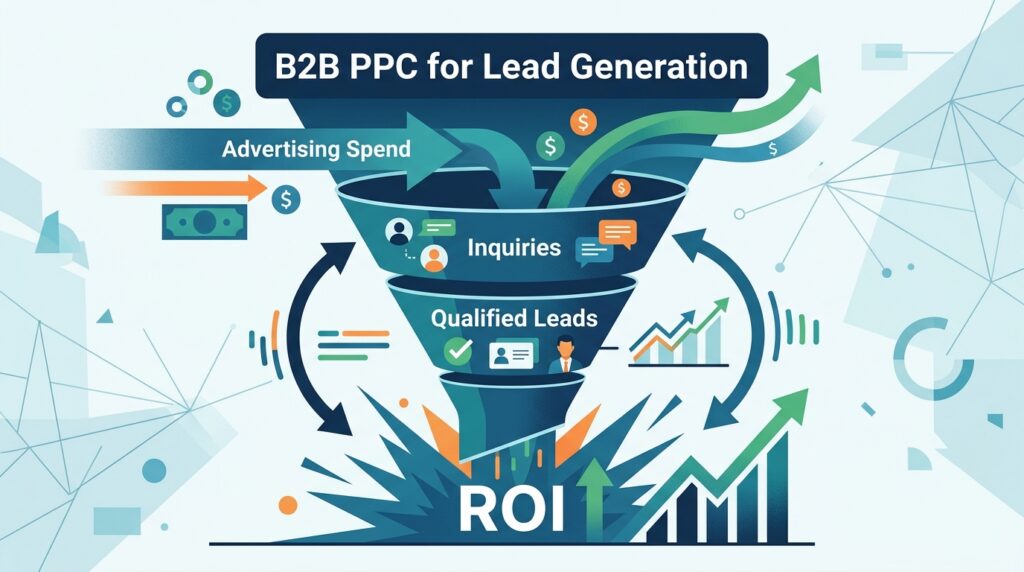
A campaign can generate more leads, report a lower cost per conversion and still leave sales with fewer opportunities worth pursuing.
B2B PPC for lead generation becomes commercially useful when campaign decisions reflect who submitted the inquiry, whether the business can serve that prospect and what happens after the form submission.
B2B PPC for lead generation uses paid advertising to attract business buyers and convert their interest into identifiable inquiries. An effective strategy connects targeting, offers, landing pages and sales follow-up, then measures qualified opportunities and customer acquisition alongside lead volume.
PPC technically describes paying for clicks. B2B paid media programs can also include advertising purchased through other billing models. Evaluate each campaign’s buying method and business purpose separately.
Define the Lead You Want Before Buying the Click
A lead definition should tell marketing what to attract and sales what to accept.
Start with an ideal customer profile: the company characteristics that make an account commercially suitable. Then define the people involved in evaluating, influencing and approving a purchase. Company fit and individual role answer different questions.
A procurement specialist at a suitable manufacturer may be more valuable than a senior executive at a company that cannot use the offering. Conversely, an ideal job title does not compensate for an account outside the service territory or below the minimum viable contract size.
Document the qualification rules before launch:
- Company fit: Industry, size, operating model, geography and relevant technology.
- Problem fit: A business need the product or service can address.
- Commercial fit: Project scope, purchasing constraints and potential contract value.
- Buying involvement: The contact’s role in evaluation, implementation or approval.
- Next-step readiness: Whether the inquiry warrants sales contact, further qualification or education.
Keep fit separate from intent. A target-account employee downloading a guide may fit the audience without requesting a conversation. A demo request may demonstrate intent while coming from an unsuitable company. The same distinction underpins a working B2B lead generation program whatever the channel.
Agree on Stage Definitions With Sales
Use explicit operating definitions rather than assuming every team interprets qualified the same way.
For example, define a sales-accepted lead as an inquiry sales has reviewed and agreed to pursue. Define an opportunity as a documented buying process with an identified need and an agreed next step. Those are proposed definitions; adapt them to the business. Where the handoff runs through a marketing qualified lead stage, write that definition down too.
Google Ads supports qualified-lead and converted-lead goals based on events in an advertiser’s own lead process. A converted lead can represent a chosen milestone, so the label does not necessarily mean a completed sale.[1]
The CRM stage behind the label should remain unambiguous.
Calculate What a Lead Can Be Worth
Set an acquisition limit before deciding whether a cost per lead is attractive. A useful planning relationship is:
Allowable media CPL = Allowable media acquisition cost per customer × Lead-to-customer rate
Use the same lead definition, customer segment and acquisition cohort in both inputs. Do not apply the close rate of sales-qualified opportunities to all form submissions.
Set the customer acquisition allowance using expected contribution, retention, payback requirements and acquisition costs outside advertising. Media spend is only one part of total customer acquisition cost.
A Worked Budget Model
The following figures are illustrative planning assumptions, not industry benchmarks or campaign results.
Figure 1. Illustrative planning assumptions. Each step inherits the uncertainty of the one above it, which is why a conservative close rate matters more than a precise allowance.
At those assumptions, clicks costing substantially more than $8 require a better conversion rate, a better close rate or a larger acquisition allowance. The model reveals the dependence between traffic cost and business performance.
The $200 figure is a ceiling under the assumptions, not a recommended bidding target. Leave room for uncertainty and use conservative close rates until the campaign has mature results.
Compare Lead Quality at Equal Spend
Consider two additional illustrative campaigns at the same media spend.
Figure 2. Illustrative campaigns. The cheaper cost per submitted lead and the cheaper cost per qualified lead point at different campaigns.
| Metric | Campaign A | Campaign B |
|---|---|---|
| Media spend | $10,000 | $10,000 |
| Submitted leads | 100 | 40 |
| Cost per submitted lead | $100 | $250 |
| Qualified leads | 10 | 20 |
| Cost per qualified lead | $1,000 | $500 |
| Qualified-lead rate | 10% | 50% |
Campaign A wins on submitted-lead CPL. Campaign B produces twice as many qualified leads at the same spend.
That comparison supports further investment in Campaign B only if qualification is consistent. Continue tracking opportunities and customers; a qualification label is useful only when it predicts commercial progress.
Choose Channels by the Job They Need to Do
Select a channel based on how buyers can be reached and what the campaign needs to accomplish.
| Campaign role | Appropriate starting point | Main evaluation question |
|---|---|---|
| Capture active solution research | Google Search or Microsoft Search | Are relevant queries producing suitable inquiries? |
| Reach defined companies and professional roles | LinkedIn advertising | Are the intended accounts and buying roles engaging and progressing? |
| Re-engage an existing audience | Eligible remarketing campaigns | Does additional exposure help prospects take a meaningful next step? |
| Expand beyond a proven acquisition approach | Broader targeting or automated campaigns | Does expansion add qualified opportunities at an acceptable marginal cost? |
Paid Search Captures Expressed Demand
For search campaigns, start with the language buyers use when evaluating a solution: product categories, service requirements, integration needs and supplier searches.
Keep branded and nonbranded activity visible separately. They answer different acquisition questions, and a combined average makes it harder to judge the cost of reaching buyers who were not already searching for the company.
Microsoft Advertising deserves its own test when there is relevant search demand. Compare actual query quality and CRM outcomes rather than assuming another search network will reproduce Google’s results.
LinkedIn Connects Audience Selection With the Offer
LinkedIn supports targeting attributes including company name, industry, company size, job title, job function and seniority. Its Matched Audiences tools also support uses such as account targeting and website retargeting.[2]
Use those capabilities to connect an offer with a defined buying audience. A technical assessment may suit implementation stakeholders, while an investment framework may be more appropriate for financial decision-makers.
Avoid narrowing an audience simply because another filter is available. Start with the attributes necessary to establish fit, then assess who actually becomes a qualified prospect.
LinkedIn Lead Gen Forms can prefill professional and contact information from member profiles.[3] Treat that as a submission mechanism: a completed form still needs to be evaluated against the campaign’s qualification criteria.
Control Search Intent Beyond the Keyword List
Keyword selection establishes an initial targeting approach; query review determines whether that approach is reaching the intended demand.
Google’s exact match can serve ads against searches with the same meaning or intent as the keyword. Phrase match also considers meaning, while broad match can reach related searches beyond that direct meaning.[4]
Figure 3. Reach widens from exact outward, but all three bands consider meaning, so none of them removes the search terms report from the weekly routine.
Consequently, exact match does not remove the need to review actual search terms.
For an initial test with limited data, consider tightly scoped commercial themes using exact and phrase match. Expand when the business can evaluate the quality of additional traffic and absorb the test cost.
Google emphasizes using Smart Bidding with broad match.[4] Before expanding, confirm that the bidding goal represents an outcome the business actually wants.
Build Negative Keywords From Disqualification Reasons
Use search terms and CRM rejection reasons together.
Potential exclusions include employment searches, coursework, consumer uses, unsupported locations and services the company does not provide. Review the context before excluding terms such as free, template or training; those words may describe legitimate offers in some business models.
Google’s negative keywords do not expand to close variants in the same way as positive keywords. Review necessary singular, plural and synonymous exclusions rather than assuming one entry covers every related query.[5]
A useful weekly question: which irrelevant inquiries could have been prevented before the click?
Design Landing Pages to Qualify as Well as Convert
A B2B landing page should make the offer understandable and help the visitor determine whether it applies to their business.
Lead with the specific service or product, the intended customer and the practical outcome. Support the promise with evidence relevant to the decision: implementation details, documented results, integrations, specifications or clearly scoped customer examples.
Place the next step near the information needed to evaluate it. Explain whether submitting the form requests a quote, starts a sales conversation or simply delivers content.
Use Form Fields That Change What Happens Next
Collect information because it affects qualification, routing or preparation.
For a complex service, a useful form might ask for company, business email, service need and project scope. For a straightforward demo, a shorter form may be sufficient when other account information can be established reliably.
Assess a form change using qualified opportunities per visitor alongside submission rate. Removing a question can increase submissions while reducing the information needed to identify suitable inquiries.
Avoid automatically rejecting personal email addresses if owners, consultants or smaller businesses are legitimate customers. Treat the address as one signal within the qualification process.
Interpret Conversion Benchmarks Within Their Scope
In the 2024 Unbounce dataset, SaaS landing pages had a 3.8% median conversion rate, compared with 6.6% across industries. The SaaS report also showed median conversion rates of 4.1% for paid search traffic and 2.9% for paid social traffic.[6]
Figure 4. Plotted on one scale, the four medians sit closer together than the headlines suggest. They describe that dataset, not a target.
Those figures describe landing-page conversions in that dataset. They do not establish qualified-lead rates, customer acquisition costs or a universal performance target for B2B companies.
Use external benchmarks to challenge assumptions. Set operating targets using the company’s own offer, traffic mix and downstream results.
Connect Ad Platforms to CRM Outcomes
Tracking a form submission establishes that an action occurred. Connecting that inquiry to qualification, an opportunity and a customer requires an additional data process.
Maintain a durable connection between campaign information and the lead record. Preserve relevant campaign parameters, supported advertising identifiers, submission time and a unique CRM identifier. Record the subsequent stage changes and their timestamps. This is the same plumbing a marketing automation program depends on.
Then establish how eligible downstream events return to each advertising platform.
Google’s enhanced conversions for leads uses hashed first-party customer data to supplement imported offline conversion information. It still requires a configured process for collecting the relevant data and importing the downstream events.[7]
Installing a website tag alone does not tell an ad platform which leads sales accepted.
LinkedIn supports conversion data sources including its Conversions API, website-based tracking, CRM connections and CSV uploads.[8] Select a supported method the team can maintain and verify.
Test the Full Journey Before Increasing Spend
Submit a test inquiry and check that it:
- Creates the correct CRM record without an unintended duplicate.
- Retains the available campaign information.
- Reaches the correct sales owner or qualification queue.
- Receives the appropriate response.
- Produces the intended downstream conversion event when its stage changes.
- Appears correctly in reporting without duplicate event counts.
Investigate rejected imports, missing identifiers and inconsistent stage definitions. A successful upload does not, by itself, demonstrate complete attribution. Clean inputs matter here too, which is where duplicate identification earns its place.
Google’s enhanced-conversion settings and upload workflows changed during 2026.[9] Use current supported integration instructions rather than reproducing an older setup without checking it.
Give Automated Bidding a Commercially Useful Goal
Choose the deepest reliable conversion event that occurs frequently and promptly enough to support campaign decisions.
For one business, that may be a qualified lead. For another, closed sales may arrive too infrequently or too late, making an earlier validated milestone more practical.
Retain visibility into the full funnel even when the campaign optimizes toward one stage. Review whether the selected event continues to predict opportunities and customers.
In Google Ads, primary conversion actions generally support bidding when their associated goal is used by the campaign. Secondary actions are generally observational, but actions included in a custom goal can be used for bidding regardless of their primary or secondary designation.[10]
Audit campaign goals as well as individual conversion settings. A correct label does not compensate for the wrong goal selection.
Avoid Treating Funnel Stages as Separate Revenue
A single prospect may submit a form, qualify, enter an opportunity and become a customer. Those are useful milestones, but they should not automatically become four additive revenue amounts.
If assigning expected values, document whether values represent revenue, contribution or another planning measure. Account for the relationship between stages so reporting and bidding do not overstate economic value.
For Performance Max, Google recommends lead-generation-specific goals and optimizing toward deeper funnel actions where possible.[11] Test expansion against a defined business outcome and controlled budget rather than judging it solely by total reported conversions.
Make Sales Follow-Up Part of the Campaign Design
Assign ownership and the response process before launch.
A quote request should reach someone equipped to discuss scope. A report download should receive the promised content and an appropriate follow-up path. Campaign performance becomes difficult to interpret when both receive the same generic treatment, which is the argument for a documented nurture framework behind the campaign.
Record first-response time, contact attempts and the reason for acceptance or rejection. Useful rejection categories include unsuitable company, unsupported need, duplicate inquiry, invalid contact information and no current project.
Measure Cohorts Before Declaring a Campaign Profitable
Compare leads acquired during the same period and give them a comparable opportunity to progress.
Figure 5. Measured on the same day, the recent cohort simply has not had time to reach the last two stages.
A current-month campaign should not be judged against an older campaign’s mature customer count without acknowledging the difference in elapsed time.
Track media spend, submitted leads, qualified leads, opportunities and customers by acquisition cohort. Report cost per stage and the percentage progressing between stages. Feeding those stages into your own business intelligence reporting is what makes the comparison repeatable.
Also record the time required to qualify and close. This helps distinguish a deteriorating campaign from a recent cohort that has not matured.
Separate Attribution From Incremental Impact
Use agreed rules for campaign attribution, but do not treat attributed pipeline as proof that every deal was caused by advertising.
Define sourced pipeline as opportunities credited to the campaign under the organization’s acquisition rules. Define influenced pipeline separately for opportunities with an eligible advertising interaction.
Figure 6. Attribution can credit three contacts. The opportunity is still one deal, and the pipeline figure should say so.
Deduplicate at the opportunity level. Several contacts from one account should not automatically produce several opportunities or multiply the same deal’s value.
Where volume and operations permit, use holdout tests or other controlled comparisons to assess incremental contribution. For smaller programs, make the attribution limitations explicit in budget decisions.
A 90-Day B2B PPC Lead Generation Strategy
The following is a proposed implementation sequence, not a promise that a long sales cycle will produce closed revenue within 90 days.
Days 1 to 30: Establish the Commercial and Measurement Foundation
Choose one customer segment, one priority offering and a clear qualification definition. Build the acquisition model and set the maximum test loss the business can accept.
Launch a focused campaign around the most defensible demand or audience. Use an offer-specific landing page and verify CRM routing, attribution fields and downstream event handling.
Keep campaign structure compact enough to evaluate. Separate groups only where they need different budgets, offers, qualification criteria or economic targets.
Days 31 to 60: Diagnose the Sources of Qualified Demand
Review actual search terms, audience composition and lead dispositions. Correct preventable mismatches and test one meaningful message or landing-page change at a time.
Compare campaign cohorts on qualification and opportunity progression. Check response handling before blaming targeting for leads that were never properly contacted.
Validate imported conversion events before changing the bidding objective. Document the decision and allow for the normal delay between acquisition and qualification.
Days 61 to 90: Expand Against a Specific Hypothesis
Increase investment where qualified opportunity economics support it. Expand one dimension at a time: a related query theme, another customer segment, an additional platform or a new offer.
State the test hypothesis and stopping condition in advance. For example: expanding an integration-focused campaign should produce additional qualified opportunities within the established acquisition allowance.
FAQ
What is a good cost per lead for B2B PPC?
A sustainable CPL depends on the customer acquisition allowance and the close rate of the specific lead category. Multiply the allowable media acquisition cost per customer by the lead-to-customer rate, then allow room for uncertainty and costs outside media.
Is Google Ads or LinkedIn better for B2B lead generation?
Use search to test expressed demand for a solution and LinkedIn when professional or company attributes are central to reaching the audience. Compare downstream results against each campaign’s role rather than choosing solely on click cost.
How much should a B2B company budget for PPC?
Budget for a defined test: expected click cost, the traffic needed to evaluate the offer and the time required for qualification. Include landing-page work, measurement, management and sales handling. Narrow the scope if the available budget cannot support meaningful evaluation.
How long does B2B PPC take to generate results?
Traffic and inquiries can precede evidence of profitable acquisition. Evaluate early relevance and routing first, then qualification, opportunities and customers as the cohort matures. The business’s sales cycle determines when revenue conclusions become credible.
Should B2B PPC send traffic to the homepage?
Use the destination that best answers the ad’s promise. A broad homepage may suit branded navigation, while a specific service, integration or assessment campaign generally warrants a page focused on that offer.
How can a company reduce spam and unsuitable PPC leads?
Combine server-side form validation, appropriate bot controls, duplicate checks and documented qualification rules. Review query quality and placements where available. Track invalid inquiries separately and optimize toward validated outcomes.
Can PPC support account-based marketing?
Yes. LinkedIn’s account-targeting capabilities can support campaigns directed toward selected companies.[2] Coordinate the offer and sales follow-up around the account, while distinguishing individual contact activity from account-level opportunity creation.
Should existing customers be excluded from lead-generation campaigns?
Separate acquisition from expansion. Exclude or separately manage existing customers when the objective is acquiring new accounts, but retain an intentional route for cross-selling or additional services. Match exclusions to the campaign’s purpose.
- Google Ads Help, “About qualified leads and converted leads,” accessed October 2026. support.google.com
- LinkedIn Business, “Ad targeting best practices,” accessed October 2026. business.linkedin.com
- LinkedIn Business, “Lead Gen Forms,” accessed October 2026. business.linkedin.com
- Google Ads Help, “About keyword matching options,” accessed October 2026. support.google.com
- Google Ads Help, “About negative keywords,” accessed October 2026. support.google.com
- Unbounce, “SaaS conversion rate,” Conversion Benchmark Report, 2024. unbounce.com
- Google Ads Help, “Enhanced conversions for leads,” accessed October 2026. support.google.com
- LinkedIn Help, “Conversion data sources,” accessed October 2026. linkedin.com
- Google Ads Help, “Enhanced conversions setting and upload changes,” accessed October 2026. support.google.com
- Google Ads Help, “Primary and secondary conversion actions,” accessed October 2026. support.google.com
- Google Ads Help, “Performance Max for lead generation,” accessed October 2026. support.google.com