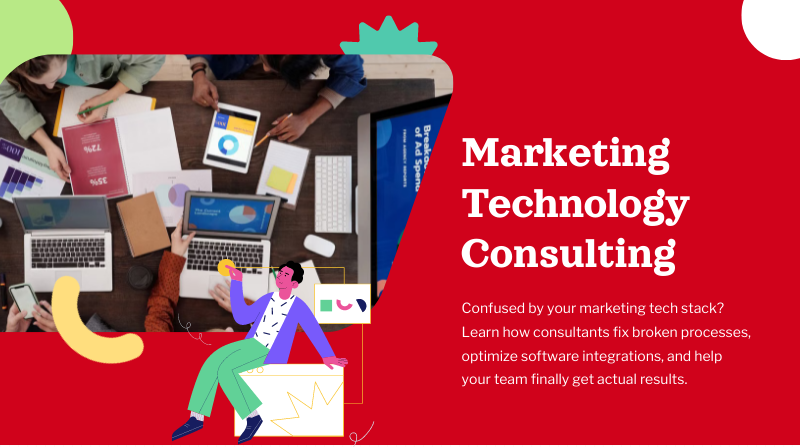
Buying another marketing platform rarely solves a broken process. A company can own a capable CRM, marketing automation platform and analytics suite yet still struggle to connect campaign activity with qualified pipeline. The problem often lies in how its systems, data and teams work together.
Marketing technology consulting helps businesses assess, select, integrate and improve the software and data processes supporting marketing. A martech consultant typically audits existing tools, designs integrations, defines measurement and governance requirements, supports implementation and trains the team that will operate the stack. The right time to hire one is before a major purchase or migration, or when disconnected systems, unreliable reporting or low platform adoption are limiting results.
The need for disciplined evaluation is measurable. The 2026 State of Martech report counted 15,505 commercial marketing technology products, up just 0.79% from 2025. Meanwhile, Gartner reports that utilization was 49% in its 2025 Marketing Technology Survey. The number of tools available is substantial, but more software does not necessarily mean more capability.
Gartner’s utilization figure is a survey measure, not a claim that every company uses exactly half of its paid licenses.
What Does a Marketing Technology Consultant Do?
A marketing technology consultant connects business objectives to technical execution. The work spans the platforms used to capture demand, recognize customers, move information between teams, execute campaigns and measure outcomes. Common systems include customer relationship management (CRM), marketing automation, content management, analytics, advertising platforms, customer data platforms (CDPs) and data warehouses.
The consultant’s central responsibility is to decide what the organization needs its technology to accomplish, determine what prevents that outcome and establish an operating model the internal team can sustain. Platform configuration may be part of the engagement, but configuration without agreed data definitions or ownership rarely resolves the underlying problem.
Core Marketing Technology Consulting Services
The work below is what most marketing technology services engagements are actually made of. Few projects need all six at once, and the sequence matters more than the list.
Martech stack audits and capability assessments
An effective audit inventories platforms, licenses, administrators, integrations, renewal dates, recurring costs and actual business uses. It also tests whether the capabilities marketing needs are available, properly configured and adopted. The deliverable should identify what to retain, consolidate, reconfigure, replace or retire, with evidence for each decision.
A useful audit distinguishes low utilization from low value. An infrequently used system supporting an essential regulatory or operational function should not be cut merely because its login count is low.
Architecture and integration design
Consultants map where leads and customer records originate, how they are identified and which system controls critical fields. They define integration methods, field mapping, sync frequency, error handling, consent-state propagation and rules for conflicting records. A diagram is only useful when accompanied by implementation specifications and named owners.
The same discipline applies to custom work. Where a standard connector does not exist, the specification for an API integration should name the fields, the direction of truth, the retry behaviour and who is paged when it fails.
CRM and marketing automation optimization
This work may involve lead routing, lifecycle stages, nurture logic, scoring, segmentation, suppression, handoffs to sales and automation testing. A B2B organization, for example, should establish whether a lead marked “qualified” in marketing has the same meaning in the CRM and sales reports. Without a shared definition, improving a dashboard will not improve the underlying metric.
Analytics, attribution and measurement
Consultants can define events, campaign taxonomy, UTM standards, identity rules and revenue reporting that reconcile with CRM stages. Google Analytics 4 documents events such as generate_lead, qualify_lead and close_convert_lead; implementations still require consistent definitions and careful testing to tie website behavior to later business outcomes.
Attribution claims need restraint. A multi-touch model can help compare touchpoints, but it cannot establish causal lift by itself. For larger investments, a consultant should also consider incrementality experiments or other tests suited to the business.
Reconciliation is usually where this work succeeds or fails. Marketing, sales and finance figures rarely disagree because one system is wrong; they disagree because each is counting a slightly different thing. Agreeing the definition is the work, and business intelligence and reporting only becomes trustworthy once that is settled.
Consent, security and governance
A consulting engagement should address access controls, vendor permissions, data retention, lawful processing requirements and how consent preferences travel through the stack. Google explains that Consent Mode communicates consent signals to tags and changes their behavior; it does not itself provide a consent banner. Server-side tagging also requires architecture and consent-aware configuration rather than serving as an automatic privacy solution.
Training and operating procedures
The engagement should leave usable documentation: naming conventions, change approval steps, QA checklists, troubleshooting guidance and an escalation path. A system that works only while an outside consultant has administrator access is an incomplete implementation.
When Should a Business Hire a Martech Consultant?
The strongest hiring signal is a material decision or operational problem that the existing team cannot resolve with its current capacity or specialist knowledge. Several situations warrant outside expertise.
None selected yet. Work through the list above.
Hiring a consultant is less useful when the real gap is routine campaign execution or an internal staffing shortage with no architectural decision to make. In those cases, a marketing operations hire or an execution-focused agency may be the better fit.
Consultant, Agency or In-House Marketing Operations Team?
| Option | Best use | Main limitation |
|---|---|---|
| Independent consultant | Focused audit, neutral advice, requirements or specialist troubleshooting | Limited delivery capacity or coverage |
| Specialist consulting firm | Cross-platform design, implementation, migration and governance | Requires clear scope and internal ownership |
| Marketing agency | Campaign production, media operations and optimization | May not own deep systems architecture |
| In-house marketing operations | Continuous administration, iteration and organizational knowledge | May lack niche expertise or surge capacity |
An outside partner does not eliminate the need for an internal system owner. For complex engagements, the most effective arrangement pairs a responsible internal marketing operations or IT lead with outside specialists who can transfer decisions and documentation as the work proceeds.
How to Choose a Marketing Technology Consulting Firm
Evaluate firms against the problem they must solve, not the number of platform badges on their website. A credible partner should demonstrate how it will diagnose the situation before proposing technology, how recommendations will be tested and who will be accountable for outcomes.
1. Begin with a specific business use case
Describe one end-to-end workflow, such as capturing a high-intent inquiry, assigning it to the appropriate account owner, updating its status and reporting the resulting opportunity. Ask each firm to explain the failure points it would investigate, the required data, the systems affected and the evidence that would confirm success. This reveals more than a generic platform demonstration.
2. Inspect the proposed deliverables
A complete statement of work should specify tangible assets, not simply activities. Typical deliverables include the current-state inventory, target architecture, data dictionary, integration specifications, test plan, prioritized roadmap, governance model, user training and handover. Ask which documents the client will own after the project.
3. Verify hands-on platform and integration experience
Request examples involving your actual CRM, automation software, analytics environment and integration patterns. Ask who will perform technical work, not only who will sell or supervise the engagement. Certifications can support a claim of familiarity, but a working sample of field mapping, error handling or measurement QA provides stronger evidence.
4. Understand commercial incentives and data access
Confirm whether a firm receives reseller commissions or referral revenue from platforms it recommends. This does not automatically invalidate its advice, but the arrangement should be disclosed. The agreement should also define administrative access, security expectations, subcontractors, intellectual property, documentation ownership and the process for revoking access at project close.
5. Require a credible pilot and acceptance criteria
For a high-impact change, start with a bounded use case and success criteria before authorizing an enterprise-wide migration. Gartner recommends evaluating vendors through real-world proofs of concept and assessing interoperability with existing CRM and analytics systems.
A Practical Martech Consulting Firm Scorecard
Use a weighted scorecard to compare shortlisted firms consistently. The weights below are an editorial evaluation framework, not industry survey findings. Score each criterion from 1 (weak evidence) to 5 (strong evidence), multiply by its weight and divide the total by five to obtain a 100-point score.
| Criterion | Weight | Evidence to request |
|---|---|---|
| Diagnosis and use-case clarity | 25 | Specific discovery questions, sample workflow analysis |
| Technical delivery capability | 25 | Named implementers, comparable architecture and integrations |
| Measurement and QA | 20 | Acceptance tests, reconciliation and monitoring plan |
| Governance and handover | 15 | Documentation, access controls and training |
| Commercial transparency | 15 | Detailed scope, exclusions, pricing and partner disclosures |
Specific discovery questions, sample workflow analysis
Named implementers, comparable architecture and integrations
Acceptance tests, reconciliation and monitoring plan
Documentation, access controls and training
Detailed scope, exclusions, pricing and partner disclosures
The weights are an editorial evaluation framework, not industry survey findings. A firm that fails a minimum requirement for security, data ownership or technical competency should be excluded whatever it scores here.
Do not treat a high score as automatic approval. A firm that cannot meet minimum requirements for security, data ownership or relevant technical competency should be excluded even if it performs well in other categories.
What a Successful Martech Consulting Engagement Looks Like
A disciplined project begins by establishing a baseline rather than immediately making configuration changes. The initial phase should confirm the business goal, document the current workflow, identify decision-makers and establish measurable acceptance tests. The consultant then designs the target state, validates its dependencies and sequences the work by business impact and implementation risk.
Consider an illustrative B2B company whose website reports 600 form submissions in a month but whose CRM records only 420 newly created leads. Those figures alone do not prove that 180 leads were lost: some may be duplicate contacts, existing customers or intentionally excluded submissions. A consultant would trace event firing, form processing, deduplication, CRM creation rules and reporting windows before changing any system. The output would be a reconciled definition and a repeatable exception-monitoring process.
A project should conclude with evidence that the workflow behaves as specified: sample records pass through each stage, failures are logged, consent rules are respected, reporting totals reconcile under an agreed definition and internal owners know how to maintain the configuration.
How to Measure Martech Consulting ROI
Return should be judged against the business objective established before work begins. Possible measures include reduction in duplicate or unusable records, faster lead assignment, fewer manual reconciliation hours, higher completion of defined lifecycle fields, lower redundant software expense and improved adoption of workflows that matter.
For an illustrative savings calculation, suppose a team spends 20 staff hours each week manually reconciling campaign and CRM data. If an intervention reduces that to eight hours, it frees 12 hours weekly. At an assumed fully loaded cost of $60 per hour and 50 operating weeks, the annual labor capacity equivalent is $36,000. That is an illustrative productivity calculation, not a published benchmark or a guarantee of cash savings. It should be assessed alongside implementation cost, ongoing maintenance and whether the recovered time produces measurable business value.
This is an illustrative productivity calculation, not a published benchmark and not a guarantee of cash savings. Assess it alongside implementation cost, ongoing maintenance and whether the recovered time produces measurable business value.
Business outcomes such as pipeline or revenue deserve separate analysis. If conversion increases after a CRM redesign, changes in demand, sales coverage and campaign mix may also have contributed. A consultant should explain what can be measured directly and what requires a more rigorous comparison.
Common Warning Signs During Firm Selection
A vendor pushing a new platform before auditing current capabilities may have selected the solution before understanding the requirement. Other concerns include vague success measures, missing integration ownership, promises of perfect attribution, refusal to document custom configurations and a project plan that does not include user acceptance testing.
Be equally cautious of a consultant who treats AI functionality as a substitute for data governance. Automated decisions depend on field quality, access permissions, business rules and monitoring. Adding an AI layer to inconsistent customer records can make the underlying problem harder to detect.
Where Marketing Technology Consulting Is Heading
The 2026 State of Martech landscape recorded 1,488 products added and 1,367 removed, leaving comparatively little net growth despite substantial turnover. That makes portability, documented integrations and exit planning meaningful selection criteria, even for teams that intend to keep their current vendors.
The next consulting decision for many organizations will be which workflows can safely use AI-assisted automation and which require human approval. Firms that define data quality, permission boundaries and monitoring before deployment will be better positioned to adopt new capabilities without rebuilding their operating model after every software change.
Marketing Technology Consulting FAQ
What does a marketing technology consultant actually do?
A martech consultant connects business objectives to technical execution across the systems that capture demand, recognize customers, move information between teams, run campaigns and measure outcomes. In practice that means auditing the existing stack, designing integrations, defining measurement and governance requirements, supporting implementation and training the team that will operate it afterwards. Configuration work may be part of the engagement, but configuration without agreed data definitions or named owners rarely resolves the underlying problem.
When is the right time to hire a martech consultant?
The strongest signal is a material decision or operational problem the existing team cannot resolve with its current capacity or specialist knowledge. Common triggers are an upcoming CRM, marketing automation or CDP purchase; a migration, merger or consolidation; campaign, CRM and finance reporting that disagree; approaching renewals with license overlap; and a plan to deploy AI-driven workflows before data quality and access policy have been defined.
When is hiring a consultant the wrong answer?
When the real gap is routine campaign execution or an internal staffing shortage with no architectural decision to make. In those cases a marketing operations hire or an execution-focused agency is usually the better fit. Bringing in a consultant to run campaigns tends to produce an expensive version of work the team could have done.
What is the difference between a martech consultant, an agency and an in-house marketing operations team?
A consultant or consulting firm is strongest on audits, neutral advice, architecture, migrations and governance. An agency is strongest on campaign production and media operations. An in-house marketing operations team provides continuous administration and organizational knowledge. The three are not substitutes, and an outside partner does not remove the need for an internal system owner.
What deliverables should a martech consulting statement of work include?
Tangible assets rather than activities. A complete statement of work typically names the current-state inventory, target architecture, data dictionary, integration specifications, test plan, prioritized roadmap, governance model, user training and handover. Ask explicitly which documents the client owns when the project closes.
How do you measure the return on a martech consulting engagement?
Against the business objective set before the work began. Measurable candidates include a reduction in duplicate or unusable records, faster lead assignment, fewer manual reconciliation hours, higher completion of defined lifecycle fields, lower redundant software expense and better adoption of the workflows that matter. Pipeline and revenue deserve separate analysis, because demand, sales coverage and campaign mix move at the same time.
Does low utilization mean a tool should be cut?
Not on its own. A useful audit separates low utilization from low value. An infrequently used system supporting an essential regulatory or operational function should not be retired because its login count is low. The question is what the business would lose without it, not how often someone signs in.
Should a consultant disclose reseller or referral revenue?
Yes. Confirm whether a firm receives reseller commissions or referral revenue from the platforms it recommends. The arrangement does not automatically invalidate the advice, but it should be disclosed, and the agreement should also define administrative access, security expectations, subcontractors, intellectual property, documentation ownership and how access is revoked at project close.
Most stacks do not need another platform. They need agreed definitions, working integrations and reporting the business trusts. That is the work.
New to the terminology? The marketing glossary and our B2B lead generation work cover the adjacent ground.Sources
- Chiefmartec, “State of Martech 2026,” May 2026 newsletter.chiefmartec.com
- Gartner, “Maximize ROI With Marketing Technology,” reporting the 2025 Marketing Technology Survey gartner.com
- Google for Developers, “Recommended events,” Google Analytics 4 developers.google.com
- Google for Developers, “Implement consent mode with server-side Tag Manager” developers.google.com
- Google Analytics Help, “About consent mode” support.google.com