
Digital Marketing Using AI: Intelligence, Visibility, Tools & Real Examples
What marketing intelligence is, how AI search is reshaping visibility, the leading AI marketing tools — Claude, ChatGPT, Gemini and more — and a proprietary framework for putting it all to work.
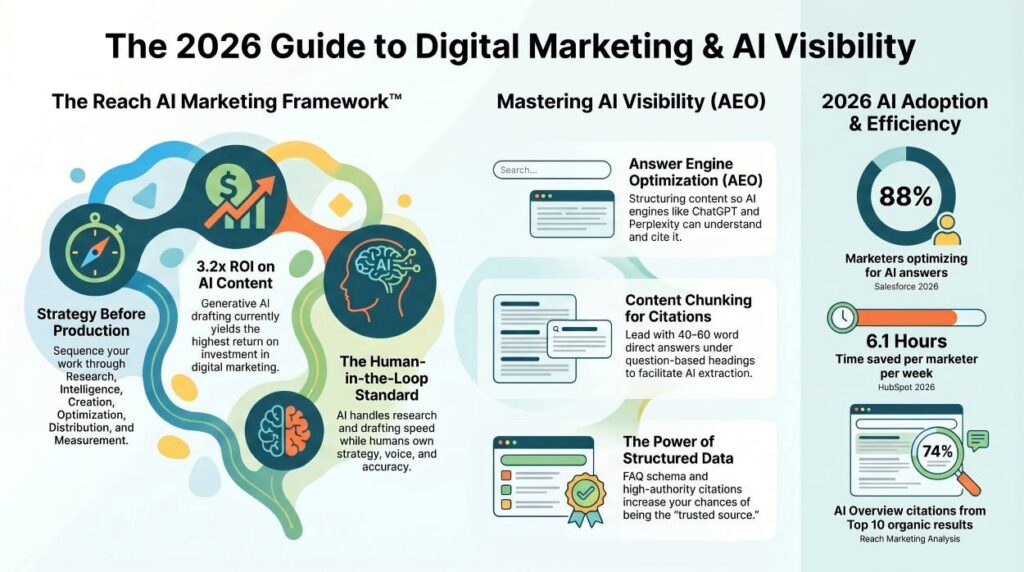
Digital marketing with AI uses artificial intelligence — large language models, machine learning, and generative tools — to research audiences, create content, personalize campaigns, optimize for AI search, and turn data into decisions faster than manual workflows allow. As of 2026, about 75% of marketers have adopted AI and 88% are already optimizing for AI-generated answers (Salesforce). AI content drafting returns roughly 3.2× ROI on average, making it one of the highest-return applications in marketing.
- The Reach AI Marketing Framework™
- What is marketing intelligence?
- Digital marketing with AI
- Examples of AI in digital marketing
- How AI search is changing marketing
- AI visibility & answer engine optimization
- AI agents & agentic marketing
- AI marketing automation
- ChatGPT for digital marketing
- Top AI marketing tools
- AI governance
- What is an AI content agency?
- How we use AI at Reach
- FAQ
Artificial intelligence has moved from novelty to the operating layer of modern marketing. The question for most teams is no longer whether to use AI, but how to use it well — which tools to trust, where AI adds real value, and how to stay visible now that search itself is becoming AI-driven. This guide is a single, plain-English map of the territory: the concepts, the tools, real examples, and the workflows that turn AI-powered marketing into measurable results.
It’s written for marketers and business owners evaluating an AI SEO or digital marketing strategy.
The Reach AI Marketing Framework™
With extensive hands-on experience using AI and prompt engineering to assist modern digital marketing campaigns, we organize our work around six stages. The framework keeps human strategy in charge while AI accelerates the work at each step — and it’s how we’d recommend any team sequence an AI marketing strategy.
Research
AI-assisted audience, keyword, and demand research to find where the opportunity is.
Intelligence
Marketing intelligence on competitors, trends, and your own data to decide what to do.
Creation
Generative AI drafts content and creative at scale; humans edit for voice and accuracy.
Optimization
SEO and answer engine optimization (AEO) so content ranks and gets cited by AI.
Distribution
Right message, right channel, right moment — automated across email, social, and paid.
Measurement
Track time saved, output, rankings, AI citations, and conversions; feed it back to step one.
The order matters. Most teams jump straight to Creation — generating content before they’ve done the Research and Intelligence that make it differentiated. The framework forces strategy before production, which is exactly why AI-assisted output stops sounding generic.
What is marketing intelligence?
Marketing intelligence is the practice of gathering and analyzing data — about your market, competitors, customers, and campaigns — to produce actionable insight for decisions. Gartner describes it as the category of tools an organization uses to gather and analyze data to determine its market opportunities, penetration strategy, and development metrics.
It matters because most marketing leaders still struggle to prove impact. According to Gartner, only about 52% of senior marketing leaders can successfully demonstrate marketing’s contribution to business outcomes. Marketing intelligence closes that gap by turning scattered data into a single, trusted view of what’s working and where budget should move.
Marketing intelligence vs. business intelligence
The two are often confused. The simplest distinction is direction: marketing intelligence looks outward at the market, while business intelligence looks inward at company operations.
| Dimension | Marketing intelligence | Business intelligence |
|---|---|---|
| Focus | External market, customers, competitors | Internal sales, finance, operations |
| Question it answers | “Where is the opportunity, and why?” | “What happened inside the business?” |
| Typical data | Campaign, ad, social, CRM, competitor signals | ERP, accounting, internal reporting |
| Main use | Strategy, targeting, budget allocation | Performance reporting, efficiency |
The four types of marketing intelligence
- Competitive intelligence — competitors’ products, pricing, share, and strategy.
- Product intelligence — how your product is perceived and used versus alternatives.
- Market understanding — the trends, conditions, and segments shaping demand.
- Customer understanding — the behaviors, needs, and preferences of your audience.
AI supercharges all four. Where marketing intelligence once meant manual reports and quarterly research, AI now reads campaign data, competitor content, and customer signals continuously — surfacing the “why” behind a metric instead of just the “what.”
What does digital marketing with AI look like?
Digital marketing using AI means embedding machine learning and generative tools into everyday marketing work — research, content, targeting, personalization, and measurement — so teams move faster and decisions are grounded in data rather than guesswork. It spans AI marketing software, AI content creation, and AI-powered analytics.
Adoption has gone from early-mover advantage to baseline expectation in roughly two years. Salesforce found that around 51% of marketers were using or experimenting with generative AI in 2024; by its State of Marketing 2026 report, about 75% had adopted AI, and a striking 88% had already begun optimizing for AI-generated answers in places like ChatGPT and Google AI Overviews. Across the wider economy, McKinsey reports that about 78% of organizations now use AI in at least one business function, with content and customer-facing tasks among the most common.
How marketers are using AI in 2026
The payoff shows up in time and output. HubSpot’s 2026 research finds the average marketer recovers about 6.1 hours per week, and teams that adopted AI content tools now publish several times more content per person than before. But there’s a catch worth stating plainly: the biggest barrier in 2026 isn’t the technology — it’s skills. Loopex Digital reports 58% of teams cite a skills gap as their top AI challenge, and only 17% have had job-specific AI training. The advantage now belongs to teams that integrate AI deeply and train for it, not those that simply own the tools.
Examples of AI in digital marketing
AI shows up across every channel. Here are the most common, high-value applications of AI-powered marketing — and the average return McKinsey attributes to the leading ones.
| Application | What AI does | Example |
|---|---|---|
| Content creation | Drafts blogs, ads, emails, product copy | Generating 10 ad variations to A/B test in minutes |
| Personalization | Tailors messages to behavior in real time | Dynamic email content by purchase history |
| Audience research | Clusters and segments customers from data | Finding a high-intent segment hidden in CRM data |
| SEO & AEO | Optimizes content for search + AI answers | Structuring a page to be cited in AI Overviews |
| Chatbots & support | Answers and routes customer queries 24/7 | Qualifying leads before a rep ever replies |
| Predictive analytics | Forecasts spend, churn, and campaign results | Reallocating budget before a campaign underperforms |
| Creative & visuals | Generates images, video, and design assets | On-brand social creative without a photoshoot |
Average ROI of AI by marketing application
AI in digital marketing, by channel
It helps to see how AI lands in each channel. The applications differ, but the pattern is consistent: AI compresses the time between idea and execution while sharpening targeting with data.
SEO and AI search. AI now sits on both sides of search — marketers use it to research keywords, cluster topics, draft content, and audit pages, while search engines themselves use AI to answer queries directly. This is driving the shift toward AI search optimization, covered in depth below.
Email and lifecycle. AI generates subject-line variations, personalizes body copy by segment, picks send times, and triggers automated lifecycle flows based on behavior.
Paid media. In paid search and social, AI generates ad variations at volume, predicts which audiences convert, and optimizes bids and budget in real time.
Social and creative. AI drafts captions, repurposes one asset into many formats, and generates on-brand images and short video — shifting the constraint from production capacity to editorial judgment.
How AI search is changing digital marketing
Search is no longer just ten blue links. AI engines now read the web and answer questions directly — often without sending a click. That changes the goal of SEO: it’s no longer only about ranking, but about being the source an AI cites in its answer. This is AI search optimization, and it’s reshaping how brands earn visibility.
Six engines matter most for marketers in 2026. Each surfaces content a little differently, but they share one trait: they synthesize answers from sources they trust, and they show (or act on) citations.
| AI engine | Maker | How it surfaces your content |
|---|---|---|
| Google AI Overviews | AI summary atop search results; cites and links sources, mostly from top organic results | |
| ChatGPT Search | OpenAI | Retrieves live web pages and cites them inline in answers |
| Perplexity | Perplexity AI | An answer engine built citation-first; sources are front and center |
| Gemini | Integrated into Google Search and Workspace; draws on Google’s index | |
| Claude | Anthropic | Answers with web search and citations; strong at long, nuanced sources |
| Copilot | Microsoft | Built on Bing’s index; cites web sources within its answers |
The strategic takeaway: citation-based visibility is now a distinct goal from ranking. A page can rank #3 organically and still be the source quoted in the AI answer — or rank well and be ignored. Winning both requires structuring content so machines can extract it, and earning the authority that makes them trust it.
AI search optimization and AI visibility
AI visibility is the practice of getting your brand surfaced, cited, and recommended inside AI-generated answers — and answer engine optimization (AEO) is how you earn it.
What is AI visibility?
AI visibility measures whether your brand appears in answers from ChatGPT, Claude, Gemini, Perplexity, and Google AI Overviews when buyers ask questions about your category. You can dominate Google’s blue links and still be invisible in AI answers — which is why AI visibility is tracked as its own metric, separate from rankings.
How ChatGPT finds content
When ChatGPT Search answers a query, it retrieves live web pages and cites them. In practice, AI crawlers — GPTBot, ClaudeBot, PerplexityBot — overwhelmingly crawl your regular HTML, not special files. Independent analyses in 2026 found the pages cited most often in ChatGPT, Perplexity, and Claude are the ones with strong traditional SEO foundations, genuine authority, and clearly structured, factual content. In other words: good SEO is the price of entry for AI citation, not a separate game.
How Google AI Overviews choose sources
AI Overviews synthesize an answer from multiple pages and link out to them. Crucially, research shows roughly 74% of AI Overview citations come from pages already ranking in the top 10 — so organic strength still gates inclusion. On top of that, Overviews favor content that directly answers the question, in extractable form, with clear structure and trustworthy signals.
What is answer engine optimization (AEO)?
AEO is the discipline of structuring content so AI answer engines can understand, trust, and cite it. Where traditional SEO optimizes for ranking a page, AEO optimizes for being the answer. The core techniques:
- Content chunking — write self-contained passages (a ~40–60 word direct answer right under each heading) that make sense even when lifted out of the page.
- Question-based headings — phrase H2s and H3s the way people actually ask, so they match queries.
- FAQ optimization — add concise Q&A blocks; question queries trigger AI answers the vast majority of the time.
- Citation optimization — include specific, sourced statistics and clear claims AI can quote with confidence.
- Entity optimization & knowledge graphs — be consistent about who you are and what you do across the web so engines map you to the right entity.
- Freshness — keep dates and data current; AI answers favor recent, maintained sources.
How to optimize content for AI search
A practical AEO workflow looks like this: lead every page with a direct answer; use question headings; add an FAQ; include sourced data; implement structured data; and keep the page fresh. Then measure whether AI engines actually cite you and refine. AEO pairs with classic SEO rather than replacing it.
The role of structured data and llms.txt
Structured data (schema markup) — Article, FAQPage, Organization, Product — labels your content so engines understand it. FAQ schema, in particular, makes Q&A eligible for rich results and is associated with stronger AI-answer inclusion. This is well-established, low-risk, and worth implementing everywhere.
llms.txt is newer and more speculative. It’s an emerging, voluntary convention — a Markdown file at your site root that gives AI systems a curated map of your most important content, conceptually similar to robots.txt. Be clear-eyed about its status: an SE Ranking study of nearly 300,000 domains found the file on about 10% of them, and no major AI provider has publicly confirmed using it to influence citations. AI crawlers still mostly read your HTML directly. That said, it’s safe and cheap to publish, it may help AI agents route your content in the emerging “agentic web,” and mainstreaming signals (like Yoast auto-generating it for WordPress) suggest it’s becoming standard hygiene. Our recommendation: ship a clean llms.txt, but invest the real effort in authority, structure, and schema — that’s what actually earns citations today.
Sample robots.txt and llms.txt
Both files live at your site root. robots.txt controls which crawlers — including AI bots — may access your pages. llms.txt offers AI systems a curated, Markdown map of your most important content. Here’s a clean starting point for each:
User-agent: *
Allow: /
Disallow: /wp-admin/

# Allow major AI crawlers to access content
User-agent: GPTBot
Allow: /

User-agent: ClaudeBot
Allow: /

User-agent: PerplexityBot
Allow: /

User-agent: Google-Extended
Allow: /

Sitemap: https://example.com/sitemap.xml
# Example Company

> Example Company makes invoice-automation software for B2B finance teams.

## Core pages
- [Product overview](https://example.com/product): What the platform does and who it serves
- [Pricing](https://example.com/pricing): Plans and pricing
- [Contact](https://example.com/contact): Talk to sales

## Resources
- [Blog](https://example.com/blog): Guides and product updates

## Optional
- [About](https://example.com/about): Company background and team
Note: keep llms.txt short, lead with a one-line brand summary in a blockquote, and link only to your highest-value pages. Adjust the robots.txt rules to your own CMS and crawler preferences.
AI agents and agentic marketing
AI agents are autonomous or semi-autonomous systems that can carry out multi-step marketing tasks — not just answer a prompt, but research a topic, draft and schedule content, monitor a campaign, and adjust it, with limited human input. “Agentic marketing” is the emerging practice of building these AI workflows into operations.
The shift is from one-off prompts to systems. Instead of asking an AI to write a single email, an agent can run a whole sequence: pull performance data, identify an underperforming segment, draft a re-engagement flow, route it for human approval, and report back. Early adopters are using agents for research, reporting, content production pipelines, and customer-support triage. The orchestration layer — how tasks are routed and where humans review — matters more than the underlying model. Expect agentic workflows to be one of the fastest-growing areas of AI-powered marketing through 2026 and beyond.
AI marketing automation
AI marketing automation combines rules-based automation with machine learning to personalize and optimize campaigns at scale — automated marketing with AI deciding not just when to send, but what to send and to whom.
Traditional automation follows fixed rules (“if a user does X, send email Y”). AI automation adds intelligence on top: it scores leads dynamically, predicts the best message and timing per person, and continuously optimizes based on results. The payoff is consistent: lower manual workload, more relevant communication, and measurable lifts in ROI. For a full breakdown of the benefits, see our guide to the key benefits of marketing automation, which pairs naturally with the AI tools below. Platforms like HubSpot now embed AI directly into automation, so lead scoring, email drafting, and workflow optimization happen inside the CRM you already use.
How to use ChatGPT for digital marketing
ChatGPT fits into nearly every stage of the marketing workflow — research, ideation, drafting, repurposing, and analysis — and the quality of what you get depends almost entirely on your prompt. A vague prompt produces generic filler; a specific one produces a usable first draft in seconds. The best ChatGPT marketing prompts name the audience, define the format, set length, and describe the tone.
Marketing prompts you can copy
Write a detailed blog outline about [topic] for [audience]. Include an SEO title, 5–7 H2 sections phrased as questions, and 2 statistics I should source. Tone: [expert but plain].
Act as an SEO strategist. For the target keyword [keyword], give me search intent, 8 supporting subtopics to cover, 5 related questions to answer, and 3 internal-link ideas. Audience: [who].
Group the keyword list below into topical clusters. For each cluster, name the pillar topic, list the keywords, and suggest one page title. Keep clusters by search intent, not just word overlap. Keywords: [paste list]
Compare my page against these competing URLs for the query [query]. Identify topics they cover that I don’t, their content structure, and 5 specific gaps I should fill to outrank them. My page: [paste] · Competitors: [URLs]
Review this older blog post and suggest 5 ways to update it for 2026 without a full rewrite — outdated stats, missing subtopics, new internal links, and AEO improvements. Post: [paste]
Based on the content below, write 6 FAQ questions real users would ask, each with a concise 40–55 word answer suitable for FAQ schema. Use natural, question-style phrasing. Content: [paste]
Rewrite this section for answer engine optimization: add a 50-word direct answer at the top, turn the heading into a question, and make each paragraph self-contained so an AI could quote it accurately. Section: [paste]
Top AI marketing tools in 2026
The AI marketing tools market splits into general-purpose assistants (great at writing, analysis, and ideation) and specialized tools built for one job (images, video, SEO, search visibility). Strong stacks combine one or two assistants with a few specialists.
General-purpose AI assistants
AI assistants compared at a glance
| Tool | Best for | Cost | Key strength |
|---|---|---|---|
| ChatGPT | General marketing | $$ | Versatility |
| Claude | Long-form content | $$ | Writing quality & analysis |
| Gemini | SEO research | $$ | Google integration |
| Perplexity | Research & AI visibility | $ | Source citations |
Cost is relative ($ = free/low-cost tier available, $$ = paid plans typical for business use). All four offer capable free tiers except where noted; pricing changes often, so confirm current plans before budgeting.
Specialized marketing tools
| Tool | Category | Best for |
|---|---|---|
| Jasper | Copy platform | Brand-consistent marketing copy at scale, with templates and a trained brand voice |
| Midjourney | Image gen | High-quality, original marketing images and ad creative |
| Synthesia | Video | AI avatar and voiceover video for explainers and ads without a studio |
| Surfer SEO | SEO | Optimizing content structure and coverage to rank in search |
| Canva (Magic Studio) | Design | Fast on-brand social graphics and design for non-designers |
| HubSpot (Breeze) | Automation | CRM-integrated AI for email, lead scoring, and workflow automation |
AI governance: privacy, compliance, and oversight
For any serious brand — and especially enterprise buyers — using AI in marketing comes with responsibilities. Strong AI governance is what keeps AI-powered marketing safe, compliant, and trustworthy.
- Privacy & data handling — never feed confidential customer data into public AI tools; use enterprise tiers with data protections where needed.
- Compliance — align AI use with regulations (data protection, advertising standards) relevant to your industry and region.
- Human review — every AI output is checked by a person before it ships; this is the single most important control for quality and accuracy.
- Copyright & originality — ensure AI-assisted content is original and properly sourced, and that generated images respect licensing.
- Transparency — be honest about where AI is used, both internally and with audiences where appropriate.
Governance isn’t a brake on AI — it’s what lets you scale it with confidence. The brands that win long-term are the ones that move fast and stay trustworthy.
What is an AI content agency?
An AI content agency is a marketing or creative agency that combines generative AI tools with human strategy, editing, and brand expertise to produce content at scale. The distinguishing feature isn’t that AI writes everything — it’s that AI handles research, drafting, and production speed while humans own strategy, voice, accuracy, and final judgment.
The model exists because AI alone tends to produce generic, sometimes inaccurate output. An AI content agency adds the layer that makes it usable: a defined brand voice, fact-checking, editorial control, and a workflow that ties content to business goals. A typical engagement looks like this:
- Discovery & strategy — define brand voice, audience, and goals; map content to the funnel.
- AI-assisted research — analyze competitors, find content gaps, and surface trending topics.
- Drafting & production — generate first drafts, variations, and visuals quickly with AI tools.
- Human editing & QA — fact-check, refine for voice, and ensure accuracy and originality.
- Optimization & reporting — tune for SEO/AEO, publish, and track performance to inform the next cycle.
The best agencies are transparent about where AI is used and keep a clear standard of human oversight — both for quality and for the ethical reasons covered in AI governance above. Done well, the result is the speed of AI with the trust and craft of an experienced team.
How we use AI at Reach Marketing
We practice what we publish. At Reach Marketing, we use AI-assisted workflows for content production, keyword clustering, competitor analysis, and AI visibility optimization. By combining AI tools with human editorial review, we’ve reduced content production time by 40% while improving organic visibility for our clients.
Every piece still passes through a human editor for accuracy, brand voice, and originality — the same human-in-the-loop standard we recommend to clients. AI accelerates the research and first-draft stages; our strategists and editors own the judgment that makes the work differentiated and trustworthy. It’s the Reach AI Marketing Framework™ applied to our own work.
How to start using AI in your marketing
You don’t need to overhaul everything at once. The teams that succeed start narrow, prove value, and expand.
- Pick one high-friction task — usually content drafting or repurposing — and apply AI there first.
- Choose one assistant and one specialist rather than ten tools you’ll never master.
- Write a brand-voice brief you can paste into prompts so output sounds like you, not a robot.
- Keep a human in the loop — every AI output gets reviewed before it ships.
- Optimize for AI search — structure content for AEO so you’re cited, not just ranked.
- Measure against goals — track time saved, output, rankings, AI citations, and conversion.
Frequently asked questions
What is the difference between marketing intelligence and AI marketing?
What is AI visibility and answer engine optimization (AEO)?
Is ChatGPT or Claude better for digital marketing?
Can Google detect AI-generated content?
Do I need an llms.txt file for AI search?
Can AI replace a marketing team?
Sources
Figures in this guide are drawn from the following 2024–2026 industry research. We link primary publishers where possible; confirm any statistic against its primary source before reuse, as vendors update these reports periodically.
- Salesforce — State of Marketing (generative AI adoption among marketers). salesforce.com
- McKinsey & Company — The State of AI / Global AI Survey (organizational AI adoption; AI ROI by application). mckinsey.com
- HubSpot — State of Marketing / AI Trends 2026 (time saved; content output). hubspot.com
- Gartner — marketing leaders demonstrating ROI; definition of marketing intelligence. gartner.com
- Pragmatic Institute — four types of market/marketing intelligence; MI vs BI. pragmaticinstitute.com
- Loopex Digital — AI skills gap and training (reported via BizIQ). biziq.com
- Digital Applied — AI marketing statistics 2026 (ROI by application; adoption data). digitalapplied.com
- SE Ranking — llms.txt adoption and AI-citation study (nearly 300,000 domains; 10.13% adoption). seranking.com
- Presenc AI / Limy / DerivateX — 2026 analyses of llms.txt adoption and AI-crawler behavior. presenc.ai, limy.ai
- Google Search Central — guidance on AI-generated content and helpful content. developers.google.com
- Smart Insights / WebFX — ChatGPT prompting practices and use cases for digital marketing. smartinsights.com
- The Branded Agency — AI content agency model (background reference). brandedagency.com