
What B2B lead generation email templates actually are
B2B lead generation email templates are structured outbound messages designed to initiate qualified sales conversations with business decision-makers. They balance repeatable structure with targeted personalization to scale outreach without sounding automated. Their purpose is not to close deals, but to create credible, low-friction entry points into a buying conversation.
Unlike one-off sales emails, templates encode tested positioning, sequencing logic, and response triggers. They function as operational assets that align email marketing intent with sales execution. When designed correctly, they reduce variability while preserving relevance.
Why email remains a primary B2B lead generation channel
Email remains effective because it aligns with how B2B buyers evaluate solutions: asynchronously, privately, and on their own timeline. Decision-makers expect cold outreach and are skilled at filtering it, which rewards clarity and restraint over volume. Email allows precise targeting without forcing immediate engagement.
Other channels often depend on algorithms or intermediaries, while email creates direct access to inboxes that buyers already manage daily. Its durability comes from predictability rather than novelty. Performance is driven by message quality, not platform shifts.

Proven B2B lead generation email templates by intent
Well-performing B2B lead generation email templates align tightly with buyer intent rather than product messaging. Each template below is designed to open a conversation, not advance a pitch. The language is intentionally restrained to preserve credibility and reduce friction.
Role-based relevance template
This template works when targeting a specific job function with a known operational mandate.
Subject: Quick question about {{role responsibility}}
Hi {{First Name}},
Teams responsible for {{role responsibility}} often run into {{common constraint or risk}} as scale increases. I work with organizations facing that exact challenge when {{situational trigger}} becomes harder to manage.
Would it make sense to compare notes for ten minutes to see whether this is relevant for {{Company Name}} right now?
Best,
{{Sender Name}}
Account-context alignment template
This template leverages light account awareness without implying deep monitoring or assumptions.
Subject: {{Company Name}} and {{situational signal}}
Hi {{First Name}},
I noticed {{Company Name}} is navigating {{account-level context}}, which often introduces pressure around {{operational outcome}}. That tends to surface questions about {{problem area}} that are difficult to validate internally.
Open to a brief conversation to see whether this is timely or something to revisit later?
Regards,
{{Sender Name}}
Problem-recognition template
This template is effective when the target audience already acknowledges the problem but has not prioritized action.
Subject: Reducing friction in {{problem area}}
Hi {{First Name}},
Across {{industry or role group}}, {{problem area}} becomes harder to control once {{common scaling condition}} is in place. Many teams know the issue exists but lack a clean way to assess impact.
If it helps, I’m happy to share how others are pressure-testing this without committing to a larger initiative.
Best,
{{Sender Name}}
Event-triggered outreach template
This template is used when a clear external or internal trigger creates temporary relevance.
Subject: Following {{trigger event}}
Hi {{First Name}},
After {{trigger event}}, teams often reassess how {{related process or system}} is holding up under new expectations. That moment tends to reveal gaps that were previously manageable.
Would a short alignment call be useful to determine whether this warrants attention now or later?
Thanks,
{{Sender Name}}
Referral-style credibility template
This template borrows the tone of an introduction without claiming a direct referral.
Subject: A pattern I’m seeing across {{peer group}}
Hi {{First Name}},
I’ve been speaking with several {{peer group or role}} leaders who are reevaluating {{specific area}} as priorities shift. The common thread is uncertainty around {{decision point or risk}}.
If a brief comparison would be helpful, I’m glad to connect and keep it informal.
Best,
{{Sender Name}}
Disengagement-safe re-approach template
This template works as a follow-up that respects silence without escalating pressure.
Subject: Closing the loop
Hi {{First Name}},
I didn’t want to assume timing around {{problem area}} was right. In case this becomes relevant later, I’m always open to a short conversation to validate fit or rule it out entirely.
Either way, appreciate you taking a look.
Regards,
{{Sender Name}}
Be sure to customize your email templates
No B2B lead generation email template should be used without deliberate customization to the sender’s market, audience, and operating context. Templates provide structural guidance, not guaranteed performance, and must be adapted to reflect role-specific priorities, industry language, and real business conditions. Using templates verbatim increases the risk of irrelevance, deliverability issues, and diminished credibility.
Each organization should treat templates as starting frameworks that require refinement through testing, feedback, and alignment with internal sales processes. Effective lead generation depends on judgment and context, not reuse alone.
Using GPT prompting to create tailored B2B lead generation email templates
GPT can be used to generate high-quality B2B lead generation email templates when prompts are structured around intent, constraints, and audience specificity. Output quality depends almost entirely on how precisely the request defines who the email is for, what problem it addresses, and what outcome is acceptable. Vague prompts produce generic messaging; disciplined prompts produce usable drafts.
A strong prompt establishes role, industry, company maturity, and outreach goal before requesting any language. It also constrains tone, length, and call-to-action expectations to prevent promotional or overly verbose output. This framing allows GPT to generate structurally sound templates that still require human refinement.
Defining intent and audience in the prompt
Effective prompting begins by stating the exact purpose of the email and the recipient’s role. This anchors language choices and prevents default sales phrasing. Including the operational context the recipient operates within improves relevance without requiring personalization at the individual level.
Constraining tone, length, and structure
Explicit constraints guide output toward professional, low-friction messaging. Specifying sentence count, paragraph limits, and acceptable calls to action prevents bloated or overly aggressive drafts. GPT performs best when boundaries are clear and narrow.
Requesting multiple intent-based variations
Rather than asking for a single template, prompts should request multiple versions aligned to different outreach scenarios. This produces a usable set of options that reflect distinct buyer moments rather than superficial wording changes.
Examples of intent framing include:
- First-touch cold outreach to validate relevance
- Follow-up after no response without escalation
- Event- or trigger-based re-engagement
- Role-specific outreach for executives versus operators
Treating GPT output as draft material, not final copy
GPT-generated templates should be reviewed, edited, and pressure-tested before deployment. Human review ensures alignment with brand voice, legal requirements, and real-world sales conversations. The most effective teams use GPT to accelerate ideation, not replace judgment.
When prompting is disciplined and review is intentional, GPT becomes a practical tool for scaling high-quality B2B lead generation email templates without sacrificing relevance or control.
How lead generation emails differ from sales emails
Lead generation emails focus on permission and relevance, not persuasion. Their objective is to validate fit and open dialogue rather than present full solutions or pricing. Sales emails, by contrast, assume intent already exists.
This distinction changes tone, structure, and call-to-action design. Lead generation templates prioritize curiosity, problem recognition, or situational alignment. They succeed when recipients feel the message respects their time and role.

What determines whether a template generates replies
Reply rates are driven by perceived relevance, not clever wording. A template succeeds when it demonstrates contextual understanding of the recipient’s role, constraints, or priorities within the first few lines. Generic benefit statements rarely achieve this.
Timing, list quality, and sender credibility matter, but message structure remains the primary lever. Clear intent, minimal friction, and credible positioning determine whether a recipient responds or ignores the email.
Structural elements every high-performing template contains
Effective B2B lead generation templates share consistent structural components even when messaging varies. These elements guide the reader without drawing attention to themselves.
Key structural components include:
- A subject line that signals relevance rather than urgency
- An opening line grounded in the recipient’s role or environment
- A concise problem or opportunity framing
- A credibility anchor that avoids overstatement
- A low-commitment call to action
Structure creates familiarity, which reduces cognitive load. Familiarity increases the likelihood of engagement when relevance is present.
Subject lines that support lead generation goals
Subject lines function as relevance filters, not persuasion tools. Their role is to signal that the message applies to the recipient’s professional context. Overly creative or promotional lines often reduce trust.
Effective subject lines are specific without revealing the entire message. They reference roles, scenarios, or outcomes that resonate with the target account. Brevity supports clarity, not mystery.
Opening lines that establish credibility immediately
The opening line determines whether the rest of the email is read. It must demonstrate awareness of the recipient’s business reality without assuming knowledge that has not been earned. Credibility comes from alignment, not flattery.
Strong openings often reference industry conditions, role-specific pressures, or observable business signals. Weak openings focus on the sender rather than the recipient. The difference is felt instantly.
Problem framing without triggering resistance
Problem statements should reflect issues the recipient already recognizes. Introducing unfamiliar problems increases skepticism and cognitive friction. Familiarity reduces resistance and accelerates engagement.
Effective templates describe problems neutrally, without exaggeration or implied blame. The goal is recognition, not persuasion. When recipients see their own challenges reflected accurately, response likelihood increases.
Positioning value without overselling
Value positioning in lead generation emails must remain incomplete by design. Revealing too much removes the incentive to respond, while overstating value reduces credibility. Balance is achieved through implication rather than explanation.
Templates should suggest outcomes rather than detail solutions. They indicate that a conversation may be worthwhile without asserting superiority. This restraint differentiates credible outreach from promotional noise.
Calls to action that invite, not pressure
Calls to action succeed when they minimize perceived effort. Asking for short conversations, quick alignment checks, or brief confirmations respects time constraints. Demanding demos or long meetings increases friction.
Effective CTAs are specific but optional. They allow recipients to decline without discomfort, which paradoxically increases acceptance. Pressure signals misalignment with professional norms.
Personalization layers that scale without breaking consistency
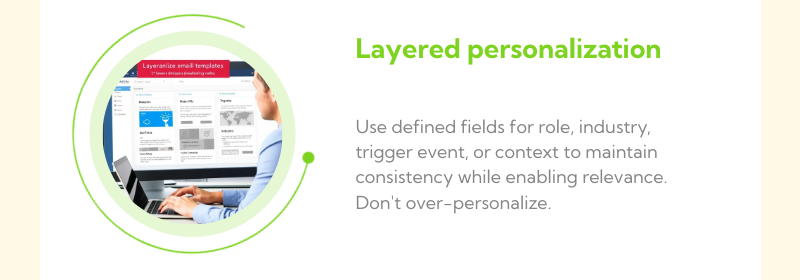
Personalization is most effective when layered, not improvised. Templates should include defined fields for role, industry, trigger event, or operational context. This preserves consistency while enabling relevance.
Over-personalization often introduces errors or awkward phrasing. Under-personalization signals automation. Structured personalization maintains credibility at scale.
Role-based personalization
Role-based personalization aligns messaging with functional responsibilities rather than individual traits. It acknowledges how different roles evaluate value and risk. This approach scales reliably across large account lists.
Account-level personalization
Account-level signals such as growth phase, market position, or operational complexity enhance relevance. These cues demonstrate preparation without implying surveillance. Subtlety matters.
Sequencing logic across multiple templates
Single emails rarely generate leads in isolation. Effective programs deploy sequences that evolve messaging across touches. Each email builds on the previous without repeating it.
Sequencing allows gradual escalation of specificity. Early messages test relevance, later messages test timing. Templates must be designed as a system, not standalone artifacts.
Cold outbound versus warm lead templates
Cold outbound templates assume no prior interaction and therefore prioritize context and permission. Warm lead templates build on known interest and can progress faster toward conversations.
Confusing these contexts reduces effectiveness. Applying warm messaging to cold audiences often feels presumptive. Clear separation improves performance and protects sender reputation.
Industry-specific versus horizontal templates
Industry-specific templates address sector-specific language, constraints, and outcomes. Horizontal templates focus on shared operational challenges across industries. Each has a place.
Industry-specific messaging typically produces higher response rates but requires more maintenance. Horizontal templates scale more easily but rely heavily on role-based relevance. Selection depends on resource capacity.
Compliance and deliverability considerations
Legal compliance and deliverability affect whether templates ever reach inboxes. Opt-out language, sender identification, and list sourcing practices influence risk and reputation. Noncompliance undermines even the best messaging.
Deliverability is also shaped by language choices. Excessive links, images, or promotional phrasing increase filtering. Plain, professional language supports inbox placement.

Measuring effectiveness beyond open rates
Open rates provide limited insight into lead quality. Reply rates, conversation conversion, and pipeline contribution better reflect template performance. Measurement should align with business outcomes.
Templates that generate many low-quality responses may underperform compared to those producing fewer but more qualified conversations. Evaluation must account for downstream impact.
Common mistakes that prevent templates from converting
Many templates fail because they attempt to do too much too soon. Overly long emails dilute focus and increase cognitive load. Vague messaging fails to signal relevance.
Other common errors include:
- Leading with company descriptions
- Using generic value propositions
- Asking for excessive commitment
- Ignoring role-specific priorities
Avoidance of these mistakes often improves performance more than adding new elements.
When templates should be rewritten or retired
Templates should be revisited when response rates decline consistently across segments. Market conditions, buyer expectations, and competitive language evolve. Static messaging degrades over time.
Retiring underperforming templates prevents dilution of results. Continuous iteration based on response data maintains effectiveness without constant reinvention.
Aligning templates with sales team execution
Templates only perform as well as their execution. Sales teams must understand intent, tone, and appropriate follow-up. Misalignment between messaging and conversation erodes trust.
Clear guidelines for use, personalization boundaries, and follow-up timing protect consistency. Templates are tools, not substitutes for judgment.
Adapting templates for different stages of company growth
Early-stage companies often emphasize problem discovery and market fit. Mature organizations may emphasize differentiation and risk reduction. Templates should reflect organizational context.
Mismatch between company maturity and messaging creates credibility gaps. Alignment ensures that outreach feels proportionate and realistic.
Integrating templates into broader lead generation systems
Email templates function best when integrated with targeting, sequencing, and qualification processes. Isolated use limits impact. Integration ensures that responses are handled appropriately.
Coordination with CRM systems, scoring frameworks, and follow-up workflows maximizes return. Templates initiate conversations; systems convert them into revenue.