
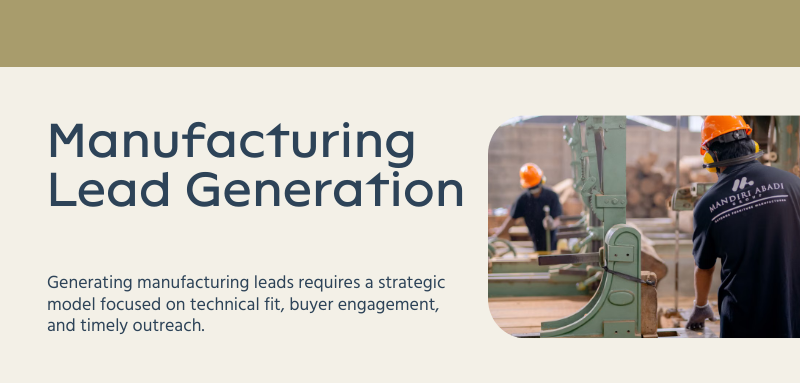
Why Manufacturing Lead Generation Requires a Different Approach
A manufacturer is rarely chosen because its marketing message sounds compelling. The supplier must satisfy a combination of engineering, quality, capacity, delivery, commercial, and risk requirements simultaneously.
Depending on the product, a buying group may include design engineers, plant and operations leaders, procurement and strategic sourcing, quality and regulatory personnel, maintenance or reliability teams, IT and cybersecurity reviewers, finance and executive approvers, and external integrators or consultants. Each evaluates a different type of evidence.
To generate manufacturing leads, define an ideal customer profile around technical capability and commercial fit, publish the information buyers need to evaluate that fit, capture high-intent demand through search and sourcing channels, run account-specific outbound campaigns, and connect every response to a shared qualification workflow. AI can improve research, scoring, personalization, content operations, and RFQ triage — while automation moves data and triggers follow-up. Engineering, pricing, compliance, and final qualification should remain under human control.
A 2025 global B2B study found that trust remained the leading decision factor, while integration with buyer processes and minimum quality requirements became more influential — and AI was used in 77% of the buying processes examined. AI-assisted buyers can compare more suppliers and interrogate more documents in less time. Vague claims such as “industry-leading quality” carry less value than explicit information about tolerances, certifications, materials, inspection methods, supported volumes, and delivery constraints.
This model prevents a common failure: celebrating lead volume while sales receives students, job seekers, incompatible RFQs, or contacts with no active project. Understanding the MQL stage in a manufacturing context is different from standard B2B — technical fit must precede commercial qualification.
Build the ICP Around Manufacturing Capabilities, Not Personas Alone
A useful manufacturing ICP describes the work the company can perform profitably and reliably. Firmographic filters are helpful, but they do not establish production fit. The ICP should combine five layers.
- Supported materials, processes, tolerances, finishes
- Required certifications and traceability
- Min/max order quantities and production scale
- Design-for-manufacturability support
- Typical initial and lifetime contract value
- Gross-margin range by product or process family
- Repeat-order or aftermarket potential
- Revenue concentration and credit risk
- Available equipment and labor capacity
- Typical lead-time expectations
- Geographic service constraints
- Supply-chain and installation dependencies
- Engineering, operations, procurement, quality, and executive roles
- Decision criteria by role and function
- Evidence each role needs to approve a supplier
- New plant, line, or facility; equipment modernization
- Product launch, design revision, or supplier consolidation
- Reshoring, regulatory requirement, or second-source initiative
- Hiring for manufacturing engineering, automation, or sourcing roles
Building a complete ICP across all five layers is the foundation of an effective B2B lead generation program for manufacturers. Without it, scoring models and outbound campaigns have no reliable target to optimize toward.
Turn the Website Into a Technical Qualification System
The manufacturing website should allow a buyer to answer three questions without contacting sales: Can this supplier perform the required work? Under the necessary quality and operating conditions? What information is needed to start a productive commercial conversation?
A 2024 global study of nearly 4,000 B2B decision-makers found that buyers used an average of ten interaction channels. Roughly one-third preferred in-person engagement, one-third remote interaction, and one-third digital self-service at a given stage of the journey. A capable website supports all three paths — independent research, remote sales conversations, and preparation for plant visits or in-person meetings.
Publish capability pages with disqualifying detail
A high-value capability page should specify processes and equipment, materials and material grades, dimensional or performance ranges, tolerance limits, supported production volumes, quality systems and certifications, inspection capabilities, industries and applications served, geographic coverage, and clear exceptions and unsupported work. Disqualifying detail may reduce raw form fills, but it improves the proportion of inquiries worth pursuing.
Technical claims should be reviewed by the responsible subject-matter expert. AI can assemble first drafts, convert transcripts into structured content, and identify terminology gaps — but it should not invent specifications, performance results, certifications, or customer outcomes. Ground AI output in approved source material.
Offer different conversion paths for different levels of intent
A single “Contact Us” form forces every visitor into the same process. More effective conversion paths include: request a quote, submit a drawing securely, ask an engineer, request a sample, schedule an application review, check distributor availability, download CAD or compliance files, register for a demonstration. RFQ forms should request only information needed for initial routing — longer engineering questionnaires can follow once fit is established.
Sensitive drawings and specifications need an approved, access-controlled submission method rather than a general email inbox or consumer AI tool. Protecting customer IP from the first interaction is part of establishing trust in a technical sales process.
Select Channels by Buying Situation, Not Popularity
No single channel covers the full manufacturing buying journey. The right mix depends on whether the business is capturing existing demand, creating demand in named accounts, developing relationships, or reaching buyers at a sourcing event.
| Channel | Strongest Role | Main Limitation |
|---|---|---|
| Technical SEO | Capturing active research on specific process, material, application, or problem queries | Requires authoritative content and time to mature |
| Paid Search | Capturing immediate commercial or RFQ-oriented demand | Expensive when keywords are broad or poorly qualified |
| Supplier Directories | Reaching active sourcing teams in category search or supplier evaluation | Profiles become interchangeable without precise capability data |
| Account-Based Outbound | Creating and accelerating demand in named accounts with a verified business trigger | Generic automation damages credibility at scale |
| Trade Shows | Discovery, validation, and relationship development with technical buyers | Weak follow-up turns badge scans into unusable records |
| Webinars and Demos | Educating technical buyers — registrations indicate topic interest | Registrations alone do not indicate purchase timing |
| Content Syndication | Building familiarity and driving qualified downloads across industry audiences | Lead quality depends on publisher audience relevance |
| Email Marketing | Nurturing qualified accounts with role-specific technical content over long sales cycles | Requires clean list hygiene and suppression management |
| Distributors and Partners | Expanding reach and local access — partners often know local projects before the manufacturer | Attribution and ownership can become unclear |
| Customer Expansion | Generating repeat, cross-sell, and referral demand from installed-base signals | Requires connected customer and product data |
Channel selection should follow deal economics. A high-value capital-equipment supplier can justify account research, field sales, application engineering, and major events. A producer of standardized components may need searchable catalogs, distributor coverage, and automated replenishment.
Use account-based outbound for narrow, high-value markets
Outbound works best when the account is selected for a defensible reason. A strong outbound sequence answers five questions: Why this company? Why this function? Why now? Why is the proposed capability relevant? What low-friction next step would help the buyer evaluate fit? An effective message might reference a new production line, supported material, known integration environment, regional service requirement, or second-source risk. It should not pretend that an automated observation proves a problem exists.
Manufacturing marketers rated in-person events as their most effective distribution channel at 51% in a 2024 survey. But that finding supports events as part of an integrated program — not as a standalone badge-collection exercise. Before the event: identify attending target accounts and schedule application reviews. During: record the business problem, application, timeline, stakeholder role, and agreed next step. After: send the promised material, associate contacts with accounts, and measure pipeline by account cohort over the full sales cycle. The lead qualification framework applied to digital inquiries should apply to event conversations without modification.
Use AI and Automation as Different Parts of the Revenue System
Automation executes predefined rules. AI classifies, predicts, summarizes, generates, or recommends based on data. That distinction determines where human review is required — and where removing it creates risk.
Manufacturing marketing teams are experimenting with AI, but most have not operationalized it. In a 2024 survey of manufacturing marketers, 76% reported using generative AI tools, while only 7% said AI was integrated into daily processes. Fifty-one percent described usage as ad hoc. The same research found that 58% lacked automation for repetitive tasks and 52% lacked efficient lead-generation capabilities. The priority should be a reliable workflow, not another disconnected AI application.
Understanding the difference between automation and AI is foundational. Marketing automation follows predetermined triggers and rules — it fires the same way every time. AI uses models to classify, predict, generate, or recommend based on pattern recognition across data. Both are necessary; neither replaces the other.
Higher-risk applications include autonomous outreach, final lead rejection, specification interpretation, pricing commitments, performance claims, and unsupervised responses to engineering questions. These stay with humans regardless of AI confidence scores.
Ground AI in controlled business data
An AI system becomes more useful when it can retrieve from current, approved sources: CRM account and opportunity records, product information management systems, approved technical documentation, quality and certification records, ERP availability and order history, and approved case studies and claims libraries. Confidential drawings, export-controlled information, customer pricing, and trade secrets should not enter a model or connector unless the organization has approved the architecture, retention terms, security controls, and permitted uses.
The NIST Generative AI Profile identifies confabulation, data privacy, information security, intellectual property, harmful bias, and overreliance among the risks organizations should govern, measure, and manage. For manufacturing lead generation, practical controls include approved data sources, human review, output logging, test sets, confidence thresholds, and a way to report incorrect results.
Score Accounts on Fit, Evidence, and Timing
Traditional lead scoring often overvalues easy digital actions. A webinar registration or repeated page view may indicate research, professional development, or competitor monitoring — not an active project. Behavioral activity should never compensate for a fundamental lack of technical fit.
Illustrative routing bands: 75–100 — immediate sales review; 50–74 — account research, stakeholder mapping, or targeted nurture; 25–49 — automated education and monitoring; below 25 — suppress, disqualify, or retain only for appropriate broad communications.
Apply negative scores or hard disqualifiers for unsupported processes, prohibited applications, uneconomic quantities, excluded geographies, unresolved credit risk, student inquiries, employment requests, and known competitors. AI may recommend a score, but the CRM should retain the supporting evidence. Sales needs to know why an account was prioritized, and management needs to audit whether the model systematically overlooks certain segments.
This approach applies principles from enterprise B2B lead generation — where the unit of measurement shifts from individual leads to account progression — into the specific context of manufacturing’s technical qualification requirements.
Measure Pipeline Quality Instead of Lead Volume
Cost per lead can make a low-quality channel appear efficient. Manufacturing teams need metrics that connect acquisition activity with technical qualification, quotes, opportunities, revenue, and margin.
Report performance by ICP segment, product family, application, geography, deal size, and acquisition motion. An overall conversion rate can conceal the fact that one campaign generates small profitable orders while another produces large but operationally incompatible RFQs. For more on the data architecture that supports reliable measurement, see how campaign management systems connect marketing activity to CRM outcomes at the account level.
A 90-Day Manufacturing Lead Generation Plan
This sequence produces a working feedback loop before the organization scales media spend, content volume, data purchases, or autonomous AI workflows.
Many manufacturers begin by fixing the data model and routing logic before adding new channels. A reliable workflow — with human review checkpoints — is more durable than another disconnected AI application running on uncleaned data.
For manufacturers evaluating whether to build this program in-house or work with a specialized B2B lead generation service, the 30-day audit phase often surfaces the answer: organizations that lack clean data, defined stages, and documented qualification criteria need those foundations before adding more technology or spend.
Avoid the Failure Modes That Reduce Lead Quality
The strongest manufacturing lead engine will not be the one that sends the most messages or publishes the most articles. It will be the one that recognizes a technically viable opportunity early, supplies credible evidence across the buying group, and moves the account from independent research to expert human engagement — without losing context at every handoff. For more on how high-value B2B deals differ from commodity lead programs, the principles apply directly to manufacturing’s long qualification cycles.
Frequently Asked Questions
What is the best way to generate manufacturing leads?
Combine demand capture with account development. Use technical content, search, sourcing platforms, and RFQ paths to capture active demand, then use account-based outreach, events, partners, and customer data to develop high-value opportunities.
Should manufacturers buy lead lists?
Purchased data can support account research, but an unverified contact list is not a lead source by itself. Validate company fit, role relevance, data provenance, outreach rights, and current employment before placing contacts into a campaign.
How can AI improve manufacturing lead generation?
AI can rank accounts, summarize buying signals, classify inquiries, draft personalized outreach, recommend approved content, capture CRM notes, and extract fields from RFQs. Human reviewers should retain responsibility for technical qualification, pricing, claims, compliance, and relationship decisions.
What should manufacturers automate first?
Start with data normalization, duplicate management, inquiry acknowledgment, ownership routing, task creation, suppression handling, and reporting. These rule-based processes create the reliable data foundation needed for effective AI applications.
What is the difference between an MQL and a manufacturing opportunity?
An MQL indicates that an account meets agreed fit and engagement criteria. A manufacturing opportunity requires evidence of a project, sourcing event, operational need, or commercial initiative that sales can actively pursue.
How long should manufacturers nurture leads?
Nurture should follow the account’s buying situation rather than an arbitrary sequence length. Continue while the account remains a viable fit, but adjust content and contact frequency based on project timing, engagement, installed-base events, and sales feedback.
Supply credible evidence across the buying group.
Move the account from independent research to expert human engagement — without losing context.
That is the complete manufacturing lead generation framework. For manufacturers ready to build or rebuild their demand program with the right data foundation and AI controls in place, Reach Marketing provides the database, automation, and campaign infrastructure to connect technical content to qualified pipeline.
- Gartner, “Gartner Sales Survey Finds 61% of B2B Buyers Prefer a Rep-Free Buying Experience,” 2025. gartner.com
- dentsu B2B, “Superpowers Index 2025,” 2025. dentsu.com
- 6sense, “The 2024 B2B Buyer Experience Report,” 2024. 6sense.com
- McKinsey & Company, “Five Fundamental Truths: How B2B Winners Keep Growing,” 2024. mckinsey.com
- Content Marketing Institute and MarketingProfs, “Manufacturing Content Marketing Benchmarks, Budgets, and Trends: Outlook for 2025,” 2024. contentmarketinginstitute.com
- Thomasnet, “2024 Annual Sourcing Activity Snapshot,” 2024. thomasnet.com
- Deloitte, “2025 Smart Manufacturing and Operations Survey,” 2025. deloitte.com
- NIST, “Artificial Intelligence Risk Management Framework: Generative AI Profile,” 2024. nvlpubs.nist.gov
- FTC, “CAN-SPAM Act: A Compliance Guide for Business,” updated 2023. ftc.gov
- Google, “Email Sender Guidelines,” current. support.google.com
- UK Information Commissioner’s Office, “Direct Marketing Guidance,” updated 2026. ico.org.uk