
A lead can meet your targeting criteria, request information and enter your CRM without reaching the salesperson equipped to help. B2B lead management closes the operational gaps between an inquiry and a qualified sales opportunity: incomplete records, unclear ownership, misleading scores and follow-up that loses the buyer’s original context.
Those gaps compete for already limited selling time. In research published for 2026, sales representatives reported spending 60% of their time on non-selling work.1 Increasing acquisition volume without improving how leads move through the business can add administrative work to an already constrained team.
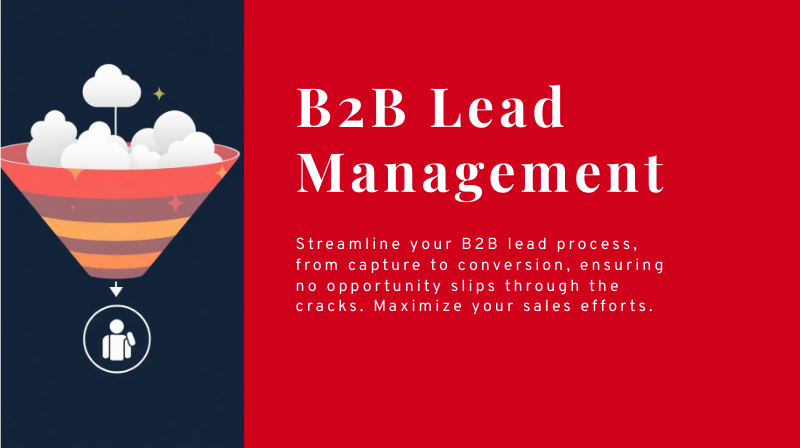
B2B lead management is the process of capturing, validating, qualifying, assigning and developing business prospects through a coordinated marketing and sales workflow. An effective process records who owns each lead, why it qualifies for attention, what should happen next and whether that action produces a sales opportunity.
Build B2B Lead Management Around Decisions and Ownership
Lead generation attracts or identifies prospective buyers. Lead management determines how the business handles those prospects after identification, including those who are unqualified, unresponsive or not ready to buy.
The distinction matters when diagnosing poor performance. A campaign producing unsuitable companies has a targeting problem. Suitable prospects waiting without an owner have a routing problem. Prospects speaking with sales but failing to advance may reveal qualification, positioning or product-fit issues. Each requires a different intervention.
Start by defining the evidence required to move a lead forward. Then specify the person responsible for evaluating that evidence and the action that follows. The following is a recommended operating framework; organizations should adapt its stage boundaries to their sales process.
| Stage | Decision to make | Accountable function | Required record before progression |
|---|---|---|---|
| Capture and validation | Is this a usable inquiry, and does the person or account already exist? | Marketing operations | Contact identity, source, inquiry context and account match |
| Marketing qualification | Does the prospect meet the agreed fit and readiness criteria? | Marketing or demand generation | Qualification reason and supporting evidence |
| Sales acceptance | Has the receiving team accepted responsibility? | Sales development or account owner | Acceptance timestamp, owner and next action |
| Sales qualification | Is there a credible business need worth pursuing? | Sales | Confirmed need, relevant participants and agreed next step |
| Opportunity creation | Is there an identifiable potential transaction? | Account executive | Opportunity record, account association and qualification evidence |
| Recycling or closure | Should follow-up resume later, stop or move elsewhere? | Current owner | Outcome reason, future trigger and responsible team |
A notification alone should not count as acceptance. A completed call alone should not count as qualification. Define progression around evidence and accountability so activity does not become a substitute for progress.
Keep Lifecycle Stage, Work Status and Contactability Separate
A lifecycle stage describes the prospect’s relationship with the business. A work status describes what the team is doing now. Contactability describes whether a particular channel may be used under the organization’s applicable permissions and suppression rules.
These fields answer different questions. A previously qualified prospect may now be waiting for a budget decision. That prospect’s qualification history remains useful even though active selling has paused. Similarly, a strong prospect who opts out of marketing email should not be placed back into an email nurture simply because its score remains high.
CRM conventions also differ. HubSpot distinguishes lifecycle stages from lead status and notes that its default automatic lifecycle updates move records forward.2 Design the workflow around the platform’s behavior rather than assuming every recycled lead should move backward through the lifecycle.
Use clear working definitions:
- Marketing-qualified lead (MQL): A prospect marketing considers ready for sales review under jointly agreed criteria.
- Sales-accepted lead (SAL): A prospect the receiving sales team has accepted responsibility for reviewing or working.
- Sales-qualified lead (SQL): A prospect sales has assessed against the organization’s requirements for a credible sales pursuit.
These are operating definitions, not universal certification standards. Document how your team applies them, including whether sales acceptance is a separate stage or a timestamped action. Preserve the distinction even if the CRM labels differ.
Validate the Record Before Automating the Handoff
Routing depends on reliable identity and account information. Before introducing more elaborate scoring, determine which fields must be present to make an assignment and which can be collected later.
A practical record should retain:
- Contact identity and usable contact details
- Associated company or account, including uncertainty in the match
- Original source and the latest inquiry or campaign interaction
- Product interest and the buyer’s submitted message
- Territory, account owner and relevant customer or opportunity status
- Applicable subscription preferences and channel suppressions
- Qualification evidence, timestamps and the next-action deadline
Do not make complete enrichment a prerequisite for answering a direct sales request. Send incomplete but actionable inquiries to a monitored review queue while missing fields are resolved. Otherwise, a workflow designed to improve data quality can delay the most valuable conversations.
Preserve account context when resolving duplicates
Check whether the inquiry belongs to an existing contact, customer, open opportunity or named account before assigning a new owner. Match cautiously: a shared corporate domain does not always identify the correct subsidiary, buying division or commercial relationship. Disciplined duplicate identification is what makes that judgment reliable at volume.
Define which system controls each field. A CRM may own account assignment while the marketing platform owns subscription status. Specify how conflicts are resolved and which updates must never be overwritten by enrichment or imports.
Keep the original inquiry and campaign history when resolving duplicates. Merging identity should not erase the evidence explaining why the buyer contacted the business.
Data cleanup is also a current operational priority. In a survey of 4,050 sales professionals conducted in August and September 2025 and published in 2026, 74% reported focusing on data cleansing to improve AI outcomes.3 That is evidence of attention to the problem, not proof that cleanup alone delivers a particular conversion increase.
Qualify Fit and Readiness Before Relying on a Total Score
Company fit and engagement should remain visible as separate dimensions. Fit concerns whether the organization can plausibly become a suitable customer. Engagement concerns observed behavior; buying readiness requires interpretation of that behavior and, often, direct conversation.
HubSpot’s current scoring tool supports separate fit and engagement scores, as well as combined scores. It also supports limits on score groups and decay of older engagement events.4 These features can help operationalize a qualification policy, but they do not determine what a qualified buyer means for the business.
Prevent repetition from inflating readiness
A scoring policy should state which actions count, how repeat activity is limited and when old evidence becomes less useful. Avoid allowing repeated low-value interactions to outweigh a direct expression of need.
Email engagement requires particular caution. Security scanners and privacy technologies can generate activity that differs from a person intentionally reading or clicking. HubSpot documents filtering suspected bot activity from marketing email analytics, including activity associated with security scanners and privacy filters.5
Verify which events actually feed your scoring workflow; a filtered reporting dashboard does not by itself establish the behavior of every connected integration. Give stronger consideration to substantive replies, requested meetings and confirmed business needs than to isolated opens.
Do not copy another company’s point threshold and present it as a benchmark. Review your own accepted, rejected and opportunity-producing leads to determine which signals distinguish useful sales conversations. Reassess the model when targeting, offers or sales capacity change.
Route by Account Relationship Before Distributing Workload
Lead routing should protect existing commercial relationships before balancing new work across representatives. A fresh inquiry from an active opportunity usually requires coordination with the opportunity owner, not a disconnected introductory sequence.
Test overlapping conditions before deployment. Also test missing country fields, inactive owners, repeat submissions and records already attached to an opportunity.
Define the response clock precisely
A service-level agreement should specify when the clock begins, which business hours apply, what constitutes a response and what happens when a deadline is missed.
Track receipt, assignment, acceptance, first meaningful response and disposition separately. An automated acknowledgment may confirm receipt, but it should not be reported as a salesperson’s response.
Every exception queue needs an accountable reviewer. Define escalation or reassignment rules for overdue work, including how the original owner is notified so multiple representatives do not contact the buyer independently.
Develop the Buying Group Without Manufacturing Opportunities
Contact-level activity does not necessarily correspond to separate purchasing decisions. Associate relevant people with the same account and, where evidence supports it, the same opportunity. Keep distinct initiatives separate when their budgets, use cases or buying teams differ.
Buyer research reinforces the importance of context. A 2025 global study of nearly 4,000 B2B buyers found that buyers first contacted sellers about 61% of the way through their purchase journey; the winning vendor was on the initial shortlist in 95% of purchases. Participants had made purchases of at least $25,000, so these findings should not be generalized to every small-business transaction.7
The operational implication is to capture what the buyer already knows. A new CRM record does not mean a buyer is beginning research. Ask about the problem, evaluation stage, participants and next decision rather than forcing every inquiry through the same introductory sequence.
When a prospect is not ready, record the reason and design nurturing around it. Pending budget approval calls for different material from an unresolved integration requirement. A competitor contract with a known renewal period suggests a future review trigger. An explicit request to stop contact requires the appropriate suppression, not a slower sequence. Running that logic through campaign management keeps the reason attached to the record rather than living in someone’s notes.
Keep the seller’s discovery notes available to marketing. Otherwise, recycling can send the prospect back to information already covered in a sales conversation.
Use AI Where the Decision Can Be Checked
AI should support a defined lead-management decision with inspectable inputs and measurable outcomes. Start with bounded tasks that a person can review: summarizing inquiry history, suggesting a category, identifying missing information or drafting a response from approved material.
For each application, identify the failure that matters. An incorrect summary can mislead a seller. An incorrect account match can expose a buyer to duplicate outreach. An inaccurate qualification prediction can deprioritize a viable prospect.
Use the following evaluation requirements before expanding automation:
- Summaries: Retain links to the underlying notes and interactions so the seller can verify the account history.
- Classification: Allow uncertain cases to remain unclassified and enter a review queue.
- Predictive prioritization: Define the target outcome, validate against later outcomes and compare performance with the current approach.
- Drafted outreach: Check product claims, buyer context and the approved communication channel before sending.
A predictive model should not be evaluated only on whether it reproduces past sales acceptance. Acceptance may reflect historical workload or seller preferences rather than actual customer potential. When sufficient outcome data exists, examine whether priorities predict qualified opportunities or wins, and check results across important business segments.
Record which model or scoring version produced the recommendation. Without that history, later changes in lead quality cannot be distinguished from changes in the decision system. Keep a route for sellers to flag incorrect recommendations and explain why they disagreed.
Measure Conversion With Consistent Cohorts and Denominators
Lead-management reporting should connect throughput, response discipline and commercial outcomes. Start with definitions that prevent the dashboard from mixing unrelated populations.
| Metric | Recommended calculation | What it helps diagnose |
|---|---|---|
| Sales acceptance rate | Accepted handoffs ÷ eligible handoffs in the same cohort | Agreement on handoff quality |
| Response SLA attainment | Eligible inquiries receiving a meaningful response within target ÷ eligible inquiries | Follow-up execution |
| Accepted-to-qualified rate | Accepted leads that become SQLs ÷ accepted leads in the cohort | Qualification effectiveness |
| Lead-to-opportunity rate | Unique eligible leads associated with a qualifying opportunity ÷ unique eligible leads in the cohort | Progression toward pipeline |
| Cost per qualified opportunity | Defined acquisition and development costs ÷ unique qualified opportunities attributable under the chosen method | Economic efficiency |
| Unworked backlog | Assigned records past their response deadline without a recorded response or disposition | Lost operational capacity |
Define the observation window for conversion metrics. Dividing opportunities created this month by leads generated this month can mix older leads with newer acquisitions. Instead, follow a cohort through a stated maturation period and label incomplete cohorts clearly. Connecting those definitions to business intelligence reporting keeps every team working from the same denominator.
Report contact conversion and unique opportunity counts separately. Several contacts may legitimately progress within one buying group, but their shared opportunity should not be counted multiple times in the pipeline total.
Use the median and an upper percentile for response time, alongside the overdue backlog. A median describes typical performance; the upper tail identifies neglected inquiries. Excluding unanswered records from every view can make response performance look better while the backlog grows.
Break outcomes down by source, segment, inquiry type and qualification reason. Rising MQL volume with falling sales acceptance suggests a different problem from stable acceptance with declining opportunity creation. Keep rejection reasons specific enough to distinguish targeting errors, duplicates, timing issues and capacity constraints.
Put the Process Into Operation With a 30-Day Pilot
Use a limited pilot to verify the workflow before applying it across every source and business unit. The following schedule is a proposed implementation sequence, not an industry benchmark or a guarantee that every integration can be completed within a month.
- Week 1: Define and inspect. Agree on qualification, ownership and outcome definitions. Review records representing accepted, rejected, recycled, unworked and converted leads. Identify the gaps between documented policy and actual practice.
- Week 2: Configure and test. Establish required fields, routing precedence, timestamp capture and exception handling. Test repeat inquiries, existing customers, absent owners and incomplete records. Confirm that suppression rules survive imports and synchronization.
- Week 3: Launch with visible oversight. Start with one manageable inquiry stream. Have sales and marketing review disputed handoffs and unresolved exceptions together. Correct rules before extending them to other sources.
- Week 4: Evaluate execution. Measure assignment accuracy, response performance, acceptance and backlog. Assess early qualification results, but allow enough time before judging opportunity and revenue outcomes in a long sales cycle.
As acquisition and follow-up become more automated, the operating advantage will depend on how quickly the business learns from each decision. A recorded qualification reason, a verified account relationship and a clear outcome give the next workflow better evidence to act on. A well-configured marketing automation platform is where most of that evidence is captured or lost.
FAQ
Who should own B2B lead management?
Assign one accountable process owner, often in revenue operations or marketing operations, with authority to coordinate changes across teams. Marketing owns acquisition and agreed qualification inputs; sales owns acceptance, follow-up and discovery outcomes. The process owner resolves gaps between those responsibilities.
Should every downloaded asset create an MQL?
No. A download establishes an interaction, but the handoff should depend on agreed qualification criteria. Record the asset and its subject so later activity can be interpreted in context. Avoid treating access to educational material as a confirmed request for a sales conversation.
Can a small team manage leads without predictive AI?
Yes. Begin with explicit qualification rules, account-aware assignment and a review queue. Predictive scoring becomes worth evaluating when it addresses a specific prioritization problem and enough reliable outcome data exists to assess whether it improves decisions.
What should happen when sales rejects a lead?
Require a specific reason and a next destination. Incorrectly assigned leads need rerouting; incomplete records need review; suitable prospects with deferred timing need a future trigger. Do not automatically return every rejection to the same nurture program.
How should imported or externally sourced contacts enter the process?
Preserve their source, collection context and applicable contact permissions. Validate identity and account matches before activating outreach. Do not assume that an imported contact has shown the same readiness as someone submitting a direct inquiry on your website.
When should a CRM replacement be considered?
Consider replacement when documented requirements cannot be met reliably through configuration or supported integrations. First distinguish platform limitations from unclear definitions, inconsistent adoption and faulty synchronization. A new CRM will still require those underlying process decisions.
- Salesforce, “40 Sales Statistics to Watch for in 2026,” 2026. salesforce.com
- HubSpot Knowledge Base, “Use contact and company lifecycle stages,” accessed September 28, 2026. knowledge.hubspot.com
- Salesforce, “Salesforce Announces State of Sales Report for 2026,” 2026; survey conducted August to September 2025. salesforce.com
- HubSpot Knowledge Base, “Overview of the lead scoring tool,” updated September 2, 2026. knowledge.hubspot.com
- HubSpot Knowledge Base, “Understand bot filtering in marketing email analytics,” accessed September 28, 2026. knowledge.hubspot.com
- Salesforce Help, “Set Up Assignment Rules,” documentation accessed September 28, 2026. help.salesforce.com
- 6sense Research, “2025 B2B Buyer Experience Report,” 2025. 6sense.com