
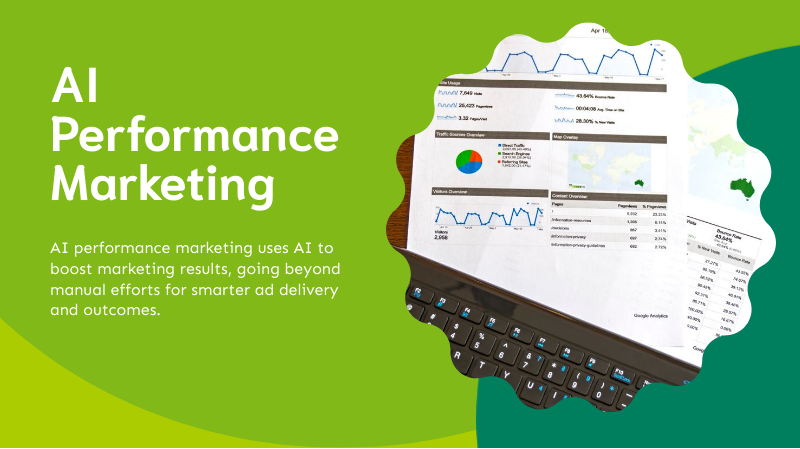
AI performance marketing combines artificial intelligence with outcome-based marketing. AI evaluates audience, bidding, placement, creative and conversion data, then predicts which action is most likely to produce a sale, qualified lead or other defined result. The strongest programs connect that optimization process to revenue, margin and incrementality—not simply clicks or platform-reported conversions.
- The AI Performance Marketing Learning Loop
- AI Changes More Than Media Buying
- AI Only Optimizes the Outcome It Receives
- Performance Metrics Need a Business Hierarchy
- Attribution, Incrementality and Mix Modeling
- A Framework for Implementation
- Where AI Performance Marketing Fails
- Human Judgment Moves Upstream
- Frequently Asked Questions
AI Performance Marketing Creates a Continuous Learning Loop
Traditional performance marketing follows a campaign cycle: launch, collect data, review and adjust. AI shortens that cycle by making predictions and adjustments whenever new signals become available. Modern advertising platforms already apply this model — Google Performance Max uses AI across bidding, budget optimization, audience discovery, creative combinations and attribution. The platform handles more auction-level decisions than a human team could process manually. The marketer determines what the system should pursue, what information it receives and which boundaries it must respect.
Using an AI feature is not the same as operating an AI-ready marketing system. Only 30% of organizations have fully integrated AI across the campaign lifecycle (IAB, 2025).
AI Changes More Than Media Buying
AI performance marketing is often reduced to automated bidding, but its influence extends across the campaign lifecycle — connecting planning, activation, creative development, conversion management and measurement. A complete AI-enabled program addresses each of these areas, not just the bid management layer.
Predictive Audience and Intent Modeling
AI can evaluate combinations of behavioral, contextual and first-party signals that would be difficult to organize into fixed audience segments. The system may identify prospects who resemble valuable customers, demonstrate purchase intent or are likely to progress toward a specific conversion. These predictions are probabilistic — they extend beyond the audiences initially suggested by the advertiser, which is why audience signals guide the model rather than function as strict targeting boundaries.
Generative Creative and Asset Selection
Generative AI can produce variations of headlines, descriptions, images and landing-page content. Separate prediction systems then determine which assets or combinations to serve. More content does not automatically mean more useful experimentation. Assets need meaningful differences in message, offer, visual treatment or audience relevance — producing 50 superficial rewrites of the same advertisement gives the optimization system volume without strategic diversity.
Forecasting and Performance Monitoring
AI analysis can identify unusual cost changes, conversion declines, tracking interruptions and emerging audience patterns. Predictive models can also estimate how budget changes may affect acquisition volume or marginal returns. These outputs are decision aids rather than guaranteed forecasts — demand shifts, promotions, competitor activity and tracking changes can all produce results that historical campaign data did not anticipate.
| Marketing Function | Conventional Approach | AI-Enabled Approach |
|---|---|---|
| Audience selection | Predefined segments | Predictive expansion based on conversion probability |
| Bidding | Rules and periodic adjustments | Auction-level bids based on predicted value |
| Budget allocation | Scheduled manual changes | Dynamic allocation across campaigns or placements |
| Creative testing | Limited sequential tests | Larger sets of assets and combinations |
| Analysis | Historical reporting | Pattern detection, forecasting and anomaly alerts |
| Personalization | Broad message variations | Content selected for specific users or contexts |
AI Only Optimizes the Outcome It Receives
The most important input in AI performance marketing is not the advertising platform. It is the conversion objective. An algorithm does not independently understand whether a lead is qualified, an order is profitable or a customer is likely to remain. It learns from the values and events supplied by the business. Weak objectives create highly efficient campaigns that produce the wrong results.
For B2B lead generation, connecting advertising data with the CRM is especially important. Offline conversion imports can return downstream events — qualified leads and closed revenue — to the advertising platform so the model learns which interactions produce genuine business value.
Performance Metrics Need a Business Hierarchy
AI can improve a metric while weakening the overall economics of a campaign. A lower cost per lead has little value if lead quality deteriorates enough to reduce sales. The same principle applies to AI lead generation across every channel. Metrics should be arranged in four levels — where Tier 1 diagnoses and Tier 4 decides.
Explain how the campaign is operating — useful for diagnosis, rarely a final business objective.
- Impressions and reach
- Click-through rate
- Cost per click
- Video completion rate
- Landing-page conversion rate
Guide day-to-day campaign decisions — definitions should remain consistent across platforms.
- Cost per acquisition
- Return on ad spend
- Cost per qualified lead
- New-customer acquisition cost
- Cost per activated account
Determine whether performance is economically sustainable — AI cannot fix these without downstream data.
- Customer acquisition cost
- Contribution margin
- Sales-qualified pipeline
- Customer lifetime value
- Payback period
Estimate what happened because the advertising ran — not just which interactions received credit.
- Incremental conversions
- Incremental cost per acquisition
- Incremental ROAS
- Lift vs. holdout group
- Contribution-adjusted ROAS
Attribution, Incrementality and Marketing Mix Modeling Serve Different Purposes
No single measurement method provides a complete view of AI performance marketing. A stronger system uses platform reporting for operational decisions, CRM data for commercial outcomes and controlled testing or calibrated modeling for causal validation. Marketing mix modeling has become more accessible as measurement shifts away from user-level tracking — Google released Meridian as an open-source framework in 2025, while Meta maintains Robyn, an open-source package using machine-learning methods to analyze channel effectiveness and budget allocation.
| Method | Primary Question | Main Limitation |
|---|---|---|
| Platform attribution | Which interactions received conversion credit? | Can overstate the platform’s causal impact |
| Web analytics | How did users interact with owned properties? | Identity and cross-device gaps remain |
| CRM attribution | Which campaigns influenced leads and revenue? | Depends on accurate identity matching and sales data |
| Incrementality testing | What happened because the campaign ran? | Requires an appropriate control and sufficient data |
| Marketing mix modeling | How did channels contribute over time? | Less suited to individual-user or daily decisions |
| Unit-economics analysis | Did the acquired business create value? | Requires reliable margin, retention and revenue data |
Attribution describes which interactions receive credit for a conversion. Incrementality estimates what happened because the advertising ran. Some attributed customers would have purchased without seeing the campaign — that difference is what controlled lift studies reveal. Understanding both is essential before scaling spend.
A Practical Framework for Implementing AI Performance Marketing
A business should establish its measurement and decision structure before expanding automation. The sequence matters: scaling an AI-enabled campaign before the conversion path is reliable will amplify data problems, not solve them.
Define the Economic Outcome
Start with the result the company can profitably purchase — a completed order, funded account, retained subscriber or qualified sales opportunity. Document the maximum sustainable acquisition cost, the value assigned to different conversion types, the expected delay between advertising and revenue, and the treatment of cancellations, returns and duplicate leads.
Repair the Conversion Path
Tracking should capture the stages between the advertisement and commercial result. Review analytics tags, consent controls, CRM fields, phone tracking, ecommerce data and offline conversion imports. The objective is not to collect every possible data point — it is to create a dependable connection between media exposure and the outcomes used for optimization.
Choose a Constrained Pilot
Select a campaign with a clear conversion event, sufficient historical activity, reliable downstream data, a defined audience and creative assets that can be varied meaningfully. Avoid testing several new platforms, offers and tracking systems simultaneously — too many changes make the result difficult to interpret.
Establish Human-Controlled Boundaries
Automation should operate inside explicit commercial and brand constraints: geographic restrictions, excluded customer categories, brand and keyword exclusions, approved creative elements, maximum acquisition costs and escalation rules for unusual spending. These boundaries are not limitations on AI — they are the marketer’s job.
Compare Commercial Quality, Not Just Volume
Evaluate whether the AI-enabled campaign changes qualified conversions, revenue, margin or incremental return. A rise in conversion volume is insufficient when the customer mix, average order value or sales acceptance rate declines. This is where CRM data and marketing automation reporting become essential to the evaluation.
Scale in Stages
Increase automation only after the pilot demonstrates accurate measurement and acceptable commercial quality. Expand one dimension at a time — budget, audience reach, creative variation or channel coverage. This preserves enough control to identify why performance changed.
Where AI Performance Marketing Commonly Fails
Most failures begin with an operating or measurement problem rather than a lack of AI capability. Understanding these patterns helps distinguish a system problem from a strategy problem before either one is mistaken for the other.
Optimizing Toward Proxy Conversions
Page views, button clicks and unqualified form submissions occur frequently — making them attractive learning signals. They may also direct the campaign toward people who complete easy actions without generating revenue.
Treating Platform Reporting as Independent Proof
Advertising platforms both deliver campaigns and report attributed results. Their dashboards are necessary for optimization, but causal tests and business records determine whether reported conversions represent incremental, profitable demand.
Generating Creative Without Governance
Generative systems can introduce unsupported claims, visual inconsistencies, biased outputs or off-brand language. A review process should verify accuracy, brand alignment, rights, disclosures and compliance before assets are activated. 70% of advertising executives have experienced at least one AI-related incident (IAB, 2025).
Automating Fragmented Data
Duplicate conversions, inconsistent naming conventions and disconnected CRM records do not become reliable because an AI tool analyzes them. Automation can magnify tracking errors by turning flawed signals into rapid spending decisions.
Eliminating Strategic Variation
AI optimizes within the available choices. If every creative asset presents the same argument to the same audience, the model cannot discover a better positioning strategy. Human teams still need to develop distinct hypotheses about customer problems, offers and objections.
Scaling Before the Signal Is Reliable
Expanding budget or automation before conversion tracking is dependable amplifies the error. The system will optimize efficiently toward the wrong outcome at a larger scale — and the cost of the error grows with spend.
Human Judgment Moves Upstream
AI reduces the value of repetitive campaign adjustments, but it increases the importance of decisions made before optimization begins. The advantage of AI performance marketing will increasingly come from better signal design rather than faster button-pushing. Businesses that translate revenue, margin and customer quality into reliable optimization inputs will give their systems a clearer definition of success.
Performance marketers remain responsible for selecting the right business objective, defining valuable customer behavior, building distinct creative hypotheses, interpreting changes in demand and competition, evaluating lead and customer quality, designing experiments, protecting brand and customer data, and challenging results that appear efficient but are commercially weak.
AI is most useful when a business has measurable outcomes, repeatable transactions and enough data for patterns to emerge. When conversion volume is extremely limited or sales cycles cannot be connected to marketing activity, improving data collection, offer positioning and conversion design may produce more value than adding another optimization platform.
Build a Performance Marketing System That Learns
From conversion signal design to CRM-connected campaigns and incrementality testing — Reach Marketing builds AI performance programs around the commercial outcome that matters to your business.
Frequently Asked Questions
What is AI performance marketing?
AI performance marketing uses machine learning, predictive analytics and automation to improve measurable outcomes such as sales, qualified leads, revenue or customer acquisition cost. It combines AI optimization with defined business objectives rather than simply applying automation to existing campaign structures.
How is AI performance marketing different from digital marketing?
Digital marketing includes all online marketing activity. AI performance marketing is a narrower approach that uses artificial intelligence to optimize campaigns toward defined, measurable business results — connecting platform optimization to revenue, margin and incrementality rather than channel metrics alone.
Does AI replace performance marketers?
AI can automate bidding, asset selection, forecasting and routine analysis. Marketers are still needed to define objectives, evaluate commercial quality, develop strategy, govern creative and validate whether results are incremental. Human judgment moves upstream — toward signal design, experiment design and strategic variation.
Can AI performance marketing work for B2B companies?
Yes. B2B companies receive the most value when advertising platforms are connected to CRM outcomes such as qualified opportunities and closed revenue. Optimizing only for lead forms can favor volume over sales quality — which is why offline conversion imports and CRM-connected reporting are especially important in B2B programs.
What is the best KPI for AI performance marketing?
There is no universal KPI. Ecommerce campaigns may prioritize contribution-adjusted ROAS, while B2B campaigns may use cost per qualified opportunity or pipeline value. The best KPI is the measurable outcome most closely connected to profitable growth — not the metric that is easiest to collect.
How should AI marketing ROI be verified?
Combine platform reporting with web analytics, CRM or transaction data, unit-economics analysis and periodic incrementality testing. Agreement across multiple measurement methods provides stronger evidence than any single dashboard. Controlled lift studies compare exposed and holdout groups to estimate what happened because the advertising ran.
- Google Ads Help, “About Performance Max Campaigns,” current documentation. support.google.com
- Interactive Advertising Bureau, “State of Data 2025,” 2025. iab.com
- Adobe, “State of Marketing in an AI-Driven World,” 2026. business.adobe.com
- Google Ads Help, “About Offline Conversion Imports and Enhanced Conversions for Leads,” current documentation. support.google.com
- Google Ads Help, “About Conversion Lift,” current documentation. support.google.com
- Google for Developers, “Meridian: Marketing Mix Modeling,” 2025. developers.google.com
- Meta Marketing Science, “Robyn: Open-Source Marketing Mix Modeling,” current documentation. facebookexperimental.github.io
- Interactive Advertising Bureau, “AI Adoption Is Surging in Advertising,” 2025. iab.com