
Strategy, Automation and Scalable Growth — Backed by AI That’s Actually Accountable
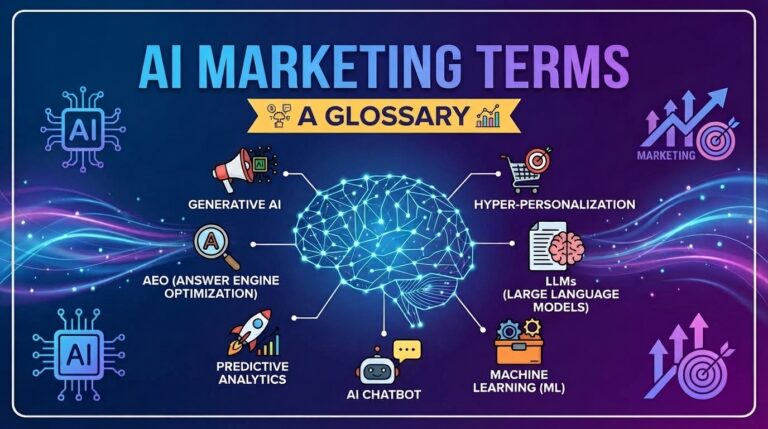
An AI marketing agency connects strategy, customer data, automation and human expertise. The value comes from connecting the right systems to a defined business objective — not from using more tools.
An AI marketing agency combines marketing strategy, customer data, automation and artificial intelligence to improve campaign performance and operational efficiency. Unlike an agency that uses generative AI only to produce content, a specialized AI marketing agency builds systems that can analyze information, personalize experiences, automate repeatable processes and support faster decisions.
What Does an AI Marketing Agency Do?
An AI marketing agency identifies where artificial intelligence can create measurable value and designs the systems, workflows and campaigns needed to capture that value. Adoption alone does not demonstrate maturity — many organizations use individual AI tools without integrating them into broader marketing operations. An agency’s role is to move the business from isolated experimentation to a controlled operating system.
Typical responsibilities include evaluating marketing data and technology, identifying practical AI use cases, connecting CRM and analytics platforms, automating repetitive processes, developing predictive audience segments, governing content production, improving paid advertising performance, building lead qualification systems, monitoring visibility in AI-generated answers and measuring performance against business outcomes.
Core service areas of an AI marketing agency — all connected to a central strategy and measurement layer
An AI Marketing Agency Is More Than an Agency That Uses AI
Nearly any marketing company can use an AI writing assistant, image generator or analytics feature. That does not automatically make it an AI marketing agency. A specialized agency integrates AI into the way marketing decisions are made and executed. The distinction matters because AI does not repair an unclear offer, weak positioning, incomplete tracking or an ineffective customer journey — it can accelerate a sound marketing system, but it can also scale poor decisions.
Traditional Marketing Agency
Strategy, creative and campaign execution across channels.
AI may be limited to internal productivity tools onlyMarketing Automation Agency
Rules-based email, CRM and workflow automation.
Systems may not reason, predict or adapt to new signalsAI Software Provider
Provides a platform or specialized AI application.
May not provide broader marketing strategy or executionAI Marketing Agency
Connects strategy, data, AI, automation and channel execution.
Requires strong data access, governance and client participationA credible AI marketing agency should be able to explain which marketing problems AI will address, what data each system requires, which decisions will be automated, where human approval will remain necessary, how output quality will be evaluated, how performance will be measured and what happens when a model or workflow fails.
AI Marketing Strategy Must Come Before Automation
The first step in an AI marketing engagement should be defining the business problem, not selecting a platform. An organization may want to reduce customer acquisition costs, respond to leads faster, improve conversion rates, increase content output or personalize campaigns. Each objective requires a different combination of data, technology and human involvement.
AI use case prioritization matrix — rank potential projects by business impact and implementation feasibility before committing resources
High-impact projects are not always the best starting point. A lower-risk workflow that can be tested quickly may generate more useful information than a large implementation with unclear success criteria. Automatically summarizing customer interviews, for example, may be a safer initial project than allowing an agent to change advertising budgets. The first use case improves research efficiency while retaining human judgment. The second gives the system direct control over spending and therefore requires stricter permissions, testing and monitoring.
Core AI Marketing Agency Services
AI marketing services should be organized around business functions rather than individual tools. Platforms change quickly, while the underlying problems remain more stable.
AI Readiness and Marketing Technology Assessment
An AI readiness assessment examines whether the company has the infrastructure required to support reliable automation — including analytics configuration, conversion tracking, CRM structure, customer data quality, advertising accounts and existing AI contracts. Data access is often the limiting factor. In Salesforce’s 2026 marketing research, 98% of marketers reported encountering barriers to personalization, with data problems among the most common obstacles.
Customer Intelligence and Predictive Analytics
Predictive AI analyzes historical data to estimate what may happen next — including conversion probability, churn risk, lead quality, product affinity, customer lifetime value and demand forecasting. A predictive model should not be judged only by technical accuracy. It must improve an operational decision. A lead-scoring system has limited value if sales representatives do not trust it or high-scoring leads do not receive different treatment.
AI Content Strategy and Production Systems
A governed content workflow uses AI to increase capacity without removing accountability. The agency remains responsible for accuracy, originality, brand consistency and usefulness. Human contribution is also relevant to ownership: the U.S. Copyright Office has stated that generative AI output may receive copyright protection when a human author contributes sufficient expressive elements, but prompting alone does not provide authorship.
AI Search, SEO and Generative Visibility
Search visibility now includes traditional search results, AI Overviews, answer engines, conversational platforms and other systems that synthesize information. Generative-engine optimization does not replace SEO — search engines still need accessible pages, clear information architecture, accurate content and credible supporting evidence. The difference is that content must now be understandable and extractable even when the user does not visit the original page.
Paid Media and Creative Optimization
As platforms automate more execution, the agency’s responsibility shifts toward higher-level controls: selecting the correct business objective, defining valuable conversion actions, supplying accurate first-party data, developing differentiated creative and identifying when automation is optimizing toward the wrong signal. An advertising system can efficiently produce low-quality leads when the selected conversion event rewards form volume instead of qualified opportunities.
Three Types of AI — and What Each One Does in Marketing
Generative, predictive and agentic AI serve different purposes. Understanding the distinction helps evaluate what an agency is actually proposing.
Three types of AI used in marketing — each serves a different function and requires different governance
AI agents require a clearly defined role, approved knowledge sources, permitted actions, operational guardrails and channels through which they can work. An agent that summarizes reports may only need read access. An agent that sends emails, updates customer records or adjusts campaigns requires stricter permissions, logging and escalation procedures.
How an AI Marketing Engagement Works
A structured engagement usually progresses through six stages. This phased structure limits risk while producing evidence that the system works under real operating conditions.
Six-stage AI marketing engagement — each stage gates the next to limit risk and validate performance under real conditions
Where AI Creates the Most Marketing Value
AI tends to create the strongest value where marketing teams manage large amounts of information, repeated decisions or high-volume workflows. In those situations, foundational marketing and data work should come before advanced AI deployment. Reach Marketing’s MARKETING AI® and MARKETING AI+ programs are built for B2B organizations ready to connect data, targeting and execution into a single accountable system.
- Significant lead or customer volume
- Multiple audience segments to manage
- Large content libraries or complex ad programs
- Repetitive campaign production tasks
- Long or multi-channel buying journeys
- Disconnected marketing and sales systems
- Time-sensitive customer inquiries
- Large quantities of performance data
- Minimal historical data available
- Inconsistent or unreliable analytics
- An unproven offer or unclear positioning
- Very low campaign volume
- No documented marketing process
- No internal owner for implementation
- No reliable way to measure outcomes
- Constantly changing operational rules
Measuring AI Marketing Performance
AI performance should be tied to the business process being improved. Output volume alone does not demonstrate value. Efficiency measures should be paired with quality measures — producing twice as much content is not a positive result if factual errors, editing requirements or brand inconsistencies also increase. Every implementation should begin with a baseline.
| AI Application | Appropriate Performance Measures |
|---|---|
| Lead Scoring | Qualified-lead rate, sales acceptance rate and conversion rate |
| Paid Media | Customer acquisition cost, qualified conversions and incremental revenue |
| Content Production | Production time, editorial revision rate and content-assisted conversions |
| Customer Segmentation | Segment response rate, revenue per segment and retention |
| AI Agents | Task completion rate, error rate, escalation rate and processing time |
| Lead Nurturing | Response time, appointment rate and pipeline progression |
| Search Visibility | Qualified organic traffic, assisted conversions and visibility in generated answers |
| Predictive Analytics | Forecast accuracy and improvement in the decision based on the forecast |
AI Marketing Risks Require Active Governance
AI marketing introduces operational, reputational and legal risks that must be managed throughout the system’s life cycle. The National Institute of Standards and Technology organizes AI risk management around four functions.
NIST AI Risk Management Framework applied to marketing — four functions that should be active throughout the system’s life cycle
Marketing claims also require evidence. In a 2025 enforcement action, the FTC alleged that an AI detection company advertised 98% accuracy even though independent testing found approximately 53% accuracy. The broader lesson: adding “AI-powered” to a product or service does not reduce the need to substantiate performance claims.
How to Evaluate an AI Marketing Agency
The strongest agencies can explain both the marketing strategy and the technical system behind their work. Use these criteria during evaluation.
Scalable growth comes from the system, not the tool. The competitive advantage will come from building a marketing system that can learn, adapt and scale without losing accuracy, brand judgment or control.
Frequently Asked Questions
What is an AI marketing agency?
An AI marketing agency uses artificial intelligence, customer data and automation to improve marketing strategy, campaign execution, personalization, measurement and operational efficiency.
How is an AI marketing agency different from a digital marketing agency?
A digital marketing agency may use AI tools internally. An AI marketing agency integrates AI into client-facing workflows, data systems, decisions and campaign execution.
Can AI replace a marketing team?
AI can automate tasks and support decisions, but it does not replace business judgment, customer understanding, creative direction, accountability or cross-functional leadership.
What marketing tasks can be automated with AI?
Common tasks include lead routing, reporting, content briefing, audience segmentation, email personalization, customer-response triage and campaign monitoring.
What are AI agents in marketing?
AI agents are systems that can evaluate data, make decisions and execute approved marketing actions within defined permissions and guardrails.
How should AI marketing ROI be measured?
ROI should be measured against a documented baseline using business metrics such as qualified leads, revenue, acquisition cost, retention, processing time or labor savings.
Does a business need large amounts of data to use AI marketing?
Not every use case requires a large proprietary data set. Content support and workflow automation may use smaller data sources, while predictive modeling and advanced personalization generally require sufficient historical information.
- McKinsey & Company, “The State of AI: Global Survey 2025,” 2025. mckinsey.com
- Salesforce, “State of Marketing 2026,” 2026. salesforce.com
- U.S. Copyright Office, “Copyright and Artificial Intelligence, Part 2: Copyrightability,” 2025. copyright.gov
- Google, “Google Marketing Live 2026: What’s Next for Marketers,” 2026. business.google.com
- Salesforce, “AI Agents for Marketing: A Comprehensive Guide,” 2026. salesforce.com
- National Institute of Standards and Technology, “AI Risk Management Framework,” updated 2026. nist.gov
- Federal Trade Commission, “FTC Order Requires Workado to Back Up AI Detection Claims,” 2025. ftc.gov
Connect Strategy, Data and AI to Pipeline That Scales
B2B lead generation through targeted email paths, content syndication, AI-driven audience precision and human oversight at every decision point.