
B2B Lead Generation & Revenue Technology
AI Lead Generation Is Reshaping How Companies Build Pipeline
Modern AI-driven systems continuously evaluate intent signals, engagement behavior, and conversion likelihood in real time — transforming how revenue organizations find, qualify, and close buyers.
AI lead generation refers to the use of artificial intelligence systems to identify, qualify, prioritize, and engage potential buyers with minimal manual intervention. Modern AI lead generation platforms combine machine learning, behavioral analysis, automation, and language generation to accelerate the entire customer acquisition process.
Traditional lead generation depended heavily on manual prospecting, static demographic filters, and delayed follow-up. AI-driven systems operate differently. They continuously evaluate intent signals, engagement behavior, firmographic alignment, and conversion likelihood in real time — producing a more adaptive pipeline development process that improves lead quality while reducing operational inefficiencies.
AI lead generation is no longer limited to enterprise organizations with large data science teams. Smaller companies increasingly deploy AI-enabled sales infrastructure through CRM integrations, outbound automation platforms, and conversational AI systems.
| Function | AI Contribution |
|---|---|
| Prospect Identification | Detects companies and contacts matching ICP criteria |
| Lead Scoring | Prioritizes prospects based on conversion probability |
| Outreach Automation | Generates personalized multi-channel communication |
| Data Enrichment | Expands incomplete contact or company information |
| Intent Monitoring | Detects behavioral buying signals |
| Sales Acceleration | Reduces time between engagement and follow-up |
| CRM Optimization | Maintains cleaner, more accurate sales data |
AI Lead Generation Systems Depend on Data Quality More Than Automation
Data quality determines whether AI improves lead generation or amplifies existing problems. Poor source data creates inaccurate targeting, weak personalization, and misleading scoring outputs. AI systems do not independently validate business relevance — they optimize based on the quality of information provided.
High-performing AI lead generation frameworks typically integrate multiple data categories simultaneously: firmographic data, technographic data, behavioral engagement signals, purchase intent indicators, historical CRM performance, website interaction patterns, and communication history.
Predictive Lead Scoring Changes How Sales Teams Allocate Resources

AI predictive lead scoring continuously evaluates behavioral and firmographic signals to surface the highest-probability pipeline opportunities.
Predictive lead scoring replaces static qualification models with continuously evolving probability analysis. Conventional scoring often relies on simplistic weighting — job title, company size, industry, form submissions, email opens. AI scoring systems evaluate significantly more variables simultaneously, analyzing historical conversion behavior across thousands of interactions to identify patterns associated with revenue generation.
| Predictive Signal | Strategic Importance |
|---|---|
| Website visit frequency | Indicates active research behavior |
| Buying committee engagement | Suggests organizational momentum |
| Content consumption sequence | Reveals purchase stage |
| Technology stack changes | Signals operational transition |
| Hiring activity | Indicates expansion or budget movement |
| Competitive solution usage | Identifies replacement opportunities |
| Email response velocity | Reflects engagement strength |
Instead of distributing outreach evenly across large prospect databases, AI systems identify accounts with the highest statistical likelihood of conversion. Sales teams spend less time researching low-probability prospects and more time engaging accounts already demonstrating buying intent.
AI-Powered Prospecting Reduces Manual Research Bottlenecks
Prospecting traditionally consumed a disproportionate percentage of sales development time. AI prospecting systems now automate several previously manual workflows — company discovery, contact identification, intent signal monitoring, role mapping, competitive research, outreach sequencing, and qualification prioritization.
Modern AI prospecting engines increasingly function as semi-autonomous research systems, continuously monitoring digital buying signals across websites, hiring patterns, technology adoption changes, and engagement behavior to surface emerging opportunities automatically. This evolution is moving beyond simple automation into agentic workflows where AI systems execute multi-step operational tasks rather than isolated actions.
AI SDR Systems Are Expanding Beyond Email Automation
Workflow Automation
Follows predefined rules across email sequences, follow-up scheduling, and meeting coordination.
Agentic AI Execution
Makes conditional operational decisions within established parameters — reshaping how sales development teams are structured.
Early AI outreach systems primarily generated cold emails. Current AI SDR infrastructure increasingly handles multi-channel sequencing, LinkedIn engagement, follow-up scheduling, conversation summarization, objection categorization, meeting coordination, lead routing, and sentiment-based tone adjustment.
Personalization at Scale Is the Core Advantage of AI Lead Generation
Personalization historically failed at scale because humans could not realistically customize outreach across thousands of prospects simultaneously. AI changes this constraint by generating individualized messaging dynamically using contextual variables — industry-specific pain points, company growth signals, role-based priorities, recent company events, technology usage, and behavioral engagement patterns.
| Buyer Signal | Personalized Angle |
|---|---|
| Rapid hiring growth | Operational scaling challenges |
| New technology adoption | Integration complexity |
| Geographic expansion | Process standardization |
| Regulatory changes | Compliance risk exposure |
| Funding announcements | Infrastructure acceleration |
| Leadership transitions | Strategic realignment |
Conversational AI Is Becoming a Primary Lead Qualification Layer
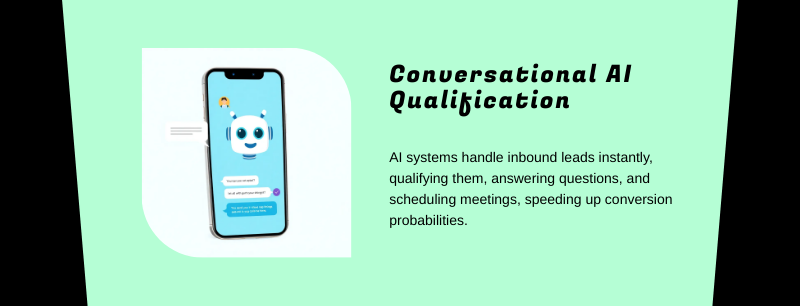
Conversational AI has evolved from scripted chatbots into dynamic qualification infrastructure that operates continuously without staffing constraints.
Conversational AI has evolved from scripted chatbot interactions into dynamic qualification infrastructure. Modern systems qualify inbound leads, route conversations, schedule meetings, answer technical questions, capture buying intent, recommend solutions, and escalate complex interactions.
The operational advantage is response speed. Lead conversion probability frequently declines as response time increases. AI systems operate continuously without staffing limitations, allowing organizations to engage prospects immediately regardless of time zone — especially relevant in high-volume inbound environments where human response delays previously created conversion bottlenecks.
Real-Time AI Sales Assistance Is Expanding During Live Conversations
AI is increasingly moving directly into active sales conversations. Emerging systems analyze live calls, retrieve relevant information, and provide real-time guidance to sales representatives during customer discussions — supporting product information retrieval, objection handling, compliance guidance, competitive positioning, next-step recommendations, and conversation summarization.
Long-Term Implication
- AI-assisted selling reduces cognitive load on sales representatives while improving response consistency.
- AI may fundamentally change how institutional sales knowledge is distributed within organizations.
- The operational layer complements — rather than replaces — human judgment in complex sales environments.
AI Lead Generation Does Not Eliminate Human Sales Strategy
AI automates operational execution more effectively than strategic judgment. Organizations frequently misunderstand this distinction.
AI Performs Well
Large data volumes, pattern recognition, repetitive workflows, high-frequency execution, and structured qualification criteria.
Humans Remain Essential
Complex negotiations, relationship development, enterprise sales strategy, political navigation, trust formation, and organizational change management.
Companies that attempt fully autonomous revenue generation often encounter quality deterioration, messaging inconsistency, and relationship fatigue. The strongest implementations treat AI as an operational augmentation layer rather than a replacement system.
AI Lead Generation Creates New Risks Around Authenticity and Trust

As AI adoption expands, authenticity itself becomes a competitive differentiator — organizations relying excessively on automation may see declining engagement quality.
Buyers increasingly recognize synthetic outreach patterns. Over-automated communication often creates detectable signals: generic personalization, repetitive sentence structures, contextual inaccuracies, artificial conversational tone, excessive sequencing, and poor timing alignment.
Key Risk Categories- Data Privacy Exposure
- Inaccurate Lead Scoring
- AI Hallucinations
- CRM Contamination
- Over-Segmentation
- Outreach Saturation
- Automation Dependency
| Risk Category | Operational Impact |
|---|---|
| Data privacy exposure | Regulatory and compliance concerns |
| Inaccurate lead scoring | Sales resource misallocation |
| AI hallucinations | Incorrect prospect communication |
| CRM contamination | Reporting distortion |
| Over-segmentation | Reduced message scalability |
| Outreach saturation | Brand fatigue |
| Automation dependency | Reduced human sales adaptability |
Organizations deploying AI lead generation systems increasingly require governance frameworks to manage these operational risks effectively.
Revenue Operations Is Becoming Central to AI Lead Generation Success
AI lead generation performance increasingly depends on revenue operations maturity. Disconnected systems create fragmented intelligence. High-performing AI environments typically integrate CRM platforms, marketing automation systems, customer data platforms, sales engagement tools, advertising data, website analytics, and communication platforms.
Revenue operations teams increasingly serve as the infrastructure layer connecting these systems into a unified operational environment. Without alignment, organizations encounter duplicate outreach, conflicting lead ownership, inconsistent scoring, reporting discrepancies, and attribution failures.
AI Lead Generation Technology Is Moving Toward Autonomous Revenue Systems
The next evolution of AI lead generation centers on autonomous workflow execution. Emerging architectures increasingly combine agentic AI, retrieval systems, predictive analytics, conversational intelligence, and dynamic orchestration. The operational objective is not merely automation — it is adaptive execution across interconnected revenue workflows.
Emerging Capabilities Accelerating This Transition
- Autonomous prospect research and AI-generated account plans
- Real-time buying signal analysis and dynamic campaign optimization
- Predictive engagement timing
- Multi-agent workflow coordination
AI is gradually transforming revenue generation from a sequence of disconnected operational activities into a continuously adaptive intelligence system. Organizations that combine operational discipline, high-quality data, and strategic human oversight will outperform businesses that treat AI solely as a volume amplification tool.
Frequently Asked Questions
What is AI lead generation?
AI lead generation uses artificial intelligence to identify, qualify, prioritize, and engage potential customers using automation, predictive analysis, and behavioral data.
How does AI improve lead quality?
AI evaluates large volumes of engagement, firmographic, and behavioral data to identify prospects with stronger conversion probability.
Can AI replace sales development representatives?
AI can automate many prospecting and qualification tasks but still lacks the strategic judgment and relationship management capabilities required for complex sales environments.
What industries benefit most from AI lead generation?
B2B industries with longer sales cycles, large prospect databases, and high outbound activity typically gain the most operational value.
What is predictive lead scoring?
Predictive lead scoring uses machine learning models to estimate the likelihood that a prospect will convert into a customer.
Why does CRM quality matter in AI lead generation?
AI systems depend on accurate datasets. Poor CRM hygiene weakens personalization, scoring accuracy, and automation reliability.
What are the biggest risks of AI lead generation?
Major risks include inaccurate personalization, excessive automation, compliance exposure, CRM contamination, and reduced buyer trust.
How is agentic AI changing lead generation?
Agentic AI systems increasingly execute multi-step workflows autonomously, allowing AI to manage operational sales processes with reduced human intervention.
Ready to build a stronger AI-powered pipeline?
Talk with the Reach Marketing team about your lead generation goals.