


What Prevents B2B Email Marketing From Damaging List Quality
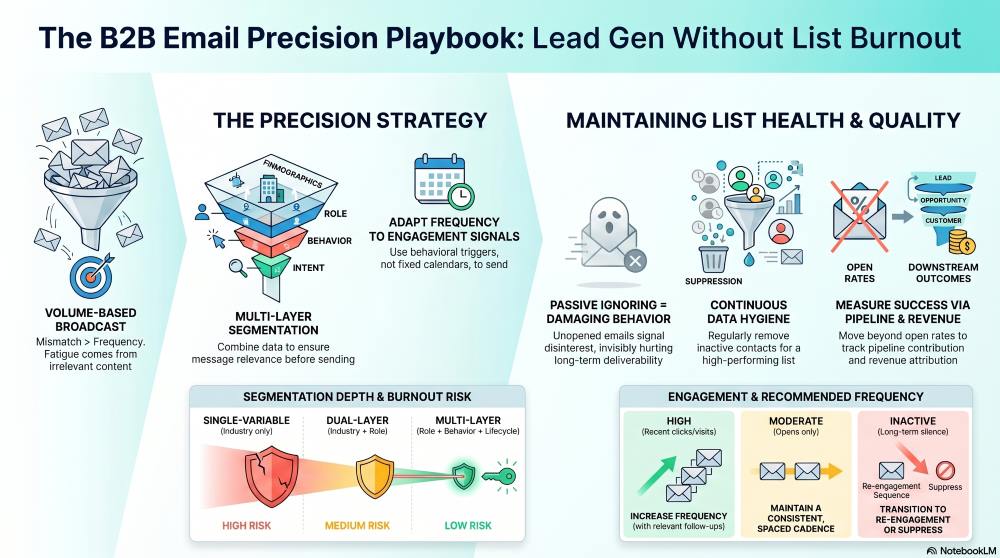
B2B email marketing avoids list burnout when relevance, timing, and audience fit are consistently aligned. List degradation occurs when contacts receive messages that do not match their role, intent, or stage in the decision cycle.
List fatigue is not caused by frequency alone. It is caused by a mismatch between expectation and delivery. When recipients anticipate value and receive generic outreach, disengagement accelerates quickly and compounds across future campaigns.
Three structural failures typically drive this outcome:
- Misaligned segmentation that groups unlike buyers together
- Overreliance on static messaging across dynamic buying stages
- Lack of behavioral feedback loops guiding campaign adjustments
Maintaining list health requires treating email as a precision channel rather than a broadcast channel. Each send must be defensible in context.
Why Most B2B Email Campaigns Fail to Convert Qualified Leads
Most B2B email campaigns fail because they prioritize volume over qualification. High send volume does not compensate for poor targeting; it amplifies inefficiency and accelerates unsubscribes.
Conversion in B2B email is not driven by message frequency. It is driven by message fit relative to the recipient’s operational priorities and decision authority.
Failure patterns tend to follow a predictable structure:
| Failure Point | Operational Impact |
| Generic messaging | Low engagement, high delete rates |
| Weak audience definition | Misalignment with buyer intent |
| No lifecycle differentiation | Premature or irrelevant offers |
| Lack of content depth | Perceived lack of expertise |
| Over-aggressive CTAs | Reduced trust and early opt-outs |
The absence of contextual relevance forces recipients to ignore messages rather than engage with them. Over time, this suppresses domain reputation and reduces overall deliverability.
How List Burnout Happens in B2B Environments
List burnout occurs when repeated exposure to low-relevance messaging reduces engagement below recovery thresholds. Once engagement drops, subsequent campaigns perform worse regardless of content improvements.
This is a cumulative effect, not a single event. Each irrelevant email compounds disengagement and increases the likelihood of:
- Unsubscribes
- Spam complaints
- Passive ignoring (the most damaging long-term behavior)
Passive ignoring is particularly harmful because it signals disinterest without removing the contact. This distorts performance data and reduces sender reputation invisibly.
Key Drivers of List Burnout
- Sending to entire databases without behavioral filtering
- Ignoring role-specific differences in messaging
- Repeating similar value propositions without progression
- Overloading early-stage leads with sales-focused content
- Failing to suppress inactive contacts
List burnout is fundamentally a data discipline issue. Poor list governance produces poor outcomes regardless of creative quality.
Segmentation Is the Primary Control Mechanism for Performance
Segmentation determines whether an email is relevant before it is even opened. It is the most important structural decision in B2B email marketing.
Effective segmentation is multi-dimensional. It does not rely on a single attribute such as industry or company size.
Core Segmentation Layers
- Firmographic segmentation
Company size, industry, revenue band - Role-based segmentation
Decision-makers vs influencers vs operators - Behavioral segmentation
Website activity, past email engagement, content consumption - Lifecycle segmentation
Awareness stage vs evaluation vs purchase-ready - Intent-based segmentation
Signals indicating active solution consideration
Each layer refines message precision. Combining multiple layers significantly increases response rates while reducing unnecessary sends.
Segmentation Depth Comparison
| Segmentation Approach | Precision Level | Risk of Burnout |
| Single-variable (industry only) | Low | High |
| Dual-layer (industry + role) | Moderate | Medium |
| Multi-layer (role + behavior + lifecycle) | High | Low |
Precision reduces fatigue. When recipients feel understood, tolerance for frequency increases.
Content Relevance Determines Whether Emails Are Opened or Ignored
Content relevance is the deciding factor between engagement and dismissal. Subject lines influence opens, but content determines whether future emails are welcomed or ignored.
In B2B environments, relevance is defined by operational usefulness. Content must directly connect to problems the recipient is actively responsible for solving.
High-Performing Content Characteristics
- Specific to role responsibilities
- Tied to measurable business outcomes
- Contextualized to industry constraints
- Structured for quick extraction of value
- Progressively builds insight over time
Generic “thought leadership” without operational clarity fails to sustain engagement. Professionals prioritize applicability over abstraction.
Content Progression Model
Effective campaigns follow a progression rather than repetition:
- Problem definition
- Impact clarification
- Solution framing
- Comparative evaluation
- Implementation considerations
Each step deepens engagement and moves the lead closer to qualification without forcing premature conversion.
Email Frequency Should Be Driven by Engagement Signals, Not Calendars
Fixed sending schedules ignore recipient behavior and increase the risk of fatigue. Frequency should adapt based on engagement patterns.
High-engagement contacts can sustain more frequent communication. Low-engagement contacts require reduced frequency or reactivation strategies.
Engagement-Based Frequency Framework
| Engagement Level | Recommended Approach |
| High (recent clicks, visits) | Increase frequency with relevant follow-ups |
| Moderate (opens, limited clicks) | Maintain consistent but spaced cadence |
| Low (no activity) | Reduce frequency or pause sends |
| Inactive (long-term silence) | Enter re-engagement sequence |
This approach preserves list health by aligning communication intensity with demonstrated interest.
Lead Qualification Must Be Embedded Into Email Strategy
Email marketing for B2B lead generation must filter, not just attract. Without qualification mechanisms, pipelines become inflated with low-value leads.
Qualification occurs through content interaction, not just form fills. Engagement patterns reveal readiness and intent more accurately than single actions.
Embedded Qualification Signals
- Repeated interaction with solution-specific content
- Engagement with pricing or implementation material
- Return visits following email clicks
- Engagement across multiple content types
These signals allow marketers to distinguish between passive interest and active evaluation.
Practical Implementation
- Use progressive content gating only at advanced stages
- Track engagement sequences, not isolated actions
- Route high-intent contacts to sales at the correct timing
- Suppress low-intent contacts from aggressive campaigns
Effective qualification reduces wasted sales effort and improves conversion efficiency.
Personalization Must Extend Beyond First Names to Contextual Relevance
Surface-level personalization does not improve performance. Contextual personalization—based on role, behavior, and need—is required to maintain engagement.
Professionals respond to relevance, not familiarity. Personalization must demonstrate understanding of the recipient’s environment.
Types of Effective Personalization
- Role-specific messaging frameworks
- Industry-specific examples and constraints
- Behavioral-triggered follow-ups
- Account-level context (for high-value targets)
Ineffective Personalization Indicators
- Generic messaging with inserted first names
- Broad industry references without specificity
- Static messaging across different lifecycle stages
Personalization is only effective when it changes the substance of the message.
Data Hygiene Directly Impacts Deliverability and Performance
Clean data ensures that email campaigns reach engaged and relevant contacts. Poor data hygiene reduces deliverability and distorts performance metrics.
Inactive or invalid contacts dilute engagement rates and negatively affect sender reputation.
Essential Data Hygiene Practices
- Regular removal or suppression of inactive contacts
- Validation of email addresses before campaign inclusion
- Deduplication across databases
- Updating role and company information periodically
- Monitoring bounce and complaint rates
Impact of Data Quality
| Data Condition | Campaign Outcome |
| Clean, validated list | High deliverability and engagement |
| Mixed-quality data | Inconsistent performance |
| Poor-quality data | Low deliverability, high spam risk |
Maintaining data quality is a continuous process, not a one-time effort.
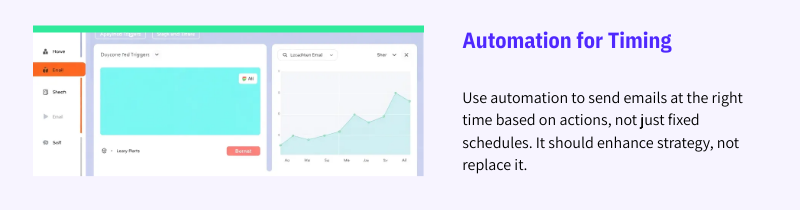
Automation Should Enhance Timing, Not Replace Strategy
Marketing automation increases efficiency but does not correct poor strategy. Automated workflows must be built on accurate segmentation and meaningful triggers.
Trigger-based automation outperforms time-based automation because it aligns communication with user behavior.
High-Value Automation Triggers
- Content downloads or views
- Website revisit patterns
- Email click sequences
- Form interactions
- Time since last engagement
Automation sequences should evolve based on interaction. Static workflows quickly become irrelevant. Marketing AI tools may help with automation.
Measuring Success Requires More Than Open and Click Rates
Open and click rates provide directional insight but do not measure lead quality. B2B email marketing success must be evaluated based on downstream outcomes.
Meaningful Performance Metrics
- Qualified leads generated
- Sales pipeline contribution
- Conversion rates from email-driven traffic
- Engagement depth across multiple interactions
- Revenue attribution from email campaigns
Measurement Gap
| Metric Type | Limitation |
| Open rate | Does not indicate intent |
| Click rate | Does not indicate qualification |
| Conversion rate | Can be inflated by low-quality leads |
Performance measurement must connect email activity to business outcomes.
Common Misconceptions That Lead to List Burnout
Several widely held assumptions lead directly to poor performance and list degradation.
Misconceptions
- More emails increase results
- Personalization is limited to names
- All leads should receive the same messaging
- High open rates indicate success
- Content quality compensates for poor targeting
Each misconception prioritizes volume over relevance, which accelerates disengagement.
Correcting these assumptions requires structural changes, not incremental adjustments.

Strategic Alignment Between Marketing and Sales Prevents Lead Waste
Email-driven lead generation fails when marketing and sales operate on different qualification standards. Alignment ensures that only viable opportunities are passed forward.
Alignment Requirements
- Shared definition of a qualified lead
- Agreement on engagement thresholds
- Feedback loops from sales to marketing
- Continuous refinement of targeting criteria
Without alignment, email campaigns generate activity but not revenue.
Practical Framework for Sustainable B2B Email Lead Generation
Sustainable email lead generation requires a system that balances engagement, qualification, lead generation tools and list health.
Core Framework Components
- Multi-layer segmentation structure
- Behavior-driven content progression
- Engagement-based frequency control
- Embedded qualification signals
- Continuous data hygiene processes
Execution Flow
- Segment audience using multiple data layers
- Map content to lifecycle stages
- Trigger emails based on behavior, not schedules
- Monitor engagement and adjust frequency
- Qualify leads based on interaction patterns
- Suppress or re-engage inactive contacts
This framework ensures that list growth does not come at the expense of performance.
FAQ: B2B Email Marketing and List Management
What causes email list fatigue in B2B marketing?
Email list fatigue is caused by repeated exposure to irrelevant or poorly timed messaging, leading to disengagement and reduced responsiveness.
How often should B2B emails be sent?
Email frequency should be determined by engagement levels rather than fixed schedules, with more active contacts receiving more frequent communication.
What is the most important factor in email performance?
Segmentation is the most critical factor because it determines whether the message is relevant before it is opened.
How can inactive contacts be handled effectively?
Inactive contacts should be placed into re-engagement campaigns or suppressed to protect overall list performance.
Does personalization improve results?
Personalization improves results only when it changes the content to reflect the recipient’s role, behavior, and needs.
How are qualified leads identified through email?
Qualified leads are identified through patterns of engagement, such as repeated interactions with solution-focused content and return visits.
What metrics matter most for B2B email campaigns?
Metrics tied to business outcomes, such as qualified leads and revenue contribution, are the most meaningful indicators of success.