


A B2B email list for lead generation is only as valuable as the audience it represents. Volume is not the goal — qualified pipeline is. The companies that build lists around account fit, verified data and smart segmentation consistently outperform those chasing contact counts.
A B2B Email List for Lead Generation Starts With the Right Audience
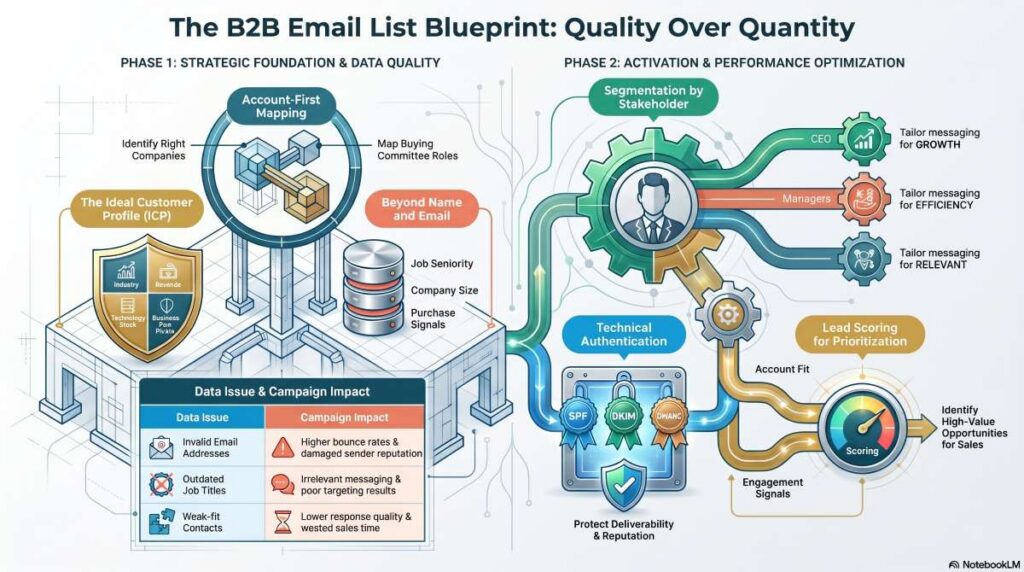
Before collecting emails, names or company records, the business needs a clear definition of which accounts are worth pursuing. That definition should include firmographic, geographic and operational details that reflect the company’s actual buyers — not just a broad description of the market.
The right question is: “Which contacts are most likely to need what we offer, understand the value and influence the purchase?”
A strong ideal customer profile may include industry or vertical, company size, annual revenue range, location or service area, department structure, buying triggers, pain points, decision-making roles and current technology environment. A company offering B2B marketing support may need sales leaders, marketing directors, business owners or executives responsible for pipeline growth.
The Right List Is Built Around Accounts, Not Just Email Addresses
Account-first list building begins with the right companies — then maps the right people inside them. A disconnected collection of names is not a pipeline asset.
Business purchases involve companies with specific needs, budgets, timing and decision structures. Individual contacts matter, but account context determines whether outreach has a meaningful business reason. B2B sales rarely depend on one person alone — a CMO may approve a campaign, a sales leader may evaluate lead quality, a business owner may make the final call and an operations manager may feel the daily pain first.
| List-Building Question | Why It Matters |
|---|---|
| Which companies fit the offer? | Prevents outreach to low-value or irrelevant accounts |
| Which roles influence the buying decision? | Helps messaging reach people with real authority or input |
| Which contacts are primary decision-makers? | Improves sales prioritization |
| Which contacts are users or recommenders? | Supports multi-contact outreach across the buying committee |
| Which companies show signs of need? | Helps prioritize timing and messaging relevance |
| Which records are verified and current? | Protects campaign quality and sender reputation |
Multiple relevant contacts at the same company can be more useful than one isolated contact per account. Multi-contact coverage gives sales and marketing teams more ways to enter the conversation without depending on a single inbox.
Good B2B Email Data Includes More Than a Name and Email
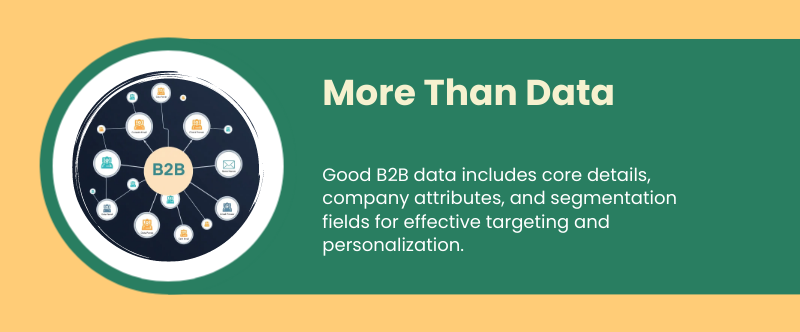
An email address alone is not enough to build a reliable lead generation campaign. A usable B2B email list should include core contact details, company attributes and segmentation fields — otherwise every message risks becoming generic and sales teams lose the ability to sort contacts by opportunity value, territory, industry or fit.
Core Record Fields
- First and last name
- Business email address
- Job title and department
- Company name and website
- Industry and company size
- Location and seniority level
- Verification status and date updated
Advanced Segmentation Fields
- Technology usage and stack
- Recent hiring activity
- Funding stage
- Estimated revenue
- Purchase signals or intent data
- Current vendor relationships
- Source or acquisition method
| Data Issue | Campaign Impact |
|---|---|
| Invalid email addresses | Higher bounce rates and weaker sender reputation |
| Outdated job titles | Poor targeting and irrelevant messaging |
| Duplicate records | Repeated outreach and distorted reporting |
| Wrong company data | Bad segmentation and sales confusion |
| Weak-fit contacts | Lower response quality and wasted sales time |
| Missing fields | Limited personalization and poor prioritization |
Email verification is important, but verification alone does not make a list good. An address can be valid and still be irrelevant. A contact can be reachable and still have no influence over the buying decision. The strongest B2B email lists are both technically clean and strategically accurate. Data hygiene services help ensure both conditions are met before campaigns launch.
Compliance Must Be Built Into the List Before Outreach Begins
Email list building for lead generation must account for consent expectations, opt-out requirements, sender identification, physical mailing address requirements and data handling standards. In the United States, commercial email can generally be sent to business contacts when the sender follows applicable rules — accurate headers, non-deceptive subject lines, proper identification and a working unsubscribe process.
Compliance is not only a legal concern — it is also a deliverability, brand and sales quality concern. A technically permissible campaign can still damage reputation if the data is sloppy, the message is irrelevant or the unsubscribe process is difficult. Treat compliance as the minimum standard and relevance as the operating standard.
Segmentation Turns a Contact List Into a Lead Generation Asset
Segmentation determines which contacts receive direct sales outreach, which receive nurture content and which should be held for a future campaign — volume without segmentation is just noise.
Without segmentation, every contact receives similar messaging regardless of industry, role, company size, location or business need. A CEO may care about growth, efficiency and competitive position. A marketing director may care about lead quality, campaign performance and conversion rates. A sales leader may care about pipeline consistency and meeting volume. The underlying offer may be the same — the buying logic is different.
Common Segmentation Dimensions
- Industry and vertical
- Company size and revenue range
- Geography and sales territory
- Job function and seniority
- Buying stage or intent level
- Technology environment
- Past engagement level
- Existing customer status
What Segmentation Enables
- Role-specific messaging by stakeholder
- Differentiated cadences by fit level
- Direct sales routing for high-intent accounts
- Nurture sequences for earlier-stage contacts
- Coordinated campaign management across channels
- Cleaner attribution and performance reporting
For broader B2B email marketing campaigns, the list structure should support coordinated execution across email, direct mail, digital advertising, sales outreach and lead nurturing — not only a one-time deployment.
Buying a B2B Email List Can Work When the Data Is Properly Sourced
A purchased list should never be treated as a shortcut around strategy. The same targeting, verification and compliance standards apply — the source is just different.
The problem is not the concept of acquiring business contact data. The problem is using low-quality, poorly sourced or irrelevant data without proper controls. A general list of “business owners” or “marketing contacts” is rarely enough for serious lead generation. Strong campaigns require precision — industry, geography, company size, role, seniority and factors that shape buying relevance.
Businesses should evaluate any list provider based on data source transparency, targeting options, verification practices, update frequency, compliance practices, suppression handling, available segmentation fields and match to the ideal customer profile. Reach Marketing’s list building service works in the space where data quality, targeting strategy and campaign activation need to align — for businesses that need precision without the internal overhead of building and maintaining lists from scratch.
First-Party Data Should Strengthen Every B2B Email List
Many companies overlook their own data before seeking new contacts. Existing databases often contain old leads, past opportunities, inactive customers, newsletter subscribers, trade show contacts and accounts that were never fully nurtured. These records may need cleaning, enrichment and segmentation — but they carry historical context that outside data cannot fully replicate.
First-party data can reveal which industries have responded before, which job titles engage with the company, which accounts reached the proposal stage, which customers are easiest to retain, which segments produce stronger deal sizes and which contacts need reactivation. A strong B2B email list combines first-party records with carefully selected third-party data. First-party data provides historical context. Third-party data expands reach.
Email Deliverability Should Be Planned Before the First Campaign
Even a well-built list can fail if the sending infrastructure is weak. Deliverability depends on authentication, sender reputation, message relevance, bounce control, complaint rates and consistent sending behavior. Modern email systems expect commercial senders to authenticate their domains properly — SPF, DKIM and DMARC are not optional details for serious B2B email programs.
Technical Authentication
Configure SPF, DKIM and DMARC on the sending domain. These records verify that email is authorized and protect sender reputation with mailbox providers.
List Verification Before Launch
Remove invalid addresses, duplicates and role addresses. Suppress existing customers, opted-out contacts and geographic segments that fall outside campaign scope.
Sending Volume Management
Warm new sending domains gradually. Avoid large volume spikes from new infrastructure. Monitor bounce rates, complaint rates and engagement as campaigns run.
Ongoing Engagement Review
Track open rates, clicks, replies, bounces and complaints at the segment level. Deliverability is not only a technical issue — it is a relevance issue that reflects list quality over time.
Lead Scoring Helps Sales Focus on the Best Opportunities
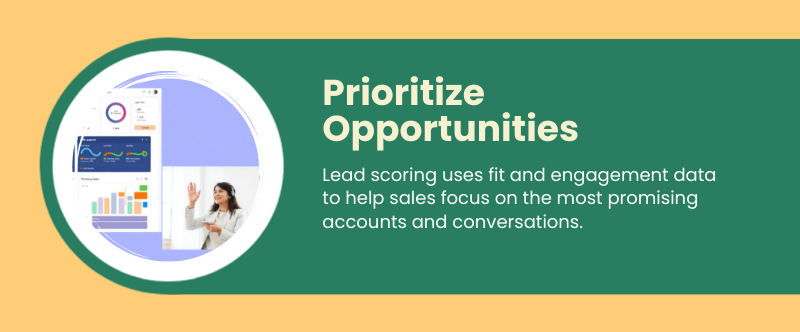
Lead scoring combines account fit with engagement signals so sales teams spend time on the accounts that deserve attention — not the ones that merely opened an email once.
Not every contact should receive the same level of attention. Lead scoring combines fit data — company size, industry, location, role, seniority — with engagement data — email opens, clicks, replies, form submissions, website visits and content interactions. The purpose is not to overcomplicate the process. The purpose is to help sales teams spend time on accounts that deserve attention first.
| Scoring Factor | Why It Matters |
|---|---|
| Industry fit | Shows whether the account belongs in the target market |
| Role fit | Indicates whether the contact can influence a decision |
| Company size | Helps estimate budget and service alignment |
| Geography | Supports sales territory and service availability |
| Engagement | Shows whether the contact has shown active interest |
| Recent activity | Helps identify timing and urgency |
Lead scoring should remain flexible. As campaigns run, sales feedback should refine the model. If certain industries respond but rarely convert, the score should change. If specific job titles produce better conversations, the list criteria should be adjusted. Marketing automation platforms can apply and update scoring rules dynamically as new engagement data comes in.
Measuring List Performance Requires More Than Open Rates
Open rates and clicks can provide directional insight, but they do not prove that the list is producing qualified opportunities. A campaign that generates fewer total replies but more qualified conversations may be more valuable than a campaign with high engagement from poor-fit contacts. The most useful measurements connect list quality to sales impact.
Activity Metrics
- Bounce rate
- Open rate (directional only)
- Reply rate
- Click-through rate
- Unsubscribe and complaint rates
Pipeline Metrics That Actually Matter
- Positive response rate
- Meeting conversion rate
- Qualified lead rate
- Sales-accepted lead rate
- Opportunity creation and pipeline value
- Closed revenue by segment
Performance should be reviewed by segment — an overall campaign average can hide important differences between industries, regions, job titles or company sizes. The best list-building programs use performance data to refine future targeting. Business intelligence reporting can surface which segments, roles and industries drive the strongest return so the next list reflects those learnings.
B2B Email List Building — Frequently Asked Questions
What is a B2B email list for lead generation?
A B2B email list for lead generation is a database of business contacts and company records used to identify, reach and nurture potential buyers. The list should include accurate contact details, company information and segmentation fields aligned to the ideal customer profile — not just a collection of email addresses.
Is it legal to buy a B2B email list?
Buying a B2B email list can be permissible when the data is properly sourced and outreach follows applicable commercial email rules, including CAN-SPAM in the US. Businesses should review compliance requirements — including any international frameworks that apply — before using purchased data.
What makes a B2B email list high quality?
A high-quality B2B email list is accurate, current, segmented, relevant to the ideal customer profile and supported by verified business contact information. Quality depends on both technical validity and sales relevance — a verified address that belongs to the wrong role or wrong company size still underperforms.
How often should a B2B email list be cleaned?
A B2B email list should be cleaned regularly, especially before major campaigns. Hard bounces, duplicates, outdated job titles and inactive records should be reviewed on an ongoing basis. Data decays quickly — job changes, company closures and role shifts mean even a recently acquired list can deteriorate within months.
Should a B2B email list include phone numbers?
Phone numbers can be useful when outreach includes sales calls or multi-channel follow-up. They should be collected and used appropriately based on campaign strategy and compliance requirements, including any telemarketing or cold calling rules that apply.
What is the biggest mistake in B2B email list building?
The biggest mistake is prioritizing volume over fit. A large list of irrelevant contacts usually performs worse than a smaller list built around the right accounts, roles and buying conditions. High contact counts create a false sense of pipeline readiness while actually diluting response quality.
How does Reach Marketing help with B2B list building?
Reach Marketing helps businesses align audience targeting, data quality and campaign execution so B2B email lists support real lead generation goals rather than disconnected outreach activity. From ICP definition and data sourcing to segmentation, deliverability and campaign activation, Reach Marketing connects list strategy to pipeline outcomes.
Build a B2B Email List That Actually Drives Pipeline
35M+ verified contacts. ICP-aligned targeting. Multi-channel campaign activation. No guesswork.