
An AI advertising agency isn’t defined by which tools it uses. It’s defined by whether AI is connected to real pipeline — not just faster ad copy.
A practical, no-hype breakdown of what AI actually changes in paid media and B2B lead generation — and where it doesn’t.
An AI advertising agency should improve campaign speed, targeting, creative testing and reporting — while humans stay responsible for strategy, messaging and the business outcome. The difference between a serious partner and a basic automation reseller is accountability.
Digital advertising is already a nearly $300 billion U.S. market. As platforms add more AI-powered campaign features, the real question for B2B companies isn’t whether AI belongs in paid media — it’s whether a partner can use it without losing strategic control, data accuracy or measurement clarity.
Three layers separate real AI advertising from basic automation
Most weak AI offers live entirely in layer two — more creative, faster launches, less manual work. Real benefits, but incomplete. The strongest partners build all three.
AI helps where humans struggle with volume, speed or pattern recognition
Not where it requires judgment about a business’s positioning. Four areas where the lift is real and measurable:
Audience Discovery
AI spots patterns across CRM data, web activity and search queries — helping move past broad personas. Two buyers with the same demographic profile may need entirely different messages depending on buying stage.
Creative Testing at Scale
86% of video buyers were using or planning generative AI for creative as of 2025. That means more message, hook and format variations tested — not unreviewed AI ads published live.
Bidding & Pacing
Google’s AI Max for Search typically drove 14% more conversions at similar cost — 27% for exact/phrase-heavy campaigns. The agency’s job is deciding when automation is appropriate, not blindly accepting it.
Reporting & Diagnosis
AI clusters search terms and surfaces creative fatigue fast — but a conversion increase isn’t always a business improvement. It’s only useful tied to qualified pipeline, not platform-reported noise.
What a real AI advertising agency should be able to prove
A shallow agency shows screenshots of AI tools. A stronger one shows operating discipline — documented, not implied.
The biggest risk isn’t a bad headline — it’s uncontrolled decision-making
Automation can quietly shift targeting, creative or reporting interpretation without enough oversight. Five areas that deserve real caution:
The FTC’s Consumer Reviews and Testimonials Rule, in effect since October 2024, makes one thing clear: AI does not create an exception to advertising truthfulness or substantiation standards.
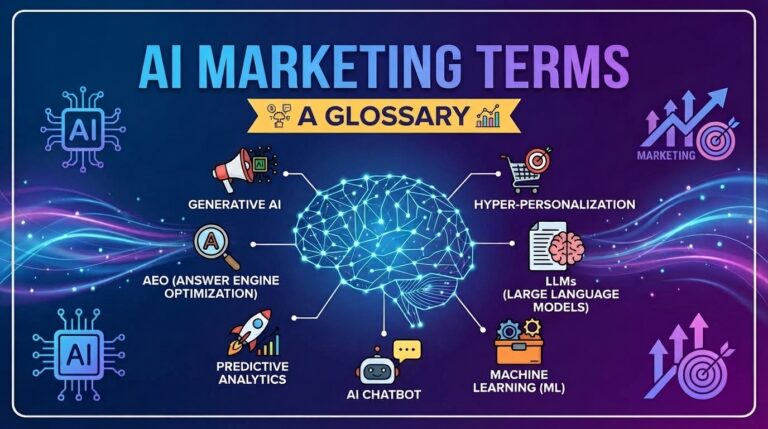
Key terms worth understanding before you evaluate a partner
Part of choosing an AI digital marketing agency is asking informed questions. Hover any term:
How to evaluate an AI advertising agency in seven questions
Many agencies use similar platforms. The difference is whether AI capability connects to qualified pipeline — or just looks impressive in a pitch deck.
When this approach is the right move — and when it isn’t
- B2B company needs better email, search or retargeting efficiency
- Scalable, role-specific outreach across a buying committee
- Tighter alignment needed between campaigns and pipeline quality
- Plateaued on manual management, needs structured testing
- Strong first-party data not yet activated effectively
- No defined offer or weak market positioning
- Unreliable conversion tracking or missing CRM feedback
- Poor website or landing-page conversion paths
- No appetite or budget for structured testing
- AI accelerates a good system — it can’t fix broken fundamentals
What to prepare so AI works from reality, not guesswork
The agency’s performance depends heavily on the inputs it receives:
Where MARKETING AI® fits into all of this
MARKETING AI® is built around B2B lead generation through targeted email paths — content syndication for assets like white papers and webinars, and a Lead Generation Tool for promoting offers directly to decision-makers. B2B teams don’t only need more contacts; they need cleaner targeting, stronger alignment and leads sales can act on quickly.
AI advertising should strengthen trust, not erode it
In a 2026 Gartner survey, 50% of U.S. consumers said they’d prefer brands that avoid generative AI in customer-facing content; 68% said they frequently wonder whether what they’re seeing is even real. That doesn’t mean avoiding AI — it means using it transparently, for clearer comparisons and more relevant outreach, not synthetic content disconnected from the brand.
The next stage of AI advertising won’t reward the agency that generates the most assets. It will reward the partner that combines machine-speed testing with credible messaging and real strategic control.
Frequently asked questions
What is an AI advertising agency?
A paid media partner that uses artificial intelligence to improve campaign strategy, creative production, media buying, audience targeting, optimization and reporting, while keeping humans accountable for strategy and business judgment.
What’s the difference between an AI marketing agency and an AI advertising agency?
An AI advertising agency usually focuses on paid media — search, social, display, video, programmatic and retargeting. An AI marketing agency may also cover content, email, CRM, SEO, sales enablement and lead generation strategy.
Is AI advertising only for large brands?
No. Small and midsized B2B companies can use AI advertising through targeted email lead generation, paid search, paid social and programmatic platforms. The requirement is clear goals, reliable tracking and enough data for testing.
Can AI replace a digital advertising agency?
AI can automate parts of the workflow, but it doesn’t replace strategy, creative judgment, compliance review, customer insight, sales feedback or business decision-making.
What are the biggest risks of AI advertising?
Inaccurate claims, off-brand creative, poor data quality, privacy issues, overreliance on platform automation, weak transparency and optimization toward low-quality conversions instead of qualified pipeline.
How should businesses evaluate an AI advertising agency?
Ask how the agency uses AI, what’s automated versus human-reviewed, how data is protected, how results are measured and how they prove improvements beyond platform-reported metrics.
What’s the future of AI digital advertising?
More automated media buying, faster creative testing, deeper first-party data use, more AI-generated video, stronger governance requirements and greater pressure to prove real outcomes like qualified pipeline.
- IAB and PwC, “Internet Advertising Revenue Report: Full Year 2025,” 2026. iab.com
- IAB, BWG Strategy and Transparent Partners, “State of Data 2025,” 2025. iab.com
- IAB, “Nearly 90% of Advertisers will Use Gen AI to Build Video Ads,” 2025. iab.com
- Google Ads, “Introducing AI Max for Search campaigns,” 2025. blog.google
- Federal Trade Commission, “Consumer Reviews and Testimonials Rule,” 2024. ftc.gov
- Gartner, “50% of Consumers Prefer Brands That Avoid GenAI in Consumer-Facing Content,” 2026. gartner.com
Built for pipeline, not just clicks
Audience precision, permissioned data, intent capture and disciplined lead delivery — paired with the human judgment that keeps AI advertising accountable.