

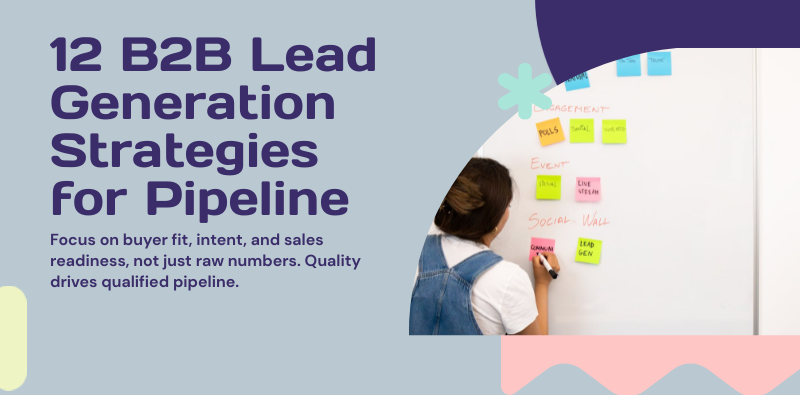
12 B2B lead generation strategies that actually drive qualified pipeline share one common trait: they focus on buyer fit, purchase intent, and sales readiness rather than raw contact volume. Here’s how to build a program that produces revenue — not just names.
B2B lead generation is the structured process of attracting, identifying, qualifying, and engaging business buyers who may become revenue opportunities. The strongest programs do not treat every form fill, email reply, webinar attendee, or downloaded asset as equally valuable. They separate casual interest from commercial potential.
Qualified pipeline depends on three conditions:
- The account fits the company’s ideal customer profile.
- The buyer has a real business problem connected to the offer.
- The sales team has a credible next step with the right stakeholder.
Lead generation fails when marketing produces names without context. Pipeline grows when marketing and sales share a definition of quality, prioritize the same accounts, and engage buyers based on observable need.
A Precise Ideal Customer Profile Prevents Weak Leads From Entering the Pipeline
A precise ideal customer profile defines which companies are worth pursuing before any campaign, content, or outreach begins. An ICP describes the firmographic, operational, financial, and behavioral traits of accounts most likely to become profitable customers. “Manufacturing companies” or “mid-market businesses” may describe a market — but those categories do not define sales quality.
A strong ICP includes industry segments with proven need, company size and revenue range, buying triggers or operational pain points, technology dependencies, geographic or regulatory considerations, deal size potential, and common decision-maker roles. The most effective B2B lead generation strategies begin by excluding poor-fit accounts — weak-fit leads consume sales capacity, distort conversion reporting, and create false optimism in marketing dashboards.
| ICP Element | Weak Definition | Strong Definition |
|---|---|---|
| Industry | Healthcare | Multi-location healthcare operators with centralized procurement |
| Company Size | Mid-market | 250–2,000 employees with regional expansion needs |
| Pain Point | Needs efficiency | Manual lead routing causing delayed sales follow-up |
| Buying Trigger | Interested in growth | Recently funded, hiring sales reps, or expanding territories |
| Decision Role | Executives | VP Sales, CRO, RevOps, or demand generation leadership |
An ICP should also identify disqualifiers — a company may look attractive by size but still be a poor target because of long procurement barriers, low urgency, limited budget ownership, or an incompatible operating model.
Account-Based Marketing Works When Sales and Marketing Pursue the Same Revenue Targets
Account-based marketing drives qualified pipeline by concentrating effort on high-value accounts instead of distributing campaigns across a broad, low-context audience. ABM is not simply personalization — it is a coordinated revenue strategy where marketing, sales, and customer-facing teams select priority accounts, identify the buying committee, build account-specific messaging, and measure progress at the account level.
ABM fails when teams treat it as a campaign theme rather than an operating model. A personalized ad or email sequence does not create an account-based strategy unless sales is aligned on target accounts, outreach timing, stakeholder mapping, and opportunity follow-up.
Tiered ABM Makes Resource Allocation More Realistic
| ABM Tier | Best Use Case | Typical Execution |
|---|---|---|
| Tier 1 | Strategic enterprise accounts | Deep research, custom messaging, executive outreach |
| Tier 2 | High-fit named accounts | Industry-specific content, segmented campaigns, sales sequences |
| Tier 3 | Broader qualified market | Scaled personalization, intent-based nurture, automated engagement |
High-Intent Content Converts Buyers Who Are Already Defining the Problem
High-intent content generates qualified pipeline by serving buyers who are actively evaluating a problem, solution category, vendor type, or purchase decision. These buyers are not merely learning vocabulary — they are comparing options, building requirements, validating budget, or preparing internal justification.
High-Intent Content Formats
- Cost and pricing explainers
- Comparison pages
- Buyer’s guides
- Industry-specific solution pages
- Use case pages
- Implementation and ROI resources
Why It Qualifies Buyers
- Reveals commercial context beyond clicks
- Helps champions build internal business cases
- Separates evaluators from browsers
- Signals purchase stage clearly
- Supports finance, compliance, and procurement
Conversion Offers Should Match the Buyer’s Stage of Commitment
The strongest B2B lead generation programs use multiple conversion paths — not every buyer is ready for a demo, and forcing that creates friction that kills pipeline.
A common lead generation mistake is forcing every visitor toward the same action. A buyer who is comparing vendors may be ready for a demo. A buyer still defining internal requirements may need a checklist, calculator, or technical guide before agreeing to a meeting.
| Buyer Condition | Best-Fit Conversion Offer | Pipeline Value |
|---|---|---|
| Exploring a problem | Diagnostic checklist | Identifies early-stage need |
| Comparing approaches | Buyer’s guide | Reveals category-level intent |
| Building a business case | ROI calculator | Indicates budget discussion |
| Evaluating vendors | Demo or consultation | Creates direct sales opportunity |
| Managing internal approval | Business case template | Supports stakeholder consensus |
Intent Data Helps Teams Prioritize Accounts Showing Active Buying Signals
Intent data improves pipeline efficiency by identifying accounts that appear to be researching relevant topics, categories, competitors, or business problems. First-party signals are behaviors captured on owned channels — website visits, content engagement, email clicks, repeat visits from the same account. Third-party intent data reflects activity across external networks and publisher environments.
Intent data becomes more valuable when paired with ICP fit. A poor-fit account showing intent may still be a weak opportunity. A high-fit account showing repeated intent deserves faster, more personalized follow-up. Strong intent-based programs look for patterns, not isolated actions.
- Multiple visits from the same target account
- Engagement with pricing, comparison, or demo pages
- Repeat visits from different stakeholders
- Sudden activity around a solution category
- Engagement after a funding, hiring, expansion, or compliance trigger
LinkedIn Lead Generation Works Best With Role-Specific Messaging
LinkedIn can support qualified B2B pipeline when campaigns target specific roles, buying committee responsibilities, and business problems rather than generic professional audiences. Effective LinkedIn lead generation narrows the message around the buyer’s operational reality — a CFO, VP Sales, IT director, and operations executive may all influence the same purchase, but each evaluates it through a different lens.
| Role | What They Care About |
|---|---|
| Revenue Operations | Attribution, lead routing, funnel visibility |
| CEO / Executive | Growth efficiency, market expansion, revenue predictability |
| CFO | Cost reduction, ROI justification, budget risk |
| IT / Technical | Integration complexity, security, implementation burden |
| Operations | Process consistency, scalability, workflow reliability |
LinkedIn also performs better when organic authority and paid campaigns reinforce each other. Executive posts, company updates, case-driven content, document ads, retargeting, and direct outreach can all support the same account journey when messaging remains consistent.
Outbound Prospecting Still Works When It Is Timely, Specific, and Relevant

Outbound fails when messages feel interchangeable. Effective prospecting connects a specific business trigger to a real commercial problem — not a feature list.
Outbound prospecting drives qualified pipeline when outreach is based on account fit, business context, and a credible reason for contact. Effective outbound begins with a reason the account should be contacted now — the first message should connect a trigger to a business issue, not explain every feature.
Strong Outbound Triggers
- New funding or investment
- Hiring for relevant roles
- Expansion into new markets
- Leadership changes
- Technology adoption or replacement
- Regulatory pressure
- Public growth initiatives
List Quality Requirements
- Accurate contact data and job functions
- Territory and account fit rules
- Suppression of competitors and current customers
- Exclusion of students, consultants, and job seekers
- Roles with actual influence over the buying decision
Lead Scoring Should Measure Fit and Readiness Separately
Many companies combine every behavior into one score. A prospect may earn points for opening emails, visiting pages, attending webinars, and downloading content — but that system can inflate interest without proving sales quality. A student, competitor, or small business outside the target market can accumulate a high score while having no real revenue potential.
| Score Type | What It Measures | Why It Matters |
|---|---|---|
| Fit Score | Whether the company resembles an ideal customer | Prevents poor-fit leads from entering sales workflow |
| Intent Score | Whether the buyer is showing active interest | Prioritizes timing and follow-up urgency |
Retargeting Keeps Qualified Buyers Engaged During Long Decision Cycles
B2B buying cycles rarely move in a straight line. Buyers research independently, revisit requirements, involve additional stakeholders, pause for budget timing, and compare vendors over extended periods. Retargeting helps maintain familiarity during these gaps.
Effective B2B retargeting is segmented by behavior. A visitor who viewed a pricing page should not receive the same message as someone who read an introductory article. Strong campaigns rotate proof points, case examples, objections, implementation assurances, and decision-stage offers. The goal is not constant exposure — the goal is progressive relevance.
- Pricing page visitors
- Demo page visitors who did not submit
- Comparison page visitors
- Target account visitors
- Webinar registrants
- Abandoned form users
Webinars and Events Generate Pipeline When They Solve Buying Committee Problems
Webinars and events create qualified pipeline when the topic attracts decision-makers with active business problems rather than broad audiences seeking general education. A webinar should not exist simply because a company needs a campaign asset — strong event topics address a problem that buyers already need to resolve.
Pipeline-Focused Topic Angles
- A new operational challenge
- A costly mistake buyers want to avoid
- A comparison of approaches
- A regulatory or compliance shift
- A benchmark or performance gap
- A practical decision framework
Success Metrics Beyond Registration
- Attendance quality and account fit
- Questions asked during the session
- Poll responses and engagement level
- Post-event meeting conversion
- Sales follow-up referencing session context
Referral and Partner Programs Increase Trust Before the First Sales Conversation

A referred opportunity enters the pipeline with more credibility than a cold lead — trust is transferred before formal sales engagement begins.
Referral and partner programs generate stronger leads because trust is transferred before formal sales engagement begins. In B2B markets, buyers often rely on peers, advisors, consultants, technology partners, and industry groups to reduce perceived risk.
The mistake many companies make is treating referrals as informal luck. A structured referral program defines who can refer, what type of account is valuable, how introductions should happen, how partners are supported, and how success is measured. Partner-generated leads should still be qualified — a warm introduction does not automatically mean a strong-fit opportunity.
Sales and Marketing Alignment Converts More Leads Into Accepted Opportunities
Sales and marketing alignment improves qualified pipeline by ensuring both teams agree on lead definitions, routing rules, follow-up expectations, and opportunity criteria. Misalignment usually appears in predictable ways: marketing celebrates lead volume, sales complains about quality, leads sit untouched, and reports show activity but not revenue movement.
| Alignment Area | Poor Practice | Strong Practice |
|---|---|---|
| Lead Definition | Any form fill becomes an MQL | Fit, intent, and role determine qualification |
| Routing | Leads enter a general queue | High-intent leads go directly to assigned owners |
| Follow-Up | Sales decides when to respond | Response expectations are defined by lead type |
| Feedback | Rejections are informal | Disposition reasons are tracked consistently |
| Reporting | Campaigns measured by volume | Campaigns measured by pipeline contribution |
AI-Assisted Lead Generation Is Most Valuable When It Improves Precision
AI should not be treated as a replacement for strategy. Its value comes from increasing speed and precision around already sound revenue logic.
AI should not be treated as a replacement for strategy. Its value comes from increasing speed and precision around already sound revenue logic. A poor ICP, weak offer, unclear messaging, or misaligned sales process will not become effective simply because automation is added.
Useful AI Applications
- Identifying patterns across closed-won data
- Summarizing company research for sales teams
- Personalizing outreach by role and context
- Detecting engagement patterns across accounts
- Enriching CRM records
- Generating campaign variations for testing
Where AI Creates Risk
- Generic automation at scale
- Low-effort personalization buyers can recognize
- Scaling outreach without strategic control
- Replacing human judgment in high-value accounts
- Treating all signals as equally meaningful
B2B Lead Generation Strategy Should Be Chosen by Sales Motion, Deal Size, and Buyer Complexity
No single strategy fits every B2B company — the correct acquisition model depends on deal size, buying committee structure, and market maturity.
| Business Context | Better-Fit Strategy |
|---|---|
| High average deal value | ABM, executive outreach, partner referrals |
| Shorter sales cycle | High-intent content, paid search, demo-led conversion |
| Complex buying committee | Role-specific content, webinars, retargeting |
| Narrow vertical market | Industry pages, targeted outbound, partner channels |
| Early-stage category | Educational content, thought leadership, demand creation |
| Mature competitive category | Comparison content, proof assets, intent data |
The better question is not which tactic produces the most leads — it is which tactic produces the most qualified pipeline at an acceptable acquisition cost.
Qualified Pipeline Requires a Clear Definition of Sales Readiness
A lead is not sales-ready simply because someone downloaded a resource. A lead is not unqualified simply because the buyer is early in the process. Sales readiness depends on whether outreach would be useful, timely, and commercially justified.
| Qualification Question | Why It Matters |
|---|---|
| Does the account fit the ICP? | Confirms revenue potential |
| Is there a relevant business problem? | Establishes need |
| Is the stakeholder connected to the decision? | Reduces wasted outreach |
| Is there a logical next step? | Creates sales momentum |
The best lead generation systems do not send every contact to sales. They route the right contacts, suppress the wrong ones, and nurture buyers who need more time.
Frequently Asked Questions
What is B2B lead generation?
B2B lead generation is the process of attracting and identifying business buyers who may become qualified sales opportunities. It includes targeting, engagement, qualification, routing, and follow-up.
What makes a B2B lead qualified?
A qualified B2B lead matches the company’s ideal customer profile, has a relevant business need, includes a stakeholder connected to the buying process, and has a realistic next step.
Which B2B lead generation strategy drives the best pipeline?
The best strategy depends on sales motion and deal size. ABM, high-intent content, referrals, intent data, and targeted outbound often perform well when aligned with a clear ICP.
Why do many B2B leads fail to convert?
Many B2B leads fail because they are poor-fit contacts, lack purchase intent, are routed too slowly, or enter sales without enough context for meaningful follow-up.
Is lead volume still important in B2B marketing?
Lead volume matters only when quality remains strong. High lead volume without account fit, intent, or sales acceptance creates operational waste instead of revenue opportunity.
How should companies measure B2B lead generation?
Companies should measure through accepted opportunities, qualified pipeline, conversion rates, sales cycle progression, cost per opportunity, and revenue contribution.
How does AI affect B2B lead generation?
AI improves B2B lead generation when used for research, segmentation, scoring, personalization, enrichment, and routing. AI becomes risky when it scales generic outreach without strategic control.
Ready to build a pipeline program built on buyer fit and real intent?
Talk with the Reach Marketing team about your demand generation strategy.