

B2B lead generation is the structured process of identifying, attracting, qualifying, and converting business prospects into sales opportunities.
B2B lead generation operates as a coordinated system that transforms market awareness into measurable pipeline. The process is not limited to capturing contact information; it encompasses intent detection, qualification criteria, and progressive engagement across multiple touchpoints.
The defining characteristic in 2026 is systemization. Lead generation is no longer campaign-driven in isolation but embedded into an ongoing revenue architecture that integrates marketing, sales, and data infrastructure.
A “lead” in B2B contexts is a verified business entity with identifiable purchase potential and traceable engagement behavior.
A lead is not defined by form completion alone. A valid B2B lead includes organizational identity, role relevance, and observable signals indicating alignment with a product or service offering.
Leads typically exist within structured categories:
- Marketing Qualified Lead (MQL): A contact meeting predefined engagement thresholds
- Sales Qualified Lead (SQL): A contact vetted for direct sales outreach
- Product Qualified Lead (PQL): A user demonstrating value through product interaction
- Intent-Based Lead: A contact inferred through behavioral data across digital environments
- Account-Level Lead: A company identified as a target regardless of individual contacts
Each classification represents a different level of readiness and requires distinct handling protocols.
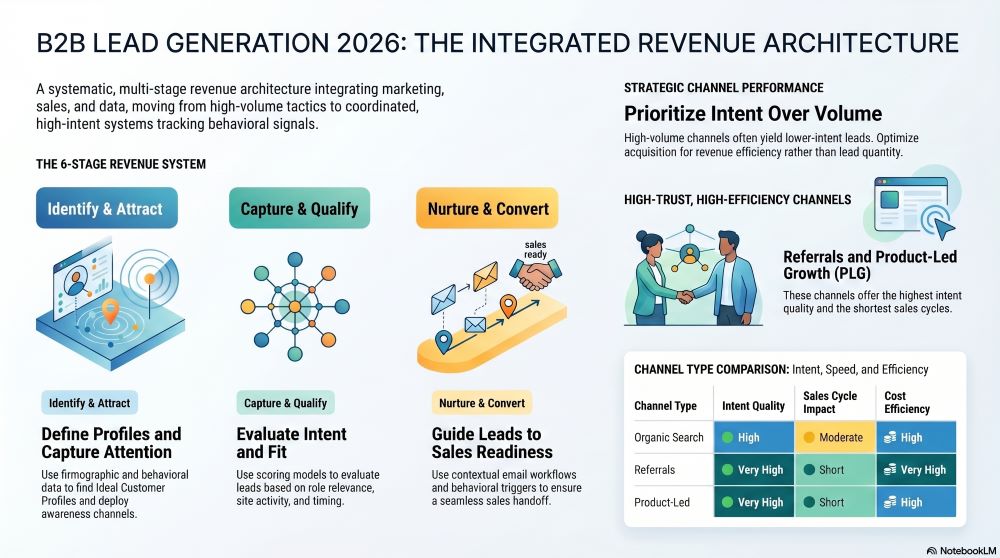
B2B lead generation functions as a multi-stage system rather than a single acquisition event.
The process unfolds across sequential but interconnected stages that collectively determine pipeline quality and velocity.
Core system stages
- Target Identification
Organizations define ideal customer profiles based on firmographic, technographic, and behavioral attributes. - Attraction and Awareness
Channels are deployed to capture attention from relevant audiences through content, outreach, or platform visibility. - Engagement and Capture
Prospects interact with assets, resulting in identifiable data capture or trackable behavior. - Qualification and Scoring
Leads are evaluated using scoring models that incorporate fit, intent, and timing. - Nurturing and Progression
Structured communication sequences move leads toward readiness. - Sales Handoff and Conversion
Qualified leads are transferred to sales teams with contextual data for efficient closing.
Each stage introduces potential friction. Performance depends on how effectively transitions are managed between stages rather than isolated optimization within a single step.
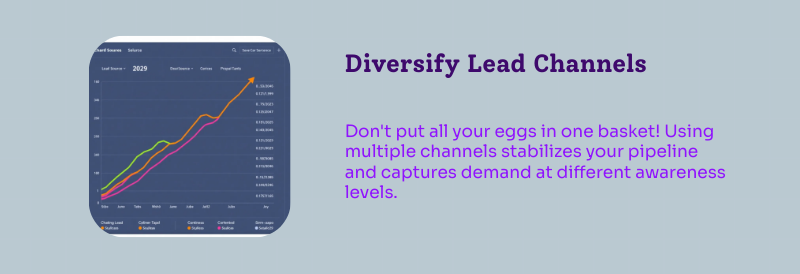
Modern B2B lead generation relies on channel diversification to stabilize pipeline performance.
No single channel reliably produces consistent, high-quality leads across all industries. Effective strategies distribute acquisition efforts across multiple sources to reduce volatility and capture demand at different stages of awareness.
Primary B2B lead generation channels in 2026
- Search-driven discovery
Organic visibility and paid placements capture high-intent prospects actively evaluating solutions. - Content ecosystems
Long-form, technical, and solution-oriented assets establish authority and generate inbound engagement. - LinkedIn and professional networks
Targeted outreach and organic positioning enable direct access to decision-makers. - Email acquisition and outbound sequences
Structured campaigns reach prospects with tailored messaging based on segmentation. - Webinars and virtual events
Real-time engagement formats provide qualification signals through participation behavior. - Referral and partnership networks
Indirect acquisition channels produce high-trust leads with shorter sales cycles. - Product-led acquisition
Free trials, freemium models, and interactive tools generate usage-based qualification signals.
Each channel operates differently in terms of cost, speed, and lead quality. Effective execution requires aligning channel selection with business model constraints and sales cycle complexity.
Channel performance varies based on intent depth, not just volume.
High-volume channels often produce lower-intent leads, while lower-volume channels tend to yield higher conversion rates. The objective is not maximizing lead quantity but optimizing for revenue efficiency.
Comparative channel evaluation
| Channel Type | Lead Volume | Intent Quality | Sales Cycle Impact | Cost Efficiency |
| Organic Search | High | High | Moderate | High |
| Paid Media | High | Variable | Short | Moderate |
| Outbound Email | Moderate | Variable | Short | High |
| LinkedIn Outreach | Moderate | High | Moderate | Moderate |
| Webinars/Events | Low | High | Long | High |
| Referrals | Low | Very High | Short | Very High |
| Product-Led | High | Very High | Short | High |
The optimal mix depends on whether the organization prioritizes speed, scale, or deal size.
Lead qualification determines whether acquisition efforts translate into revenue.
Without structured qualification, lead generation produces inflated metrics that fail to convert into pipeline. Qualification frameworks must incorporate both static attributes and dynamic behavior.
Core qualification dimensions
- Firmographic fit: Industry, company size, revenue range
- Role alignment: Decision-maker versus influencer
- Behavioral intent: Content engagement, site activity, product interaction
- Timing signals: Urgency indicators such as repeated visits or direct inquiries
- Budget indicators: Implied or explicit purchasing capacity
Modern qualification systems combine rule-based scoring with predictive modeling to prioritize leads more accurately.

Lead nurturing bridges the gap between early interest and purchase readiness.
Most B2B leads are not immediately ready to engage with sales. Nurturing systems maintain engagement while progressively increasing qualification signals.
Effective nurturing sequences include:
- Contextual email workflows aligned with user behavior
- Retargeting strategies across digital platforms
- Content progression from educational to solution-focused
- Timed outreach triggered by intent signals
- Sales-assisted engagement for high-value accounts
The objective is to reduce friction in the transition from awareness to decision-making while preserving relevance.
Sales and marketing alignment directly impacts lead conversion efficiency.
Misalignment between marketing-generated leads and sales expectations introduces pipeline inefficiencies. Clear definitions, shared metrics, and feedback loops are required to maintain consistency.
Alignment mechanisms
- Shared definitions for MQL and SQL
- Closed-loop reporting on lead outcomes
- Joint ownership of pipeline metrics
- Service-level agreements for lead follow-up
- Continuous refinement of qualification criteria
Organizations with strong alignment typically experience shorter sales cycles and higher conversion rates.
Data infrastructure is the operational backbone of B2B lead generation systems.
Lead generation performance depends on the ability to capture, unify, and act on data across multiple touchpoints. Fragmented systems reduce visibility and impair decision-making.
Core data components
- CRM systems: Centralized lead and account management
- Marketing automation platforms: Workflow execution and tracking
- Intent data sources: External behavioral signals
- Analytics platforms: Performance measurement and attribution
- Enrichment tools: Data accuracy and completeness
Data integrity directly influences targeting precision, personalization, and forecasting accuracy.
Personalization in 2026 is driven by behavioral signals rather than static segmentation.
Traditional segmentation based on industry or company size is insufficient for modern lead generation. Personalization now reflects real-time behavior, interaction history, and contextual triggers.
Examples include:
- Dynamic website experiences based on visitor intent
- Email content tailored to engagement history
- Outreach messaging aligned with specific pain points
- Account-based targeting for high-value prospects
The effectiveness of personalization depends on data quality and system integration.
Account-based strategies redefine lead generation for high-value B2B markets.
Account-based lead generation focuses on targeting entire organizations rather than individual contacts. This approach is particularly effective in complex sales environments with multiple stakeholders.
Key characteristics
- Predefined target account lists
- Multi-channel engagement across stakeholders
- Coordinated sales and marketing efforts
- Customized messaging at the account level
- Longer but more predictable sales cycles
Account-based strategies prioritize depth over breadth, resulting in higher deal sizes and stronger conversion rates.
Common failure points in B2B lead generation systems reduce pipeline effectiveness.
Several recurring issues limit performance even when channel activity appears strong.
Critical risks
- Over-reliance on a single acquisition channel
- Poor lead qualification standards
- Delayed or inconsistent sales follow-up
- Incomplete or inaccurate data
- Misaligned messaging across touchpoints
- Lack of visibility into attribution
These issues often compound, creating systemic inefficiencies rather than isolated problems.
Evaluating B2B lead generation performance requires pipeline-centric metrics.
Surface-level metrics such as traffic or form submissions do not reflect true effectiveness. Measurement must focus on outcomes that correlate with revenue.
Key performance indicators
- Lead-to-opportunity conversion rate
- Cost per qualified lead
- Pipeline value generated
- Sales cycle duration
- Customer acquisition cost
- Revenue attribution by channel
These metrics provide a clearer view of system efficiency and scalability.
B2B lead generation in 2026 is defined by integration, not individual tactics.
Successful systems operate as unified environments where channels, data, and workflows function cohesively. Fragmented approaches produce inconsistent results and limit scalability.
Organizations that treat lead generation as infrastructure rather than activity achieve more predictable growth. The emphasis shifts from campaign execution to system optimization.
FAQ’s – B2B Lead Generation
What is the primary goal of B2B lead generation?
The primary goal is to create a consistent pipeline of qualified prospects that can be converted into revenue opportunities.
How is a B2B lead different from a B2C lead?
A B2B lead represents a business entity with multiple stakeholders, longer decision cycles, and higher transaction values.
Which channel produces the highest quality B2B leads?
Referral and product-led channels typically produce the highest quality leads due to built-in trust and demonstrated value.
How long does a typical B2B lead generation cycle take?
Cycle length varies significantly but often ranges from several weeks to multiple months depending on deal complexity.
What role does automation play in lead generation?
Automation enables scalable engagement, consistent nurturing, and efficient lead management across multiple channels.
Is outbound lead generation still effective in 2026?
Outbound remains effective when highly targeted and supported by accurate data and personalized messaging.
What is the biggest mistake companies make in lead generation?
Focusing on lead volume instead of lead quality and failing to align marketing efforts with sales expectations.