


What distinguishes a high-performing B2B lead generation company?
A high-performing B2B lead generation company delivers consistently qualified opportunities by aligning targeting precision, messaging relevance, and channel execution under a unified operating model. The defining characteristic is not volume, but the accuracy of fit between prospect intent and the client’s offering.
Execution is built on clearly defined qualification standards, validated data sources, and controlled outreach cadence. Without these, even well-funded campaigns produce inflated lead counts with limited conversion value.
The strongest providers structure their services around three core layers:
- Audience definition based on firmographic and behavioral signals
- Channel orchestration across email, content syndication, and outbound touchpoints
- Qualification frameworks that filter out low-intent or misaligned contacts
Each layer must reinforce the others. Weakness in one introduces compounding inefficiencies downstream.
Why most B2B lead generation efforts underperform in practice
Most B2B lead generation efforts underperform because they prioritize activity over alignment. Campaigns are often launched with incomplete audience definitions, generic messaging, and insufficient qualification controls.
The result is predictable: inflated engagement metrics that do not translate into meaningful business outcomes.
Several recurring failure points appear across underperforming programs:
- Overreliance on purchased or outdated contact data
- Messaging that focuses on product features rather than business outcomes
- Excessive automation without contextual personalization
- Misaligned incentives that reward lead volume instead of quality
- Lack of feedback loops between marketing and sales
When these issues persist, teams compensate by increasing spend or expanding targeting criteria, which further degrades performance.

How B2B email lead generation actually works at scale
B2B email lead generation operates effectively when it combines structured targeting with controlled personalization and disciplined deliverability practices. It is not bulk email distribution; it is segmented, iterative outreach designed to initiate relevant business conversations.
The process typically follows a sequence:
- Audience segmentation based on industry, role, and buying context
- Message development focused on a specific operational problem
- Cadenced outreach across multiple touchpoints
- Response handling and qualification
- Iterative optimization based on reply patterns
Deliverability as a core constraint
Email deliverability determines whether outreach reaches decision-makers or is filtered out before being seen. Domain reputation, sending infrastructure, and engagement signals must be actively managed.
Failure to control deliverability introduces silent performance loss, where campaigns appear active but generate minimal real engagement.
Personalization versus scalability
Effective personalization is selective, not exhaustive. The objective is to demonstrate contextual awareness without introducing operational bottlenecks.
High-performing campaigns identify a small number of variables that materially impact response rates, such as:
- Industry-specific pain points
- Role-based responsibilities
- Trigger events or timing indicators
This approach balances relevance with scalability.
When B2B content syndication becomes a reliable acquisition channel
B2B content syndication becomes reliable when it is structured around intent capture rather than passive distribution. The goal is to place high-value content in environments where prospects are actively evaluating solutions.
Unlike outbound outreach, content syndication relies on opt-in engagement. However, not all engagement signals indicate readiness for follow-up.
To function effectively, syndication programs must control:
- Publisher quality and audience alignment
- Content format and depth
- Lead capture criteria
- Post-engagement validation
Content depth directly impacts lead quality
Surface-level content attracts broad interest but produces low-intent leads. In contrast, technical or decision-stage content filters for more qualified prospects.
Examples of higher-performing formats include:
- Detailed guides addressing specific operational challenges
- Comparative analyses of solution approaches
- Implementation frameworks with clear business implications
Validation layers reduce false positives
Leads generated through syndication require additional validation to confirm relevance. Without this step, organizations accumulate contacts who engaged with content but have no active need.
Validation methods may include:
- Follow-up qualification questions
- Behavioral scoring based on engagement depth
- Cross-referencing firmographic criteria
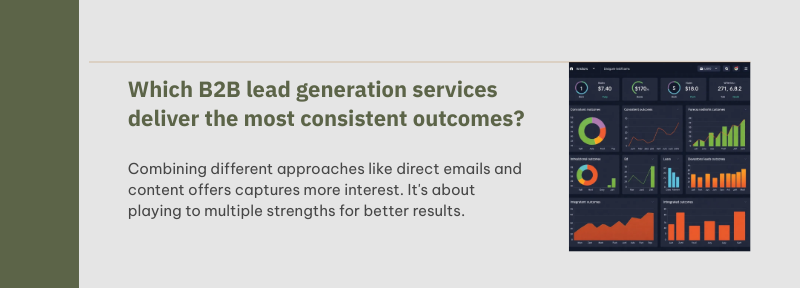
Which B2B lead generation services deliver the most consistent outcomes?
The most consistent outcomes come from services that integrate multiple channels under a unified strategy rather than relying on a single tactic. Email outreach and content syndication perform best when coordinated, not isolated.
Different service models produce different strengths:
| Service Type | Strength | Limitation |
| Email Lead Generation | Direct engagement with decision-makers | Sensitive to deliverability constraints |
| Content Syndication | Captures inbound interest signals | Requires validation for quality control |
| Hybrid Lead Generation | Combines outreach and intent capture | Operational complexity |
| Appointment Setting | Pre-qualified conversations | Dependent on targeting accuracy |
Hybrid approaches consistently outperform single-channel strategies because they capture both outbound engagement and inbound interest signals.
What evaluation criteria actually matter when selecting a provider
Selecting a B2B lead generation company requires focusing on operational transparency and alignment with business objectives. Superficial metrics such as total leads generated provide limited insight into actual performance.
Critical evaluation criteria include:
- Data sourcing methods and refresh frequency
- Qualification standards and acceptance criteria
- Messaging development process
- Reporting structure tied to meaningful outcomes
- Ability to adapt based on feedback
Qualification standards define success
A lead is only valuable if it meets predefined criteria that align with the sales process. Ambiguity in qualification leads to inconsistent results and internal friction.
Clear standards typically include:
- Role relevance
- Company size or revenue thresholds
- Demonstrated interest or engagement
- Timing indicators
Without these controls, performance measurement becomes unreliable.
How messaging strategy determines response quality
Messaging strategy directly influences not just response rates, but the quality of those responses. High-performing messaging frames outreach around business impact rather than product features.
The distinction is critical:
- Feature-focused messaging attracts curiosity
- Outcome-focused messaging attracts relevance
Effective messaging frameworks typically incorporate:
- A clearly defined operational challenge
- A concise explanation of impact
- A specific, low-friction next step
Avoiding over-generalization
Generic messaging reduces credibility and response quality. Prospects expect communication that reflects an understanding of their environment.
Precision in language signals expertise. Even small adjustments in phrasing can significantly influence engagement.
Where most companies misjudge B2B lead generation performance
Performance is often misjudged because organizations rely on early-stage metrics rather than downstream outcomes. Metrics such as open rates or content downloads provide limited insight into actual business impact.
More reliable indicators include:
- Conversion from lead to qualified opportunity
- Engagement depth during initial interactions
- Sales team acceptance rates
- Time required to move from initial contact to meaningful discussion
These metrics reflect the alignment between lead generation efforts and business objectives.
What role data quality plays in long-term results
Data quality is a foundational constraint that determines the effectiveness of every other component. Poor data introduces inefficiencies that cannot be corrected through messaging or channel optimization.
Key dimensions of data quality include:
- Accuracy of contact information
- Relevance of targeting criteria
- Timeliness of updates
- Compliance with outreach regulations
Organizations that invest in data quality reduce wasted effort and improve consistency across campaigns.
How to structure a scalable B2B lead generation program
A scalable program is built on repeatable processes, measurable inputs, and controlled experimentation. It does not rely on isolated campaigns or one-time initiatives.
Core components of a scalable structure include:
- Defined audience segments with clear prioritization
- Standardized messaging frameworks
- Channel-specific execution strategies
- Feedback loops for continuous refinement
Balancing consistency with adaptability
Consistency enables measurement, while adaptability enables improvement. High-performing programs maintain stable structures while iterating on specific variables.
This approach allows organizations to identify what drives results without introducing unnecessary complexity.

When to combine email outreach and content syndication
Combining email outreach and content syndication is effective when both channels are aligned around the same audience and messaging strategy. This creates reinforcement rather than fragmentation.
Email outreach initiates direct engagement, while content syndication captures self-directed interest. Together, they provide a more complete view of prospect behavior.
Coordination requires:
- Shared targeting criteria
- Consistent messaging themes
- Integrated reporting across channels
Without alignment, combining channels introduces noise rather than clarity.
What operational risks are commonly overlooked
Several operational risks can undermine otherwise well-structured lead generation efforts. These risks often remain hidden until performance declines.
Common risks include:
- Over-saturation of target audiences through excessive outreach
- Declining data quality over time
- Inconsistent qualification standards across teams
- Misalignment between marketing and sales expectations
- Compliance exposure related to outreach practices
Risk impact overview
| Risk Type | Impact Level | Consequence |
| Data Degradation | High | Reduced targeting accuracy |
| Deliverability Issues | High | Loss of outreach visibility |
| Misaligned Qualification | Medium | Lower conversion rates |
| Audience Saturation | Medium | Declining engagement over time |
| Compliance Failures | High | Legal and reputational exposure |
Proactive management of these risks is essential for sustained performance.
How B2B lead generation evolves as companies grow
As companies grow, lead generation shifts from opportunistic tactics to structured systems with defined inputs and outputs. Early-stage efforts often rely on experimentation, while mature programs emphasize predictability and efficiency.
Growth introduces additional complexity:
- Expanded audience segments
- Increased competition for attention
- Greater need for differentiation
Organizations that adapt their lead generation approach accordingly maintain performance consistency as scale increases.
People Also Ask – B2B Lead Gen Companies
What is a B2B lead generation company?
A B2B lead generation company is a service provider that identifies and engages potential business customers, delivering qualified contacts or opportunities aligned with specific targeting criteria.
How does B2B email lead generation work?
B2B email lead generation uses targeted outreach campaigns to initiate conversations with decision-makers, combining segmentation, messaging, and follow-up sequences to generate responses.
What is B2B content syndication?
B2B content syndication distributes gated or high-value content across third-party platforms to capture contact information from interested prospects.
Are B2B leads better from email or content syndication?
Email outreach produces direct engagement, while content syndication captures inbound interest. The effectiveness depends on targeting, messaging, and validation processes.
How do you qualify B2B leads?
B2B leads are qualified based on role relevance, company characteristics, demonstrated interest, and alignment with defined criteria for engagement readiness.
What should you look for in a lead generation service?
You should evaluate data quality, qualification standards, messaging strategy, reporting transparency, and alignment with business objectives.
How long does B2B lead generation take to show results?
Initial engagement can occur quickly, but consistent, qualified results require ongoing optimization and structured execution over time.