

Marketing budgets are designed to produce measurable growth, yet inaccurate data quietly redirects enormous portions of those budgets toward ineffective campaigns. When targeting models, attribution systems, and customer records are built on flawed information, even sophisticated marketing strategies begin optimizing for the wrong signals. The result is a cycle of spending that appears productive on dashboards but fails to produce meaningful business outcomes.
Poor data quality affects nearly every layer of modern marketing operations. Targeting becomes inaccurate, campaign performance metrics become misleading, and automation systems begin reinforcing flawed assumptions. Organizations frequently continue scaling campaigns that appear successful in reports while actual revenue impact remains stagnant.
The financial consequences are not marginal. In many organizations, inaccurate or incomplete data contaminates large portions of the marketing ecosystem, resulting in millions of dollars in wasted advertising investment each year. Understanding how this happens requires examining the structural role that data plays in modern marketing infrastructure.
What Qualifies as Bad Data in Marketing Systems
Bad marketing data refers to information that is inaccurate, incomplete, duplicated, outdated, or inconsistent across platforms. These defects undermine the reliability of analytics systems and distort the insights marketers rely on when allocating budgets and optimizing campaigns.
Marketing data originates from dozens of operational systems, including CRM platforms, analytics tools, ad platforms, marketing automation software, and third-party data providers. Each system collects and processes information differently. When inconsistencies emerge between them, the resulting dataset no longer reflects reality.
Several common data defects repeatedly appear across marketing environments:
- Duplicate customer records that inflate audience sizes
- Outdated contact information that misrepresents customer profiles
- Incomplete demographic or behavioral attributes
- Inconsistent data formatting across platforms
- Incorrect event tracking or conversion tagging
- Fragmented identity records across devices
- Misclassified leads or accounts
Each of these issues distorts how marketing performance is measured. Over time, these distortions compound across campaign planning, targeting strategies, and reporting systems.
Why Modern Marketing Infrastructure Depends on Accurate Data
Modern marketing systems are deeply dependent on continuous streams of behavioral and customer data. Targeting algorithms, attribution models, personalization engines, and campaign automation workflows all rely on this information to guide decision-making.
When the underlying data is inaccurate, the technology stack amplifies the error instead of correcting it.
Three structural realities make marketing particularly vulnerable to poor data quality:
| Marketing System | Role in Campaign Performance | Risk When Data Is Inaccurate |
| Audience targeting platforms | Identify and segment potential buyers | Ads reach irrelevant audiences |
| Attribution models | Measure which channels generate conversions | Budgets shift toward ineffective channels |
| Marketing automation systems | Trigger messaging based on behavior | Prospects receive incorrect messaging |
Because these systems operate continuously, bad data propagates quickly. A single inaccurate dataset can influence thousands of automated decisions across campaigns.
The Financial Impact of Poor Data Quality on Marketing Budgets
Poor data quality quietly drains marketing budgets by driving spending decisions based on distorted performance signals. Organizations often increase investment in campaigns that appear effective in analytics dashboards but are actually targeting the wrong audiences or measuring the wrong outcomes.
Several financial impacts typically emerge when marketing systems rely on inaccurate data:
- Advertising campaigns reach audiences with little purchase intent
- Marketing automation sends messages to outdated or incorrect contacts
- Retargeting campaigns repeatedly target the wrong user segments
- Budget allocation models prioritize channels producing misleading metrics
- Sales teams receive low-quality leads generated by flawed targeting
- Campaign optimization algorithms reinforce incorrect signals
These inefficiencies accumulate quickly. In large organizations operating across multiple advertising platforms, even small data inaccuracies can result in millions of dollars being misallocated annually.
The damage becomes particularly severe when marketing leaders rely heavily on automated optimization systems. When flawed data feeds those systems, the algorithms simply scale the error.
How Inaccurate Audience Data Drives Advertising Waste
Audience targeting is one of the most data-dependent functions in digital marketing. Campaigns rely on demographic profiles, behavioral signals, and purchase intent indicators to determine who should see specific ads.
When these attributes are inaccurate, campaigns begin targeting individuals who are unlikely to convert.
Misidentified Customer Segments
Customer segmentation often depends on CRM data and behavioral tracking systems. If customer profiles contain outdated information or incomplete attributes, segmentation models become unreliable.
Common segmentation distortions include:
- High-value customers incorrectly categorized as low-value segments
- Prospects mistakenly identified as existing customers
- Duplicate profiles fragmenting behavioral history
- Incorrect geographic or demographic attributes
Each segmentation error leads to wasted impressions and inefficient campaign reach.
Incorrect Lookalike Modeling
Lookalike audiences are generated using existing customer data. If the source dataset contains inaccuracies, the resulting audience model replicates those errors at scale.
Instead of targeting potential buyers who resemble real customers, campaigns begin targeting audiences who resemble flawed records.
Inconsistent Identity Resolution
Modern consumers interact across multiple devices and platforms. Marketing systems attempt to unify these interactions into a single identity profile. When identity resolution fails, multiple fragmented profiles are created for the same individual.
This fragmentation leads to:
- Duplicate ad exposure
- Incorrect attribution signals
- Inflated audience sizes
Advertising spend increases without improving campaign outcomes.
Attribution Errors That Mislead Budget Decisions
Marketing attribution determines how credit is assigned to different channels within a customer’s buying journey. When attribution data is inaccurate, marketing teams unknowingly invest in channels that appear successful but contribute little to actual revenue.
Attribution errors typically arise from flawed tracking implementations or incomplete customer journey data.
| Attribution Issue | Consequence | Budget Impact |
| Missing conversion tracking | Conversions not recorded accurately | High-performing channels appear ineffective |
| Duplicate event tracking | Inflated conversion counts | Poor channels appear profitable |
| Cross-device attribution failures | Incomplete customer journeys | Channels receive incorrect credit |
| Misconfigured attribution models | Incorrect weighting of touchpoints | Budget shifts toward misleading signals |
Because attribution directly informs budget allocation, even small errors can produce large financial consequences.
When marketing teams rely on incorrect attribution data, the organization gradually shifts investment toward the wrong channels. Over time, this compounds into substantial budget inefficiency.
When Marketing Automation Amplifies Bad Data
Marketing automation systems are designed to scale personalized communication across large audiences. These systems rely heavily on behavioral triggers, segmentation rules, and lifecycle stages stored in customer databases.
When these underlying data elements are inaccurate, automation workflows begin executing incorrect actions.
Several common automation failures illustrate the problem:
- Prospects receive irrelevant product messaging
- Existing customers are targeted with acquisition campaigns
- Leads are incorrectly routed to sales teams
- Customer lifecycle stages are misidentified
These errors waste marketing resources and degrade customer experience simultaneously.
Automation increases the speed and scale of marketing execution. When data quality declines, the automation engine multiplies the impact of every error.
Data Fragmentation Across Platforms Creates Blind Spots
Marketing data rarely exists within a single system. Campaign insights are typically spread across analytics tools, CRM platforms, advertising platforms, and marketing automation software.
When these systems fail to synchronize properly, the marketing organization begins operating with partial visibility into performance.
Disconnected Customer Journeys
When marketing platforms fail to share data consistently, customer journeys appear fragmented. Individual systems capture isolated interactions but cannot reconstruct the full sequence of events that leads to a conversion.
This fragmentation prevents marketing teams from understanding which channels truly influence purchasing decisions.
Conflicting Performance Metrics
Different systems often report conflicting performance metrics due to inconsistent data definitions or measurement methodologies.
Examples include:
- Conversion counts differing across platforms
- Revenue attribution varying by reporting tool
- Audience sizes appearing inconsistent across channels
Without unified data governance, marketing teams struggle to determine which metrics represent reality.
Warning Signs That Marketing Data Is Compromised
Data quality problems rarely appear suddenly. Instead, they develop gradually as small inconsistencies accumulate across systems.
Several operational indicators suggest that marketing data may be compromised:
- Campaign performance fluctuates unpredictably without clear explanation
- Conversion rates differ significantly across reporting platforms
- Audience sizes appear unusually large or inconsistent
- Marketing and sales teams report conflicting lead quality assessments
- Attribution reports frequently contradict observed revenue results
When these symptoms appear simultaneously, they typically indicate deeper structural issues within the marketing data ecosystem.
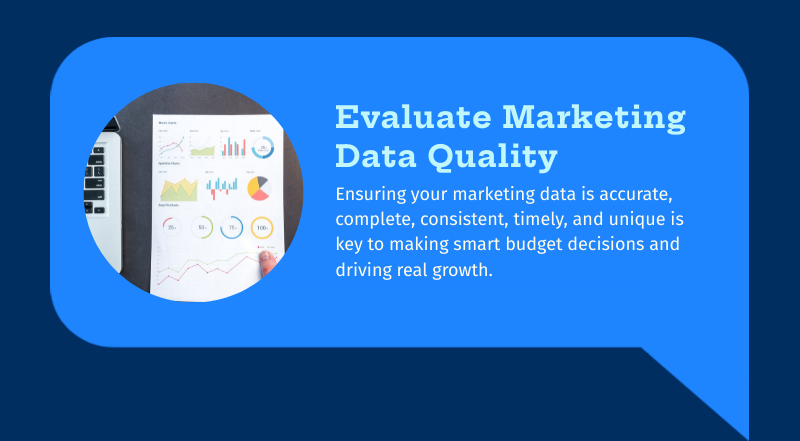
Practical Framework for Evaluating Marketing Data Quality
Organizations can assess marketing data quality by evaluating several operational criteria. These criteria determine whether the data can reliably support marketing decision-making.
Core Data Quality Dimensions
High-quality marketing data typically satisfies five core attributes:
- Accuracy – Information correctly reflects real customer behavior
- Completeness – Required fields and attributes are consistently populated
- Consistency – Data remains standardized across platforms
- Timeliness – Records are updated frequently enough to remain relevant
- Uniqueness – Each customer or account is represented by a single record
When any of these attributes degrade, marketing performance insights begin to deteriorate.
Operational Evaluation Matrix
| Data Quality Dimension | Marketing Impact | Risk if Unmanaged |
| Accuracy | Reliable targeting and segmentation | Mistargeted campaigns |
| Completeness | Detailed customer profiles | Poor personalization |
| Consistency | Unified reporting | Conflicting analytics |
| Timeliness | Current behavioral insights | Outdated audience targeting |
| Uniqueness | Clean identity resolution | Duplicate ad exposure |
Maintaining these attributes requires consistent data governance across all marketing systems.
Governance Practices That Prevent Marketing Data Decay
Data quality does not deteriorate solely due to technology limitations. Most failures originate from weak governance processes surrounding data collection, validation, and integration.
Effective marketing organizations typically implement several governance practices.
Key practices include:
- Standardized data collection formats across systems
- Regular data validation and cleansing processes
- Centralized customer identity resolution frameworks
- Cross-platform data synchronization protocols
- Clearly defined ownership of marketing data assets
- Routine audits of tracking and attribution systems
These practices prevent data inconsistencies from accumulating over time.
Data governance must be treated as an operational discipline rather than a one-time cleanup initiative.
Risk Matrix: Operational Consequences of Marketing Data Failure
When marketing data deteriorates, the risks extend beyond wasted advertising spend. The consequences affect multiple departments and strategic initiatives.
| Risk Category | Operational Impact | Strategic Consequence |
| Budget misallocation | Inefficient marketing spend | Lower return on marketing investment |
| Poor targeting | Irrelevant messaging | Reduced conversion rates |
| Attribution distortion | Incorrect channel evaluation | Misguided budget strategy |
| Sales misalignment | Low-quality lead flow | Reduced revenue productivity |
| Customer experience damage | Irrelevant communications | Brand trust erosion |
Because marketing data influences revenue strategy, its reliability becomes a strategic concern rather than a purely technical one.
Bad Data & Marketing – People Also Ask
What is bad marketing data?
Bad marketing data is information that is inaccurate, outdated, duplicated, incomplete, or inconsistent across systems, causing marketing insights and campaign decisions to become unreliable.
How does bad data waste marketing budgets?
Bad data leads to inaccurate targeting, flawed attribution models, and misleading performance reports, causing organizations to invest heavily in campaigns that do not generate real revenue.
How much marketing budget is typically wasted due to poor data?
Many organizations estimate that a significant portion of their marketing budget is lost to poor data quality through mistargeted campaigns, ineffective automation, and inaccurate performance measurement.
Why does inaccurate CRM data affect marketing performance?
CRM systems store the customer information used for segmentation, targeting, and personalization. When CRM records are inaccurate or incomplete, marketing campaigns reach the wrong audiences.
Can marketing automation worsen data quality problems?
Marketing automation can amplify data problems because automation workflows execute at scale. If inaccurate data triggers campaigns, those errors are repeated across large audiences.
What causes bad data in marketing systems?
Bad data typically originates from inconsistent data entry, poor system integrations, incomplete tracking implementation, outdated customer records, and duplicate identity records.
How can companies detect marketing data problems early?
Organizations can detect issues by monitoring inconsistent reporting metrics, unusual campaign performance patterns, duplicate customer records, and discrepancies between marketing and sales data.