

What Does “Bad Data” Actually Mean in a Business Context?
Bad data refers to information that is inaccurate, incomplete, outdated, duplicated, or inconsistent across systems. When these defects appear inside operational databases, analytics platforms, or customer systems, they contaminate the insights organizations rely on for decisions.
Data errors rarely appear as isolated incidents. They propagate across systems through integrations, dashboards, automated reports, and predictive models. Over time, small inaccuracies multiply into systemic distortion.
Several dimensions typically define poor data quality:
- Accuracy — values do not reflect real-world conditions
- Completeness — critical attributes are missing or partially filled
- Consistency — the same entity appears differently across systems
- Timeliness — information becomes outdated before it is used
- Validity — values violate expected formats or rules
- Uniqueness — duplicate records distort analysis and operations
When organizations rely on flawed inputs, every downstream system inherits the error. Dashboards display misleading performance metrics, operational processes malfunction, and strategic planning begins to drift away from reality.
The consequence is not simply technical inconvenience. It is operational misalignment across the entire organization.
How Expensive Is Poor Data Quality for Modern Organizations?
Poor data quality imposes measurable financial losses across nearly every industry. Organizations lose millions of dollars annually through operational inefficiencies, incorrect decisions, and missed opportunities.
The financial impact appears in several forms simultaneously:
| Cost Category | How Bad Data Creates Loss |
| Operational inefficiency | Employees spend large portions of time correcting, reconciling, or validating data instead of performing productive work |
| Lost revenue | Incorrect forecasting or customer information leads to missed sales opportunities |
| Misallocated investment | Capital is directed toward initiatives based on faulty insights |
| Compliance exposure | Regulatory reporting becomes unreliable |
| Rework and remediation | Teams must rebuild analyses and correct system outputs |
Employees in many organizations spend a significant share of their time resolving data issues rather than performing value-generating work.
The financial consequences compound because bad data typically spreads across multiple departments simultaneously. A flawed dataset may affect marketing attribution, supply chain forecasting, financial reporting, and customer service all at once.
When these effects accumulate over months or years, the total cost becomes difficult to isolate—but impossible to ignore.
Why Decision-Making Breaks Down When Data Quality Declines
Data-driven organizations assume that analytics represent reality. When the underlying information is flawed, leaders unknowingly make decisions based on distorted signals.
Forecasting becomes unreliable. Operational dashboards appear precise but misrepresent actual performance. Strategic planning drifts away from market conditions.
Several decision failures commonly emerge when data quality deteriorates:
- Forecast models produce inaccurate projections
- Pricing strategies are based on incorrect demand signals
- Product investments rely on misleading performance metrics
- Customer segmentation becomes unreliable
- Risk assessments underestimate exposure
The most dangerous aspect of bad data is that it often looks credible. Dashboards, reports, and models still produce outputs, but those outputs reflect corrupted inputs.
As a result, decision-makers may move forward with confidence while unknowingly steering the organization in the wrong direction.
Over time, the cumulative effect is strategic drift.
Revenue Loss Is Often the First Visible Symptom of Bad Data
Revenue degradation is one of the clearest outcomes of poor data quality. When organizations misunderstand their customers, markets, or operations, revenue leakage becomes inevitable.
Revenue loss often originates from three areas.
Incorrect Customer Information
Sales and B2B marketing teams rely heavily on customer data to identify opportunities, personalize messaging, and manage relationships. Inaccurate or incomplete records disrupt that process.
Typical outcomes include:
- Marketing campaigns targeting the wrong audience
- Missed cross-selling opportunities
- Incorrect lead prioritization
- Duplicate outreach that frustrates customers
Poor customer data directly reduces conversion rates and sales efficiency.
Distorted Demand Signals
Product and supply chain planning rely on accurate historical data and forecasting inputs. If demand signals are distorted, organizations either overproduce or fail to meet demand.
Both scenarios create financial damage.
- Excess inventory increases carrying costs
- Underproduction leads to lost sales
- Pricing strategies become misaligned with market demand
Revenue erosion often occurs gradually, making the underlying data issue difficult to diagnose.
Misleading Performance Analytics
Revenue strategies depend on accurate analytics. If performance dashboards are built on flawed data, leaders may optimize the wrong initiatives.
Marketing teams might increase investment in campaigns that appear successful but are actually misattributed. Product teams might prioritize features based on distorted usage metrics.
Over time, capital flows toward initiatives that do not truly drive growth.
Operational Inefficiency Becomes a Hidden Tax on the Entire Organization
Bad data quietly drains productivity across every department.
Employees spend significant time verifying reports, reconciling datasets, correcting records, and troubleshooting inconsistencies. These tasks rarely appear in project plans, but they consume enormous organizational energy.
The operational consequences include:
- Manual reconciliation between systems
- Repeated validation of analytics outputs
- Duplicate work across departments
- Delayed reporting cycles
- Slower decision-making processes
- Increased reliance on spreadsheets and workarounds
Operational friction emerges because teams stop trusting automated systems. Instead of relying on dashboards or analytics platforms, employees begin performing manual verification.
Once this behavior becomes common, productivity declines sharply.
Customer Trust Erodes When Data Is Wrong
Customers experience the consequences of poor data quality directly.
Incorrect billing, inaccurate account information, misdirected communications, and inconsistent service interactions all originate from flawed data systems. These failures undermine trust in the brand.
Customer trust deteriorates through several mechanisms:
- Incorrect invoices or transaction records
- Repeated requests for information already provided
- Personalized offers based on inaccurate history
- Service agents unable to access correct account details
- Miscommunication caused by outdated contact information
Each individual incident may appear minor, but repeated errors create a perception of incompetence.
Once trust erodes, customers become less willing to share information, engage with marketing, or maintain long-term relationships. The reputational damage often exceeds the operational cost of fixing the data.
Poor Data Quality Disrupts Analytics and Artificial Intelligence
Analytics platforms and machine learning models depend heavily on high-quality data. When inputs are flawed, outputs become unreliable regardless of how sophisticated the algorithms may be.
Poor data quality disrupts analytics in several ways:
- Training datasets contain incorrect or biased information
- Data pipelines introduce inconsistencies between systems
- Automated models learn patterns that do not reflect reality
- Predictions become unstable over time
Organizations often invest heavily in analytics technology while underestimating the importance of the underlying data infrastructure.
Without reliable data inputs, even the most advanced AI initiatives fail to deliver meaningful results.
In many cases, organizations discover data quality problems only after analytics initiatives produce inconsistent or unexpected outcomes.
Data Quality Problems Usually Originate in Predictable Places
Most data problems originate from a small number of systemic issues rather than random mistakes.
Understanding these root causes is essential for prevention.
Fragmented Data Systems
Organizations frequently store information across multiple disconnected platforms. Customer data may exist simultaneously in CRM systems, marketing tools, finance systems, and spreadsheets.
When synchronization fails, inconsistencies emerge.
Manual Data Entry
Manual processes introduce typographical errors, inconsistent formatting, and incomplete records. Even small error rates become significant when datasets grow large.
Weak Governance Policies
Many organizations lack clear ownership of critical datasets. Without defined governance, data standards are inconsistently applied.
Poor Integration Design
Data pipelines that connect different systems may transform or truncate fields incorrectly. Integration failures often introduce hidden inconsistencies.
Rapid Organizational Growth
Mergers, acquisitions, and new technology implementations frequently introduce incompatible datasets that require extensive reconciliation.
When these conditions exist simultaneously, data quality deteriorates quickly.
A Practical Framework for Understanding the Full Cost of Bad Data
Organizations often underestimate the total cost of bad data because its effects appear in multiple areas simultaneously.
A structured evaluation framework helps reveal the full impact.
| Impact Category | Typical Consequences |
| Strategic decisions | Misguided investments, incorrect forecasts |
| Revenue generation | Missed opportunities and reduced conversions |
| Operational efficiency | Time spent correcting data and reconciling systems |
| Customer experience | Errors that reduce trust and satisfaction |
| Compliance | Inaccurate regulatory reporting |
| Innovation initiatives | Delays in analytics and AI adoption |
When these categories are evaluated collectively, the cost of poor data quality becomes far more visible.
In many organizations, the largest impact is not a single catastrophic failure but rather the continuous accumulation of small inefficiencies.
How Organizations Typically Detect Data Quality Problems
Bad data rarely announces itself clearly. Instead, it appears through subtle symptoms that gradually become more severe.
Common warning signs include:
- Different reports showing conflicting numbers
- Sudden changes in analytics metrics without clear explanation
- Frequent manual corrections to operational systems
- Increasing time required to prepare reports
- Customer complaints about incorrect information
- Analytics models producing inconsistent predictions
When these signals appear repeatedly, the underlying issue is often systemic data quality failure rather than isolated technical errors.
Organizations that ignore these symptoms risk allowing the problem to spread across more systems and processes.
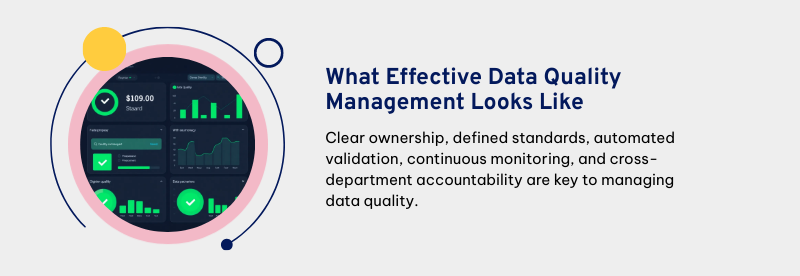
What Effective Data Quality Management Looks Like
Organizations that successfully control data quality treat data as a managed asset rather than a byproduct of operations.
Several principles guide effective data quality management.
Clear Data Ownership
Every critical dataset should have a designated owner responsible for accuracy, governance, and maintenance.
Defined Quality Standards
Organizations must define acceptable thresholds for completeness, accuracy, and timeliness.
Automated Validation
Data pipelines should include validation rules that detect errors before they propagate.
Continuous Monitoring
Data quality must be monitored continuously rather than audited occasionally.
Cross-Department Accountability
Because data flows across departments, governance must extend beyond IT teams.
When these principles are implemented consistently, organizations significantly reduce the operational risk associated with poor data quality.
Why Data Quality Is Ultimately a Leadership Issue
Many organizations treat data quality as a technical problem. In reality, it is primarily an organizational leadership issue.
Technology teams can build validation systems and data pipelines, but they cannot enforce governance across the entire organization without executive support.
Effective data quality initiatives require:
- Executive sponsorship
- Cross-department collaboration
- Defined accountability structures
- Investment in governance infrastructure
When leadership recognizes data as a strategic asset, quality improves rapidly. When it remains an afterthought, problems persist regardless of technology investment.
FAQ: Common Questions About Bad Data and Business Impact
What is considered bad data in a business environment?
Bad data includes inaccurate, incomplete, duplicated, outdated, or inconsistent information that does not accurately represent real-world conditions. These issues distort analytics and operational systems.
How does poor data quality affect business decisions?
Poor data quality leads to inaccurate forecasts, misleading performance metrics, and incorrect strategic planning. Decision-makers unknowingly rely on distorted insights.
Why does bad customer data hurt revenue?
Inaccurate customer records disrupt marketing targeting, sales outreach, and personalization efforts. Opportunities are missed and conversion rates decline.
What departments are most affected by bad data?
Marketing, sales, finance, operations, analytics, and customer service all rely heavily on accurate data. Data quality failures typically affect multiple departments simultaneously.
How can companies measure the cost of bad data?
Organizations typically measure the cost through lost revenue, productivity losses, operational rework, compliance risk, and delayed analytics initiatives.
What is the most common cause of poor data quality?
Fragmented systems, manual data entry, weak governance policies, and poorly designed integrations are among the most common causes.
Can technology alone solve data quality problems?
Technology helps detect and correct issues, but governance, accountability, and leadership alignment are necessary to maintain long-term data quality.
How often should organizations monitor data quality?
Critical datasets should be monitored continuously through automated validation and reporting processes.
A Future Defined by Data Integrity
Organizations increasingly rely on data to guide nearly every operational and strategic decision. As digital systems expand and analytics become more central to competitive advantage, the cost of poor data quality will only increase.
Companies that treat data as infrastructure—governed, monitored, and maintained with the same rigor as financial systems—will make faster and more reliable decisions. Those that ignore data integrity will continue to operate with hidden inefficiencies, strategic blind spots, and declining trust in the numbers that are supposed to guide them.