
Email continues to dominate as a cornerstone of B2B marketing. In fact, according to Campaign Monitor, 64% of B2B marketers say email is their most effective channel for generating revenue, and HubSpot reports that email marketing drives an average ROI of $36 for every $1 spent. Numbers like these explain why every company wants to grow its email database.
But this leads to a big decision: Do you buy business email lists, or do you build your own verified business email database?
On the surface, purchasing a ready-made list of B2B contacts seems like the fastest way to scale your outreach. Vendors promise you thousands of targeted email addresses of CEOs, CFOs, CTOs, and other decision-makers. But anyone with real-world experience knows that what you gain in speed, you often lose in accuracy, compliance, and long-term ROI.
On the other hand, building your own database through organic lead generation, using strategies like content marketing, webinars, or LinkedIn campaigns takes time. But it gives you verified business email addresses from people who have shown genuine interest in your brand, meaning engagement and trust levels are far higher.
What Are Business Email Lists?
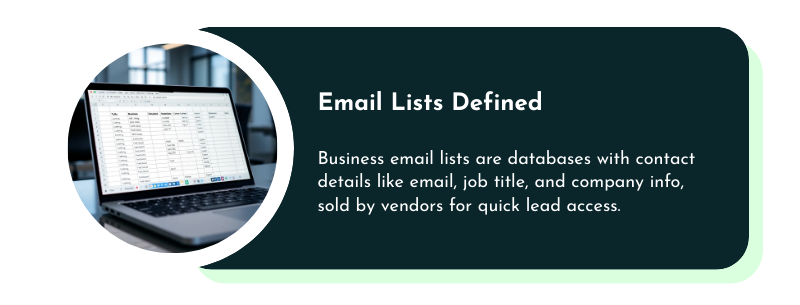
A business email list is essentially a database of professional contact details, most commonly email addresses, but often bundled with additional information such as job title, company size, revenue, industry vertical, phone numbers, and even LinkedIn profiles. These lists are typically compiled and sold by third-party data vendors who promise businesses quick access to potential leads without the time and effort required to generate them organically.
Vendors often market these as “verified business email databases” or “ready-to-use business email lists”, emphasizing convenience and scale. The number of contacts can range widely, from a few thousand highly targeted decision-makers in a single industry to millions of generic B2B contacts spread across multiple sectors and regions.
Why Businesses Buy B2B Contacts
For many companies, the appeal of buying a business email list lies in speed. Instead of slowly collecting leads through website forms, content downloads, webinars, or trade shows, a purchased list gives them immediate access to a pool of names and emails. A startup trying to break into a competitive market may see this as a way to jumpstart outreach campaigns and get sales conversations going quickly.
This approach can also look appealing to businesses that:
- Lack marketing resources to run inbound campaigns.
- Need to target new geographies or industries quickly.
- Rely heavily on outbound sales strategies where cold outreach is the norm.
- Want to populate their CRM with thousands of contacts for their SDRs to call or email.

How Vendors Collect Business Email Lists
Data brokers often source their lists from:
- Publicly available business directories.
- Web scraping tools that collect professional emails.
- Partnerships with event organizers and industry associations.
- Lead generation companies that harvest contacts through questionable tactics.
While some vendors do make efforts to validate their lists (using email verification tools to remove inactive accounts), the reality is that even “verified” lists often contain outdated, duplicated, or irrelevant contacts. According to research from Validity, 22% of business email data goes bad every year as people change jobs, companies shut down, or emails become inactive.
The “Verified” Promise
When a provider claims to sell a verified business email database, it usually means the addresses have been checked for technical validity (i.e., the email exists and can receive mail). However, this doesn’t mean that:
- The person still works at that company.
- The contact has consented to receive marketing emails.
- The list complies with regulations like GDPR or CAN-SPAM.
This distinction is critical because it explains why many businesses struggle to see ROI from purchased lists despite the vendor’s promises.
The Problem Behind the Promise
Even when vendors advertise verified business email databases, the truth is that data quality degrades quickly. According to MarketingSherpa, data decays at a rate of 2% per month, meaning up to 30% of purchased contacts could be outdated within a year.

Pros of Buying Business Email Lists
Buying business email lists does have its advantages, at least in the short term.
- Speed and Scale
Buying gives you immediate access to thousands of B2B contacts. For startups with limited time or businesses entering new markets, this can feel like a fast track to building a pipeline. - Targeting Options
Reputable vendors often allow filtering by industry, company size, geography, and job title. If you want to buy B2B contacts for a specific niche, you can quickly focus on a small but relevant audience. - Jumpstart for Outbound Campaigns
Purchased lists can be used to seed cold email campaigns, LinkedIn outreach, or telemarketing. For example, a cybersecurity consulting firm might buy a list of CISOs at Fortune 500 companies to begin targeted outreach.
Cons of Buying Business Email Lists
Unfortunately, the downsides are significant and often outweigh the short-term gains.
- Low Quality and Inaccuracy
Even “verified business email databases” often contain outdated information. People change jobs, switch industries, or abandon email accounts. High bounce rates damage your sender score and hurt deliverability across all campaigns. - Legal and Compliance Risks
Under GDPR, CAN-SPAM, and CCPA, marketing to people without consent can expose you to fines and lawsuits. In 2019, British Airways was fined £183 million under GDPR for customer data misuse, proving compliance isn’t optional. - Damaged Reputation
When recipients mark your cold emails as spam, it hurts your domain reputation. Once blacklisted, even your legitimate, opt-in email campaigns can struggle to reach inboxes. - Poor Engagement
Cold contacts don’t know your brand. This translates to low open rates (often below 10%) and even lower click-through rates. In contrast, opt-in lists regularly see 20–30% open rates.
What Does It Mean to Build Your Own Business Email Database?
Building your own business email database means creating a collection of verified business email addresses directly from prospects who have willingly given you their contact information. Instead of buying B2B contacts from a third-party vendor, you grow your database organically through permission-based marketing strategies. This ensures that the people in your database are already interested in your product or service, making them higher-quality leads than those on generic purchased lists.
The focus here is on attracting, engaging, and converting potential customers through value-driven tactics. For example, instead of cold emailing strangers who have never heard of your brand, you publish a helpful whitepaper, webinar, or case study that resonates with your target audience. When a professional downloads that content in exchange for their email address, you’re not just adding another line in your CRM, you’re building a relationship from the very first interaction.

Common Tactics to Build a Verified Business Email Database
- Content Marketing
One of the most popular ways to build an email database is through gated content. Whitepapers, case studies, eBooks, and industry reports are excellent tools for attracting B2B buyers who are actively researching solutions. By offering this material in exchange for an email, you ensure your contacts are self-qualified leads, they’ve shown interest in your expertise. - Events & Webinars
Hosting virtual webinars, workshops, or in-person conferences is another effective method. Attendees provide their business emails during registration, meaning you get high-intent leads who are engaged with the topic you’re presenting. This works especially well in industries with long sales cycles, like SaaS, consulting, or manufacturing. - LinkedIn Ads and Lead Forms
LinkedIn is a powerful channel for B2B lead generation because of its precise targeting capabilities. With LinkedIn lead gen forms, prospects can share their verified business email address without leaving the platform. This not only improves conversion rates but also helps ensure data accuracy. - Website Pop-Ups & CTAs
Strategically placed pop-ups, banners, and CTAs (calls to action) on your website encourage visitors to subscribe to newsletters, product updates, or exclusive offers. For example, offering a “Free Industry Benchmark Report” in exchange for a business email can turn casual visitors into potential leads. - Customer Referrals
Referrals remain one of the most trusted sources of B2B leads. When a customer shares your service with a peer or colleague, that prospect is more likely to engage because the introduction comes from a trusted source. By incentivizing referrals, you can build a verified, high-quality business email database of contacts already predisposed to trust your brand.
The Key Difference: Consent
The most critical distinction between buying B2B contacts and building your own database comes down to consent. When you purchase a business email list, the contacts have not agreed to hear from you. This often leads to low engagement, higher unsubscribe rates, spam complaints, and potential compliance issues under regulations like GDPR, CAN-SPAM, or CCPA.
By contrast, when you build your own verified business email database, every contact has opted in through a form, event registration, or campaign. This means your database is:
- Compliant with email marketing laws.
- Trustworthy, since people expect communication from you.
- More valuable long-term, because engaged leads are far more likely to convert into paying customers.
Over time, this permission-based approach not only safeguards your reputation but also lowers your cost per lead (CPL) and increases your return on investment (ROI).
Pros of Building Your Own Database
- High Lead Quality
Since prospects chose to engage with your brand, they’re more likely to open, click, and convert. According to DMA, opt-in lists generate engagement rates 5x higher than purchased lists. - Regulatory Compliance
Opt-in subscribers align with GDPR and CAN-SPAM rules, minimizing legal risk. - Improved Deliverability
Verified emails, low bounce rates, and consistent engagement all improve your sender reputation, ensuring your campaigns land in inboxes instead of spam folders. - Long-Term ROI
While building takes time, organic lists compound in value. A single blog post or webinar can continue generating leads for years.
Cons of Building Your Own Database
- Time-Consuming
You can’t build thousands of contacts overnight. Expect 6–12 months of sustained effort before seeing significant results. - Resource-Intensive
Building requires investments in content creation, marketing automation, and lead nurturing. - Scaling Challenges
Rapid scaling can be difficult without paid ads or aggressive content distribution. Some industries with small target markets may find it especially slow.
Business Email Lists vs. Building Your Own Database: A Side-by-Side Comparison
| Factor | Business Email Lists | Building Your Own Database |
| Speed | Immediate access | Slow but steady growth |
| Lead Quality | Low, often outdated | High-quality, verified |
| Compliance | Risky, often non-compliant | Fully compliant (opt-in) |
| Cost | Low upfront, high long-term risk | Higher upfront, better ROI |
| Engagement | Low open/click rates | High engagement |
| Sustainability | Short-term fix | Long-term asset |
When to Use Business Email Lists
While business email lists are not the ideal long-term strategy, there are specific scenarios where buying B2B contacts can serve a short-term purpose.
- Startups Needing Quick Market Entry
For startups with limited brand awareness, a purchased business email list can help create immediate visibility in a new market. Instead of waiting months for inbound campaigns like SEO or content marketing to generate traction, startups can use an email list to quickly introduce themselves to potential customers. This approach may not generate conversions immediately, but it can help establish a footprint and begin conversations. - Outbound Sales Teams with Multi-Touch Strategies
In organizations that rely heavily on outbound prospecting, a purchased verified business email database may provide the raw contacts needed to fuel cold outreach campaigns. Sales development representatives (SDRs) often use a combination of email, phone calls, and LinkedIn outreach to reach decision-makers. In these cases, the business email list serves as a starting point for pipeline development. - Market Research and Competitive Intelligence
Sometimes, companies buy business email lists not for marketing campaigns, but for research and analysis. For example, a company may purchase a segment of contacts to better understand industry demographics, company size distribution, or decision-maker roles within a sector. Using lists for intelligence gathering can help shape future go-to-market strategies without violating compliance rules around direct marketing.
In each of these situations, buying B2B contacts can be useful, but it’s important to remember that the value is usually short-term, and risks like data inaccuracy, compliance concerns, and low engagement rates remain.

When to Build Your Own Database
For most businesses, the smarter, more sustainable approach is to build your own verified business email database. This strategy aligns with trust-building, compliance, and long-term growth, which are essential in B2B sales where relationships and credibility matter.
- Companies Selling Complex or High-Value Solutions
Businesses in industries such as SaaS, enterprise software, financial services, and consulting often deal with long sales cycles that require educating the buyer. In these cases, an organic, permission-based business email database ensures that prospects are already engaged with your brand and more receptive to ongoing communication. - Professional Services Where Credibility is Critical
Firms in consulting, law, finance, or healthcare rely on thought leadership and reputation to attract clients. Building a database through content like case studies, webinars, or newsletters helps establish authority while ensuring that the leads are genuinely interested. Purchased contacts rarely deliver this level of trust. - Manufacturers and Suppliers Focused on Long-Term Relationships
In industries where repeat business and multi-year contracts are common, building your own business email list ensures stronger customer relationships. Contacts collected through trade shows, inbound content, and referral programs tend to be more qualified, easier to nurture, and more likely to convert into loyal customers.
By focusing on organic, opt-in lead generation, businesses gain not only higher-quality leads but also the ability to scale efficiently. A self-built, verified business email database becomes an owned asset that compounds in value over time, unlike a purchased list, which typically degrades quickly and offers diminishing returns.
Challenges of Each Approach
Challenges with Business Email Lists
- Data degrades quickly (30% annually).
Contacts often change jobs or companies, making large portions of a purchased list outdated within a year. - Spam complaints and blacklisting risks.
Since recipients didn’t opt in, cold outreach can trigger spam flags that hurt deliverability. - Difficult to measure ROI because of low conversions.
Engagement is usually weak, so it’s hard to justify the cost of buying the list.
Challenges with Building Your Own Database
- Long ramp-up period before ROI appears.
Organic list growth takes time, so results aren’t immediate. - High investment in marketing automation, CRMs, and content.
Building a strong database requires tools and consistent effort, which can be costly upfront. - Standing out in crowded inboxes requires strong messaging.
Even with opt-in contacts, your emails still compete with many others for attention.
Best Practices for Success
If Buying Business Email Lists:
- Vet vendors carefully and request recent samples.
- Use purchased lists for research, not direct marketing.
- Always clean and verify contacts before outreach.
If Building Your Own Database:
- Create high-value lead magnets.
- Optimize landing pages with clear CTAs.
- Segment and personalize communication.
- Regularly update and clean your database.
Buying Business Email Lists vs. Creating Your Own Database
When comparing business email lists vs. building your own database, the decision boils down to short-term speed versus long-term sustainability.
Buying B2B contacts may provide an instant pool of prospects, but poor data quality, compliance risks, and low engagement make it a high-risk strategy. In contrast, building a verified business email database requires patience but leads to higher engagement, stronger trust, and a far better ROI over time.
For most businesses, the clear winner is building your own database, because trust and credibility can’t be bought.
FAQs: Business Email Lists vs Personal Email Databases
Q1: Are purchased business email lists legal?
They may be sold legally, but using them for marketing is often non-compliant with GDPR, CAN-SPAM, and CCPA.
Q2: What is the biggest risk of buying B2B contacts?
Poor deliverability, spam complaints, and potential regulatory fines are the main risks.
Q3: How do I verify a business email database?
Use tools like ZeroBounce, NeverBounce, or BriteVerify to validate addresses regularly.
Q4: Is building an email list worth the effort?
Yes. While slower, it results in better engagement, lower cost per lead, and compliance with data privacy laws.
Q5: Can purchased lists ever work?
They can provide short-term contacts for outbound research, but they are not sustainable for marketing campaigns.
Q6: How long does it take to build a strong business email database?
Expect 6–12 months of consistent marketing before seeing significant results.
Q7: What industries benefit most from organic lists?
SaaS, consulting, manufacturing, and professional services often see the highest ROI.
Q8: How often should I clean my email database?
At least every 3–6 months to remove invalid or unengaged contacts.
Q9: What’s the cost difference between buying and building?
Buying is cheaper upfront but riskier long term. Building has higher initial costs but delivers far better ROI.
Q10: Should I combine both approaches?
Some companies use purchased lists for research and combine them with inbound strategies, but for direct email marketing, building is always safer.