
What It Means to Build an Email List
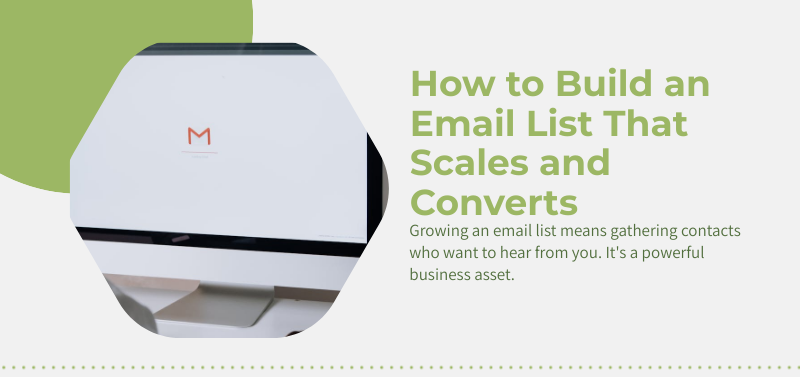
Building an email list means systematically collecting and organizing contact information from individuals who have explicitly opted in to receive communications from your organization. A list is only valuable when it comprises willing recipients whose interests align with what you deliver.
A compliant list is a business asset, not a data dump. Quality is measured by engagement, not sheer size.
Why Email List Growth Drives Business Outcomes
An email list is a direct channel to people who have chosen to hear from you, enabling controlled communication without intermediary platforms. Because it bypasses algorithmic feeds, it delivers higher reach consistency and predictable visibility.
Businesses with mature lists convert more predictably because they cultivate permission over time. Growth is an investment in future engagement.
Core Legal and Ethical Requirements for List Building
You must obtain informed consent before adding any contact to your list. Jurisdictions such as the United States and the European Union have specific opt-in and data protection requirements, including clear disclosure of how data will be used. Compliance protects your organization from regulatory risk and preserves trust.
Consent documentation and unsubscribe mechanisms are non-negotiable components of ethical list management.
Define Your Target Subscriber Profile Before You Collect
A subscriber profile specifies the types of people whose presence on your list has strategic business value. It includes demographic, professional, and behavioral attributes that align with your offer and funnel strategy.
Profiling before acquisition ensures your messaging, incentives, and segment logic are aligned with real conversion drivers.

Offer Types That Motivate Email Sign-Ups
To attract subscribers you must provide something perceived as valuable in exchange for their email address. Options include:
- Downloadable guides with specific tactical value
- Toolkits or templates that accelerate a task
- Exclusive insights or reports unavailable elsewhere
- Early access to content, products, or events
- Discounts, trials, or bonus features
Each offer type must map directly to a measurable outcome in your funnel, such as lead qualification or revenue acceleration.
Placement and Visibility of Sign-Up Mechanisms
Acquisition points must be visible where your prospective audience already engages. Common placement includes:
- Website headers with persistent call-to-action
- Contextual forms within high-traffic content
- Footer sign-up invites on every page
- Exit-intent overlays tied to behavior triggers
- Social media bios and link utilities
Placement strategies must balance visibility with user experience so engagement doesn’t feel intrusive.
Form Design Principles That Maximize Conversion
Form design impacts conversion directly. Keep forms:
- Clear in purpose
- Minimal in required fields
- Contextually aligned with the offer
- Mobile friendly
- Fast to submit
Each additional field increases friction. Only request the information you plan to use for segmentation or personalization.
Use of Incentives Without Diluting List Quality
Incentives accelerate sign-ups but can attract low-quality subscribers if misaligned with your core value proposition. For example, a steep discount may bring bargain-hunters with low long-term engagement.
Choose incentives that attract prospects naturally aligned with your ongoing communications.

Landing Page Strategies for Email Acquisition
A landing page for list acquisition should:
- Articulate a clear value exchange
- Reinforce the relevance of the list content
- Include a concise form above the fold
- Use proof elements (testimonials, examples, count of skeptics)
- Eliminate navigation that distracts from conversion
Landing pages should be optimized not for aesthetics but for clarity of purpose and friction reduction.
Leveraging Content to Drive Sign-Ups
Content marketing fuels list growth when it solves problems at the right moment. High-conversion content:
- Answers specific, recurring questions
- Reflects the language of the intended audience
- Includes contextual sign-up cues
- Leads into deeper resources behind the sign-up form
Content must be structured to funnel interest into list acquisition without undermining perceived value.
Applying Behavioral Triggers for Sign-Up Timing
Behavioral triggers use interaction data to time prompts when intent is high. Examples include:
- Time-on-page thresholds
- Scroll depth triggers
- Exit intent analytics
- Click patterns on key elements
Triggers must be calibrated so they respect user experience while maximizing signal timing.
Integrating Social Channels Into List Growth
Social channels extend your reach when they point back to acquisition assets. Effective techniques include:
- Pinning lead magnets with sign-up CTA
- Promoting gated content in posts
- Using Stories or short-form media to preview list benefits
- Adding sign-up links in profile sections
Social integration multiplies touchpoints without fragmenting your message.
Partnerships and Co-Marketing for Subscriber Expansion
Collaborations with non-competing organizations that share your audience can multiply acquisition reach. Partner contributions can include:
- Joint webinars
- Shared content exchanges
- Co-branded giveaways
Partnerships must be structured so both parties’ value propositions are clear to participants.
How to Evaluate When to Outsource List Functions
Outsourcing email list growth can relieve pressure on internal teams, but the decision must be grounded in operational clarity rather than convenience. The first consideration is whether a true expertise gap exists or whether the same capability could be developed internally with reasonable investment. External partners can accelerate execution, but only when they bring capabilities that meaningfully exceed in-house proficiency.
Cost must be evaluated against projected return, not simply against current budget capacity. Acquisition cost per subscriber, long-term engagement quality, and downstream revenue impact should justify any external spend. Lower upfront cost does not equate to higher efficiency if subscriber quality declines.
Control over messaging, data ownership, and segmentation logic is equally critical. If outsourcing limits visibility into subscriber behavior or reduces direct control over communication standards, long-term list health may suffer. External execution should extend strategy, not replace internal accountability. No outsourcing model eliminates the need for internal understanding of deliverability, engagement metrics, and consent management.
Paid Acquisition Tactics for Email List Growth
Paid channels can accelerate acquisition when organic reach plateaus. Options include:
- Search ads targeted to high-intent queries
- Social ads promoting a lead magnet
- Sponsored placements on niche newsletters or media
Paid acquisition should be measured in acquisition cost relative to downstream customer value.
Measuring Acquisition Performance
To evaluate an acquisition channel, track:
- Conversion rate from exposure to sign-up
- Cost per acquired email
- Quality of subscribers as measured by engagement
A low cost per sign-up that yields disengaged contacts is a false economy.
Segmenting Your List From Day One
List segmentation enables targeted communication. Basic segmentation criteria include:
- Source of acquisition
- Interest category indicated at sign-up
- Behavioral engagement (opens, clicks)
- Demographic or firmographic indicators
Segmentation strategies must be actionable — based on data points you will actually use in messaging.
Onboarding New Subscribers Effectively
The first message sets expectation and tone. An onboarding sequence should:
- Confirm the value offered at sign-up
- Deliver the promised incentive immediately
- Establish cadence and content expectations
- Provide ways to refine preferences
A strong onboarding sequence materially increases long-term engagement.
Maintaining List Hygiene Over Time
List health degrades if unengaged contacts remain. Practices for hygiene include:
- Periodic engagement auditing
- Re-engagement campaigns for dormant segments
- Removal of permanently inactive addresses
- Preference centers to re-classify interests
Active management preserves deliverability and strengthens signal quality.

Email Content Strategies That Sustain Engagement
Consistent engagement depends on content that:
- Reflects subscriber interests
- Provides actionable insight
- Varies format to maintain interest
- Respects frequency expectations set at sign-up
Content strategy and list building are inseparable; poor content undermines growth.
Advanced Tactics for Mature Lists
Mature email lists require structural sophistication beyond basic broadcasting. Lifecycle-based journeys segment subscribers by stage, aligning messaging with onboarding, activation, retention, or re-engagement objectives. This approach replaces uniform campaigns with contextual communication.
Predictive engagement scoring introduces prioritization. By analyzing behavioral signals such as open consistency, click frequency, and recency, organizations can allocate messaging intensity and promotional weight more strategically. High-propensity subscribers receive different treatment than dormant contacts.
Integration with cross-channel data further elevates list value. Connecting email marketing behavior to CRM systems, website interactions, and paid media responses creates a unified engagement model. When properly structured, a mature list evolves from a contact database into a coordinated communication engine that informs broader strategic decisions.
Balancing Frequency and Relevance
Too frequent sends can drive opt-outs; too infrequent sends weaken list memory. Balance is found by:
- Observing engagement patterns
- Aligning send schedules with content availability
- Allowing subscribers to set preferences
Frequency decisions must be evidence-driven, not guesswork.
Deliverability Fundamentals Every List Builder Must Know
Deliverability determines whether your messages land in the inbox. Key fundamentals include:
- Authentication (SPF, DKIM)
- Reputation management
- Content that avoids spam signals
- Consistent sending patterns
Technical setup directly affects performance, separate from content quality.
Tools and Platforms That Enable List Building
The right tools enable scalable acquisition and management. Core capabilities include:
- Form builders
- Automation workflows
- Segmentation logic
- Reporting dashboards
- Compliance and preference centers
Tool choice must reflect both current needs and anticipated scale.
Risks and Common Pitfalls in List Building
Building a list without strategy can lead to risks such as:
- Purchasing lists that violate consent and harm reputation
- Overreliance on discount-driven incentives
- Ignoring segmentation until after scaling
- Neglecting regulatory compliance
Each pitfall impacts both engagement and long-term operational resilience.
Continuous Improvement Through Testing
You must continually test forms, offers, triggers, and messaging. Tests should be:
- Hypothesis-driven
- Controlled and measurable
- Focused on meaningful metrics (engagement, conversion yields)
Iterative refinement ensures the list evolves with audience expectations.
Tools for Monitoring Compliance and Consent
Compliance is dynamic. Tools and processes for monitoring include:
- Consent logs with timestamps
- Preference centers linked to send logic
- Automated unsubscribe handling
Compliance infrastructure scales with your list.

What to Expect in the First 90 Days After Launch
The first 90 days of a new email list are defined by calibration rather than optimization. Early performance indicators include acquisition velocity, engagement patterns across initial campaigns, and the rate at which meaningful segments begin to form. These signals provide direction but rarely represent stable performance.
Acquisition may spike if a strong incentive is introduced, then normalize as exposure stabilizes. Engagement rates often fluctuate while messaging, cadence, and segmentation logic are refined. Segment growth will be uneven until behavioral data accumulates.
Volatility during this period is normal and should not trigger reactive overcorrections. Instead, establish a consistent measurement cadence and evaluate trends over time rather than isolated campaign outcomes. Early-stage lists benefit from disciplined iteration, not aggressive restructuring.
People Also Ask – How to Build an Email List
What is the most effective way to start building an email list?
Start with a compelling offer that solves a specific problem for your target profile and place the sign-up mechanism where your audience is already engaged.
How many subscribers should I aim for?
Quantity is less important than quality; aim for a group whose engagement and downstream behavior align with your business outcomes.
Can I buy an email list to speed growth?
No. Purchased lists typically lack consent, harm reputation, and violate regulations.
What should I include in a welcome email?
Deliver the promised value, confirm expectations, and explain how subscribers can manage preferences.
How often should I email my list?
Match frequency to content availability and subscriber expectations, using engagement data to guide adjustments.
How do I keep my list clean?
Regularly remove or re-engage inactive contacts and use preference centers to refine segmentation.
What tools do I need to build an email list?
You need form builders, automation workflows, segmentation logic, analytics dashboards, and compliance mechanisms.
Is social media effective for email sign-ups?
Yes, when social content drives towards a clear acquisition asset with aligned value.
Future engagement channels will blend permissioned email with emerging direct pathways.