
What constitutes bad data in SaaS lead generation systems
Bad data in B2B SaaS lead generation refers to incomplete, outdated, duplicated, or inaccurately attributed information that undermines targeting, routing, and conversion workflows. It typically originates from fragmented collection points, inconsistent enrichment processes, or uncontrolled integrations across marketing and sales platforms.
The issue is not limited to obvious errors such as invalid email addresses. More damaging forms include incorrect firmographic data, misaligned intent signals, stale engagement history, and inconsistent lifecycle status labeling. These distort how leads are evaluated and prioritized.
A single flawed field can cascade across systems. When lead scoring, segmentation, and routing rely on unreliable inputs, the entire acquisition engine begins to operate on false assumptions.
Why data integrity directly determines lead quality and pipeline velocity
Data integrity defines how accurately a lead reflects a real, reachable, and relevant buying entity. When integrity is compromised, lead quality becomes unpredictable, and pipeline movement slows.
High-quality data ensures that:
- Leads are assigned to the correct segments
- Outreach aligns with actual buyer roles and industries
- Scoring models reflect real engagement and intent
- Sales teams prioritize accounts with genuine potential
When these conditions are met, pipeline velocity increases because fewer resources are wasted on unqualified or unreachable prospects.
Poor data introduces friction at every stage. Sales teams spend more time validating information, correcting records, and chasing unresponsive contacts. This delays deal progression and reduces overall throughput.
Where bad data enters the SaaS acquisition funnel
Bad data rarely originates from a single source. It accumulates across multiple entry points, often unnoticed until performance declines.
Common entry vectors include:
- Form submissions with minimal validation: Users submit incomplete or inaccurate information
- Third-party list purchases: External datasets often contain outdated or misclassified records
- Manual data entry: Human error introduces inconsistencies and formatting issues
- CRM integrations: Sync mismatches create duplicates or overwrite accurate data
- Enrichment tools: Automated enrichment can append incorrect or conflicting attributes
- Legacy records: Older leads degrade over time without active maintenance
Each source contributes incrementally, but together they create systemic degradation. Without governance, the data layer becomes unreliable within months.
How inaccurate data inflates customer acquisition cost
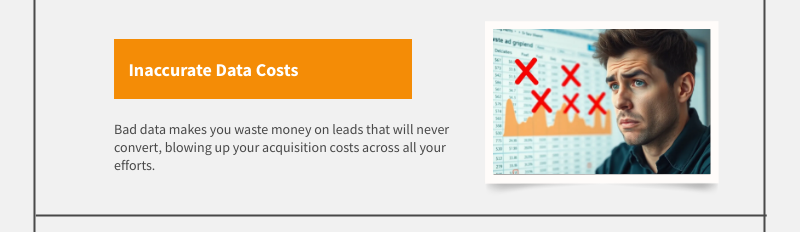
Bad data increases acquisition costs by forcing organizations to spend resources on leads that will never convert. This inefficiency compounds across paid media, outbound efforts, and sales labor.
The financial impact manifests in several ways:
| Cost Driver | Impact of Bad Data |
| Paid campaigns | Budget spent targeting irrelevant or duplicate audiences |
| SDR outreach | Time wasted on invalid contacts or incorrect personas |
| Sales cycles | Extended timelines due to poor lead qualification |
| Tool usage | Increased reliance on enrichment and validation tools |
| Attribution errors | Misallocation of budget to underperforming channels |
The result is a distorted cost-per-acquisition metric. Organizations may believe campaigns are underperforming when the root issue is data quality, not strategy.
Why conversion rates decline when lead data is unreliable
Conversion rates drop when messaging, timing, and targeting fail to align with the actual buyer. Bad data disrupts all three.
If a lead is misclassified by role or industry, messaging becomes irrelevant. If engagement data is inaccurate, outreach timing misses critical windows. If contact information is wrong, communication fails entirely.
Even small inaccuracies create compounding effects:
- Personalized campaigns lose effectiveness
- Nurture sequences trigger at incorrect stages
- Sales conversations begin with incorrect assumptions
These issues erode trust quickly. Prospects disengage when interactions feel misaligned or uninformed.
How bad data disrupts lead scoring and qualification models
Lead scoring systems depend on consistent and accurate inputs. When those inputs are compromised, scoring becomes unreliable and misleading.
Inconsistent firmographic data
Firmographic fields such as company size, industry, and revenue are foundational to scoring models. When these fields are incorrect or missing, high-value leads may be undervalued, while low-value leads receive inflated scores.
Misinterpreted behavioral signals
Behavioral data must reflect genuine engagement. Inflated metrics from bot traffic, duplicate records, or misattributed activity distort scoring thresholds.
Lifecycle misalignment
Incorrect lifecycle stages cause leads to be treated as more or less mature than they actually are. This results in premature sales outreach or delayed follow-up.
When scoring loses credibility, teams begin to ignore it. This removes a critical layer of prioritization and forces manual decision-making, reducing efficiency.
What operational risks arise from duplicate and fragmented records
Duplicate records create fragmented views of the same prospect, leading to inconsistent communication and internal confusion.
Key operational risks include:
- Multiple sales reps contacting the same lead
- Conflicting outreach messages across channels
- Inaccurate reporting due to split engagement history
- Inflated lead counts that distort performance metrics
- Missed opportunities due to incomplete data aggregation
Fragmentation prevents a unified understanding of the buyer journey. Without consolidation, organizations cannot accurately assess engagement or intent.
Why attribution modeling fails without clean data
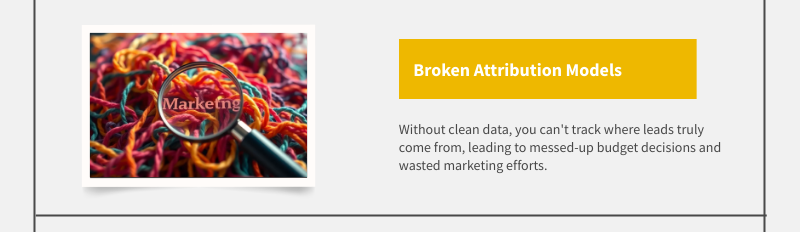
Attribution models rely on accurate tracking of touchpoints and interactions. Bad data breaks the continuity required to map these journeys.
When records are duplicated or misaligned:
- Touchpoints are assigned to the wrong lead
- Channels appear under- or over-performing
- Conversion paths become incomplete or misleading
This leads to incorrect budget allocation. Marketing teams may scale ineffective channels while underinvesting in high-performing ones.
Attribution failure is often misdiagnosed as a strategy issue. In reality, the underlying problem is data inconsistency.
How bad data weakens personalization and account-based strategies
Personalization depends on accurate context. Without it, messaging becomes generic or incorrect.
In account-based strategies, precision is critical. Target accounts must be correctly identified, mapped, and segmented. Bad data disrupts this by:
- Misidentifying decision-makers
- Assigning incorrect company attributes
- Failing to track engagement across stakeholders
The result is diluted targeting. Campaigns lose relevance, and engagement declines.
Personalization is only as strong as the data supporting it. Without reliable inputs, even advanced strategies underperform.
What signals indicate a SaaS organization has a data quality problem
Data quality issues often surface indirectly through performance anomalies. These signals are frequently misattributed to strategy or execution problems.
Common indicators include:
- Declining conversion rates despite stable traffic
- Increased sales cycle length
- High bounce rates in email campaigns
- Frequent lead reassignment or routing errors
- Discrepancies between marketing and sales reporting
- Low confidence in CRM data among teams
When multiple indicators appear simultaneously, the root cause is often systemic data degradation.
How to evaluate the severity of bad data across your funnel
Assessing data quality requires a structured evaluation of accuracy, completeness, consistency, and timeliness.
Core evaluation criteria
- Accuracy: Does the data reflect real-world entities correctly?
- Completeness: Are critical fields populated consistently?
- Consistency: Are values standardized across systems?
- Timeliness: Is the data current and regularly updated?
Practical audit approach
A comprehensive audit should include:
- Sampling lead records across lifecycle stages
- Identifying duplicate rates within the CRM
- Reviewing enrichment accuracy against verified sources
- Analyzing bounce and invalid contact rates
- Comparing reported vs. actual conversion paths
This process reveals where degradation is most severe and where corrective action should begin.
Which systems and processes most commonly amplify bad data
Technology alone does not create bad data, but poorly managed systems accelerate its spread.
The most common amplifiers include:
- Uncontrolled integrations: Data sync conflicts across platforms
- Lack of validation rules: Inconsistent field formats and missing data
- Over-reliance on enrichment tools: Blind trust in automated data append processes
- Absence of governance: No ownership or accountability for data quality
- Infrequent cleansing cycles: Data decay goes unchecked
Without structured controls, these systems multiply inaccuracies rather than correct them.
How structured data governance restores lead generation performance
Data governance establishes accountability, standards, and processes for maintaining data quality. It transforms data from a passive asset into an actively managed system.
Effective governance includes:
- Defined data ownership across teams
- Standardized field definitions and formats
- Validation rules at data entry points
- Regular deduplication and cleansing processes
- Controlled integration protocols
These measures prevent new issues while systematically resolving existing ones.
Governance impact on performance
When governance is implemented effectively:
- Lead routing becomes more accurate
- Conversion rates stabilize
- Sales productivity increases
- Attribution models regain reliability
The improvement is often immediate because underlying inefficiencies are removed.
Why prevention is more effective than continuous correction
Preventing bad data at the point of entry is significantly more efficient than correcting it later. Once inaccurate data spreads across systems, remediation becomes complex and resource-intensive.
Preventative strategies include:
- Real-time validation on forms
- Standardized data entry requirements
- Controlled enrichment workflows
- Integration safeguards to prevent overwrites
Correction still plays a role, but without prevention, it becomes a continuous and costly cycle.
What a high-functioning SaaS data layer looks like in practice
A high-functioning data layer is consistent, reliable, and aligned across systems. It enables confident decision-making and efficient execution.
Key characteristics include:
- Unified customer profiles across platforms
- Minimal duplication and fragmentation
- Accurate and current firmographic and behavioral data
- Transparent data ownership and governance
- Alignment between marketing, sales, and operations
In this state, lead generation becomes predictable. Performance improvements are driven by strategy rather than reactive fixes.
FAQ: SaaS Lead Generation and Bad Data
What is the most damaging type of bad data in SaaS lead generation?
Incorrect firmographic and contact data are the most damaging because they directly affect targeting, outreach, and qualification.
How quickly does data decay in a SaaS CRM?
Data can begin degrading within months due to job changes, company updates, and shifting engagement patterns.
Can enrichment tools fully solve bad data problems?
No. Enrichment tools can improve coverage but may introduce new inaccuracies without validation and governance.
How does bad data affect SDR productivity?
It reduces efficiency by forcing SDRs to verify information, chase invalid leads, and correct records instead of engaging prospects.
What is an acceptable duplicate rate in a CRM?
A well-maintained CRM should maintain duplicate rates below a low single-digit percentage to ensure data integrity.
How often should SaaS companies audit their data?
Quarterly audits are a minimum standard, with continuous monitoring for critical data points.
Does bad data impact inbound and outbound equally?
Yes, but in different ways. Inbound suffers from poor qualification, while outbound suffers from targeting and deliverability issues.