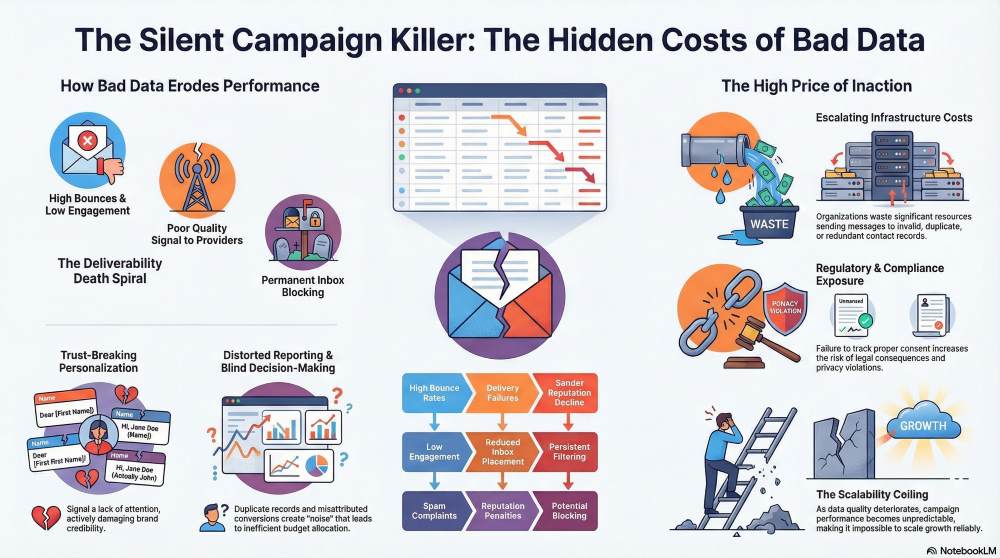




How does bad data degrade email marketing performance?
Bad data degrades email marketing performance by misaligning targeting logic, corrupting personalization, and distorting engagement signals. Email campaigns depend on precise audience definitions, and when those definitions are based on flawed inputs, execution becomes unreliable.
Segmentation is the first point of failure. When demographic, behavioral, or transactional attributes are incorrect, contacts are grouped inappropriately. Messages intended for high-intent buyers may reach inactive users, while engaged subscribers are overlooked. The result is not just lower engagement but a breakdown in campaign predictability.
Performance metrics become misleading. Open rates, click rates, and conversions no longer reflect audience intent but instead reflect data inconsistency. Decision-making deteriorates because reporting is no longer grounded in reality.
What types of bad data most commonly affect email campaigns?
The most impactful data issues fall into several distinct categories, each with operational consequences that compound over time.
Primary data quality failures include:
- Invalid or malformed email addresses
These produce hard bounces, immediately damaging sender credibility. - Duplicate contact records
Multiple entries for the same individual lead to over-sending and inconsistent messaging. - Outdated behavioral signals
Engagement data that no longer reflects current user intent causes mistimed campaigns. - Incorrect or misaligned field values
Personalization fails when names, preferences, or attributes are wrong or mismatched. - Incomplete customer profiles
Missing data forces broad targeting instead of precise segmentation. - Improper consent tracking
Contacts may be included without valid permission, increasing compliance exposure. - Disconnected data systems
Fragmentation across platforms prevents unified customer understanding.
Each of these issues disrupts a different layer of campaign execution, but all reduce message relevance and operational control.

Why does poor data quality reduce deliverability rates?
Poor data quality reduces deliverability because mailbox providers interpret negative engagement signals as evidence of low sender quality. Deliverability is governed by reputation, and reputation is built on consistent, expected behavior.
When email lists contain invalid addresses or disengaged users, campaigns generate high bounce rates and low engagement. These signals indicate that the sender is not maintaining a clean or permission-based list. As a result, filtering systems begin to restrict message visibility.
The progression is gradual but difficult to reverse:
| Data Issue | Immediate Outcome | Long-Term Impact |
| High bounce rates | Delivery failures | Sender reputation decline |
| Low engagement | Reduced inbox placement | Persistent filtering |
| Spam complaints | Reputation penalties | Potential blocking |
Once deliverability is compromised, even high-quality campaigns struggle to reach the inbox, creating a structural limitation on performance.
How does inaccurate data distort segmentation and targeting?
Inaccurate data distorts segmentation by assigning contacts to the wrong audience groups, which undermines the logic of targeted messaging. Segmentation is only as effective as the data that defines it.
When customer attributes such as purchase history, lifecycle stage, or engagement level are incorrect, segmentation models produce unreliable outputs. High-value customers may receive acquisition messaging, while inactive users are treated as engaged prospects.
This misalignment creates two immediate consequences:
- Messages fail to resonate because they do not reflect the recipient’s actual context
- Campaign performance appears inconsistent, masking the underlying data issue
Over time, segmentation loses its strategic value. Instead of refining targeting, it becomes a source of noise that reduces campaign efficiency.
What impact does bad data have on personalization accuracy?
Bad data undermines personalization by introducing errors that erode trust and reduce engagement. Personalization depends on accurate identifiers and context, and when those inputs are flawed, the experience becomes visibly incorrect.
Incorrect names, irrelevant product recommendations, or mismatched preferences signal to recipients that the sender lacks attention to detail. These errors are not neutral—they actively damage credibility.
The impact extends beyond individual campaigns:
- Recipients disengage due to perceived irrelevance
- Brand perception declines due to repeated inaccuracies
- Future personalization efforts become less effective as trust erodes
Personalization is intended to increase relevance. When powered by bad data, it produces the opposite effect.
Why does bad data inflate unsubscribe and complaint rates?
Bad data increases unsubscribe and complaint rates because it drives irrelevant and excessive communication. When targeting is inaccurate, recipients receive messages that do not align with their interests or expectations.
Frequency issues are common. Duplicate records or fragmented identities can cause the same individual to receive multiple versions of a campaign. This creates a perception of over-communication, even if total send volume appears controlled.
Irrelevance compounds the problem. Messages that fail to reflect recipient intent are more likely to be ignored, unsubscribed from, or reported as spam. Complaint rates, in particular, carry significant weight in reputation systems and can accelerate deliverability decline.
The relationship is direct: the less accurate the data, the higher the friction between sender and recipient.

How does poor data integrity affect campaign reporting and decision-making?
Poor data integrity compromises reporting by producing metrics that do not accurately reflect reality. When underlying data is flawed, performance analysis becomes unreliable.
Duplicate records inflate engagement counts. Invalid addresses skew delivery metrics. Misattributed conversions distort attribution models. Each of these issues introduces noise into reporting systems, making it difficult to isolate true performance drivers.
Decision-making suffers as a result:
- Campaign optimizations are based on incorrect signals
- Budget allocation becomes inefficient
- Strategic direction shifts based on misleading conclusions
The organization loses confidence in its own data, which slows execution and reduces the effectiveness of future campaigns.
Where do data breakdowns typically originate within email systems?
Data breakdowns typically originate at integration points, input sources, and governance gaps. Email platforms rarely generate bad data independently; they reflect upstream inconsistencies.
Common origin points include:
- CRM synchronization errors
Data fields fail to map correctly between systems. - Manual data entry mistakes
Human error introduces inconsistencies and inaccuracies. - Third-party data imports
External lists often contain outdated or low-quality information. - Tracking and tagging misconfigurations
Behavioral data is recorded incorrectly or incompletely. - Inconsistent data standards across teams
Different departments define and use data differently. - Lack of validation rules at entry points
Invalid or incomplete data is accepted without checks.
These issues accumulate over time, creating a system where data quality gradually deteriorates unless actively managed.
What are the operational risks of ignoring bad data in email marketing?
Ignoring bad data introduces operational risks that extend beyond campaign performance into compliance, cost efficiency, and brand integrity.
Key risks include:
- Regulatory exposure
Sending to contacts without proper consent can trigger legal consequences. - Escalating infrastructure costs
Sending to invalid or redundant records wastes resources. - Reputation damage
Persistent irrelevance or errors reduce brand credibility. - Reduced scalability
Campaign performance becomes unpredictable, limiting growth. - Increased remediation effort
Fixing degraded systems requires significant time and coordination. - Dependency on manual intervention
Teams compensate for bad data with workarounds, reducing efficiency.
These risks compound. What begins as a data hygiene issue evolves into a broader operational constraint.
How can organizations evaluate the severity of their data quality issues?
Organizations can evaluate data quality severity by assessing consistency, completeness, accuracy, and system alignment across their datasets. A structured evaluation reveals where breakdowns occur and how they impact execution.
Core evaluation criteria:
- Accuracy: Are data points correct and current?
- Completeness: Are required fields consistently populated?
- Consistency: Do values align across systems?
- Uniqueness: Are duplicate records present?
- Timeliness: Is data updated frequently enough to remain relevant?
- Integrity: Are relationships between data points logically maintained?
A systematic audit often reveals that issues are interconnected. Addressing one dimension without addressing others produces limited improvement.
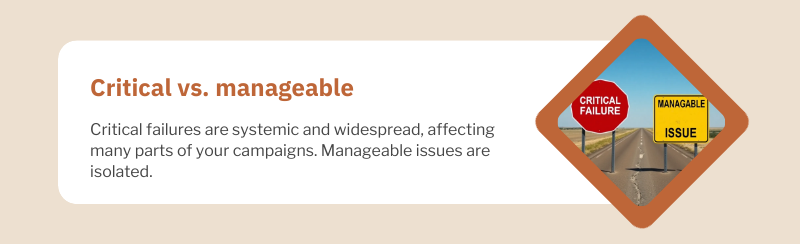
What distinguishes manageable data issues from critical failures?
Manageable data issues are isolated and reversible, while critical failures are systemic and affect multiple layers of campaign execution. The distinction lies in scope and impact.
| Issue Type | Characteristics | Operational Impact |
| Manageable | Localized errors, limited scope | Minor performance variation |
| Critical | Widespread inconsistencies | Structural performance decline |
| Systemic | Cross-platform fragmentation | Loss of data reliability |
Critical failures often involve identity fragmentation, broken integrations, or widespread inaccuracies. These issues require coordinated remediation rather than incremental fixes.
How does bad data affect lifecycle and automation strategies?
Bad data disrupts lifecycle and automation strategies by triggering incorrect workflows and misclassifying user states. Automation depends on accurate event tracking and state transitions.
When data is incorrect, users may enter or exit workflows at the wrong time. For example, a customer who has already purchased may continue receiving promotional emails, while a new lead may be excluded from onboarding sequences.
Automation amplifies data issues because errors are repeated at scale. Unlike one-off campaigns, automated flows operate continuously, propagating inaccuracies across the customer journey.
The result is not just inefficiency but a breakdown in customer experience continuity.
What are the long-term financial consequences of poor data quality?
Poor data quality reduces return on investment by increasing waste, lowering conversion rates, and requiring ongoing remediation efforts. The financial impact is often underestimated because it is distributed across multiple areas.
Costs accumulate through:
- Inefficient send volume to invalid or duplicate contacts
- Lower conversion rates due to irrelevant targeting
- Increased spend on tools and infrastructure to compensate for inefficiencies
- Time spent diagnosing and correcting data issues
- Lost revenue from disengaged or misclassified customers
The compounding effect is significant. Even small inefficiencies, when repeated across large-scale campaigns, produce measurable financial loss.
Frequently Asked Questions
Why do email lists degrade over time even without major changes?
Data naturally becomes outdated as users change behavior, switch email addresses, or disengage, leading to gradual decline in accuracy.
How do duplicate contacts affect campaign performance?
Duplicates increase send frequency to the same individual, which raises unsubscribe rates and distorts engagement metrics.
Can bad data impact brand perception directly?
Yes, visible errors in personalization or irrelevant messaging reduce trust and make communication feel careless.
Why is engagement data sometimes misleading?
Engagement metrics can be inflated or suppressed by data errors such as duplicates, tracking issues, or misattributed activity.
Is deliverability recovery possible after data-related damage?
Recovery is possible but requires sustained improvement in list quality, engagement rates, and sending practices over time.
How often should data quality be evaluated?
Data quality should be monitored continuously, with periodic audits to identify deeper structural issues.
Does automation make bad data more harmful?
Automation scales both accuracy and error, meaning bad data leads to repeated and amplified mistakes across workflows.