


Why Bad Lead Data Becomes a Structural Weakness in B2B Lead Generation Pipelines
Bad lead data creates systemic inefficiencies that compound across every stage of the B2B revenue process. When contact information, firmographic attributes, and intent signals are inaccurate or outdated, marketing campaigns distribute resources toward the wrong audiences while sales teams spend time pursuing opportunities that never had a realistic chance of conversion.
B2B lead generation pipelines rely on structured data to determine targeting, segmentation, scoring, and outreach strategy. Once poor-quality data enters the system, every downstream process inherits the same distortion. The result is not a single operational problem but a cascading chain of wasted effort, reduced pipeline accuracy, and misaligned revenue forecasting.
This structural weakness rarely presents itself as an obvious failure. Instead, it quietly erodes performance through missed connections, misqualified leads, and declining campaign efficiency. Over time, the cost becomes measurable not only in wasted marketing spend but also in lost sales productivity and damaged customer acquisition strategies.
How Inaccurate Lead Records Disrupt B2B Revenue Operations
Inaccurate lead records distort the operational mechanics of marketing automation and sales engagement systems. Because most B2B organizations rely on structured data fields to trigger workflows and segmentation rules, even small inaccuracies can cause significant downstream disruption.
A lead database typically includes fields such as job title, industry classification, company size, geographic location, and contact information. When any of these attributes are incorrect, the entire engagement model becomes misaligned.
Operational disruption commonly appears in several forms:
- Marketing campaigns targeting the wrong industries or buyer roles
- Sales development representatives contacting individuals without purchasing authority
- Automated nurture sequences triggered for irrelevant audience segments
- Lead scoring models prioritizing unqualified prospects
- Regional sales teams receiving leads outside their territory assignments
- CRM duplication that fragments engagement history across multiple records
Each of these problems forces marketing and sales teams to compensate manually, which gradually reduces the efficiency of the entire revenue operation.
Marketing Budget Waste: Where Bad Data Quietly Consumes Spend
Bad lead data converts marketing budgets into inefficient distribution systems. Campaigns still run, impressions are still delivered, and outreach sequences are still deployed, but the underlying audience quality undermines the intended results.
Marketing platforms depend on accurate data to guide targeting decisions. When segmentation fields are wrong or outdated, advertising budgets reach contacts who either cannot buy or no longer exist within the organization.
The most common areas of budget waste include:
| Marketing Channel | Impact of Bad Data | Financial Consequence |
| Paid Media Campaigns | Targeting incorrect industries or roles | Higher cost per acquisition |
| Email Campaigns | High bounce rates and disengagement | Reduced sender reputation |
| Account-Based Marketing | Incorrect account mapping | Budget directed at non-buying organizations |
| Content Syndication | Misaligned audience filters | Low-quality lead submissions |
| Event Invitations | Outdated contact information | Reduced attendance and engagement |
The financial damage becomes especially severe in campaigns that rely heavily on precision targeting. When audiences are incorrectly defined, even well-designed campaigns struggle to generate meaningful pipeline impact.

Sales Productivity Loss When Lead Data Cannot Be Trusted
Sales development teams depend on reliable lead information to prioritize outreach and allocate time efficiently. When lead records are inaccurate, representatives spend a disproportionate amount of time validating contacts rather than initiating meaningful sales conversations.
Poor lead data produces several operational inefficiencies:
- Representatives dial incorrect phone numbers or disconnected lines
- Email marketing outreach reaches inactive or abandoned inboxes
- Job titles do not reflect actual decision-making authority
- Contacts have moved to new companies or departments
- Organizations have undergone structural changes or acquisitions
These issues create a hidden productivity tax across the sales organization. Instead of advancing qualified lead opportunities, sales teams must first verify whether a prospect is even reachable.
The Hidden Time Cost of Data Verification
Manual lead verification can quietly consume hours of work each week. Sales representatives frequently check LinkedIn profiles, company directories, and external sources simply to confirm whether the information in the CRM is still accurate.
This verification step is rarely tracked as a formal metric, yet it represents a measurable reduction in pipeline velocity. When multiplied across an entire sales team, the cumulative loss of selling time can become significant.
Why Lead Scoring Models Collapse When Data Quality Degrades
Lead scoring models rely on consistent data inputs to determine which prospects deserve immediate attention. When those inputs are corrupted by inaccurate information, the scoring model begins prioritizing the wrong leads.
Lead scoring systems typically evaluate variables such as:
- Company size
- Industry classification
- Job title seniority
- Behavioral engagement
- Website activity
- Content consumption patterns
If a lead record incorrectly identifies a prospect as a senior executive within a target industry, the model may assign a high score even though the individual has no purchasing authority. Conversely, a highly qualified buyer may receive a low score because the firmographic data was incomplete.
Over time, these inaccuracies undermine confidence in the scoring system itself. Sales teams begin ignoring scores and relying on manual judgment, which defeats the purpose of automated prioritization.
Pipeline Forecasting Errors Caused by Poor Lead Data
Revenue forecasting depends on reliable pipeline metrics. When lead quality deteriorates, forecasting models begin projecting revenue from opportunities that were never viable.
Forecasting distortion typically occurs through three mechanisms:
- Inflated pipeline volume
Unqualified leads enter the pipeline and artificially increase opportunity counts. - Misclassified opportunity stages
Sales teams advance prospects through stages before confirming qualification. - False engagement signals
Automated activity tracking records engagement that does not reflect genuine buying intent.
The resulting forecasts appear healthy on the surface but fail to translate into closed revenue. Leadership teams may interpret declining win rates as a sales performance issue when the root cause is actually lead data quality.
Duplicate Records Create Fragmented Customer Intelligence
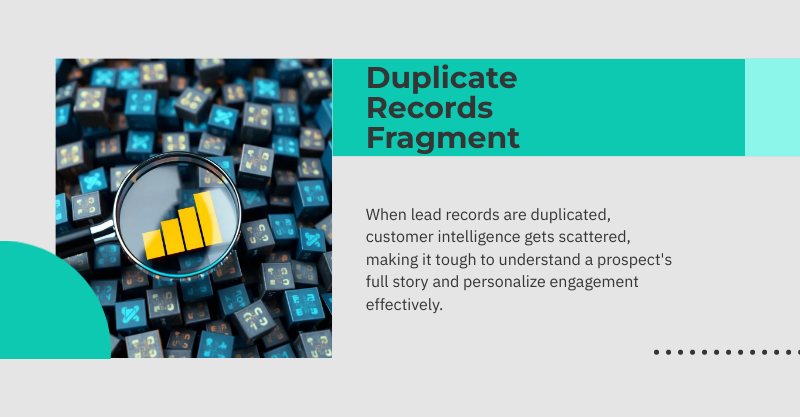
Duplicate lead records fragment the history of engagement across multiple profiles. This fragmentation prevents organizations from developing a complete understanding of prospect behavior.
Common causes of duplicate lead records include:
- Multiple form submissions with slight variations in email address
- Contacts imported from different data vendors
- Manual entry by sales representatives
- CRM integrations syncing records across systems
When duplicate records exist, engagement signals become scattered. One profile may show website activity while another records email engagement, preventing the lead scoring system from recognizing the full level of interest.
This fragmentation weakens personalization strategies and reduces the accuracy of marketing attribution.
Evaluating the Financial Risk of Poor Lead Data
The financial impact of poor lead data extends beyond individual campaigns or sales interactions. Over time, inaccurate data influences the strategic allocation of marketing resources and the operational efficiency of revenue teams.
A structured evaluation of risk often reveals multiple cost centers:
Operational Cost Factors
- Marketing spend directed toward unqualified audiences
- Sales labor spent verifying or correcting lead information
- CRM maintenance and database cleanup initiatives
- Technology costs associated with failed automation processes
Strategic Cost Factors
- Missed opportunities with legitimate buyers
- Reduced trust in marketing-generated leads
- Declining alignment between marketing and sales teams
- Slower pipeline growth due to inefficiencies
Organizations frequently underestimate these costs because they accumulate gradually rather than appearing as a single financial event.
Indicators That a Lead Database Is Experiencing Data Quality Decay
Lead databases naturally degrade over time as professionals change roles, companies restructure, and contact information becomes obsolete. Without continuous maintenance, data quality steadily declines.
Several warning indicators signal that a database may be experiencing deterioration:
- Increasing email bounce rates across marketing campaigns
- Rising percentage of disconnected phone numbers
- Declining engagement from previously active contacts
- Frequent manual corrections by sales representatives
- CRM reports showing growing numbers of duplicate records
- Sales teams questioning lead relevance or qualification
These indicators suggest that the lead generation pipeline is operating with degraded inputs, which will eventually affect revenue outcomes.
Operational Strategies for Preventing Lead Data Degradation
Preventing data decay requires a combination of technical controls, operational discipline, and periodic database hygiene initiatives. Organizations that treat lead data as a strategic asset typically implement structured data management processes.
Effective prevention strategies often include:
- Automated validation of email and phone fields during lead capture
- Standardized formatting rules for job titles and industries
- Duplicate detection systems within CRM platforms
- Regular enrichment of firmographic data through external sources
- Scheduled data audits to identify outdated records
- Integration governance across marketing and sales platforms
These processes reduce the likelihood that poor-quality data will enter or remain within the system.
Data Governance: The Often Overlooked Component of Lead Generation
Data governance establishes clear accountability for maintaining the quality of lead databases. Without governance, data ownership becomes fragmented across marketing operations, sales teams, and external vendors.
A well-structured governance framework typically defines:
| Governance Element | Purpose |
| Data Ownership | Defines who is responsible for data quality |
| Validation Standards | Establishes acceptable data formats |
| Import Controls | Prevents inconsistent data from external sources |
| Data Lifecycle Rules | Determines when records should be archived or refreshed |
| Monitoring Metrics | Tracks ongoing data quality performance |
Organizations that formalize these governance structures typically experience stronger alignment between marketing and sales operations.
How Data Quality Influences Trust Between Marketing and Sales
Trust between marketing and sales teams depends heavily on the perceived quality of generated leads. When sales representatives repeatedly encounter inaccurate or unqualified leads, confidence in the marketing pipeline deteriorates.
This erosion of trust produces several organizational consequences:
- Sales teams prioritize self-generated leads over marketing-sourced leads
- Marketing metrics lose credibility within leadership discussions
- Campaign performance becomes difficult to evaluate objectively
- Collaboration between departments becomes strained
Restoring this trust requires not only improving lead quality but also demonstrating consistent accuracy in lead data management.
Frequently Asked Questions – Bad Data in B2B Lead Generation
What qualifies as bad lead data in B2B marketing?
Bad lead data refers to contact or company information that is inaccurate, incomplete, outdated, duplicated, or misclassified. This includes incorrect job titles, invalid email addresses, outdated company affiliations, and inconsistent firmographic attributes.
Why does lead data decay over time?
Lead data naturally decays because professionals change roles, organizations restructure, and contact information becomes obsolete. Without ongoing maintenance, databases accumulate outdated records that reduce accuracy.
How does bad data affect marketing automation systems?
Marketing automation systems rely on structured data fields to trigger segmentation and workflows. When those fields contain incorrect information, campaigns target the wrong audiences and automation sequences misfire.
Can poor lead data impact sales conversion rates?
Poor lead data reduces conversion rates because sales teams spend time pursuing prospects who are unreachable, unqualified, or no longer relevant to the target market.
What is the most common cause of duplicate lead records?
Duplicate records most commonly occur when contacts enter the system through multiple channels such as form submissions, data vendor imports, and manual CRM entries.
How often should B2B companies clean their lead databases?
Many organizations perform structured database audits at least twice per year, with automated validation processes running continuously during lead capture.
What role does data enrichment play in improving lead quality?
Data enrichment supplements existing lead records with updated firmographic and contact information. This helps maintain accuracy and ensures that targeting and segmentation remain reliable.