


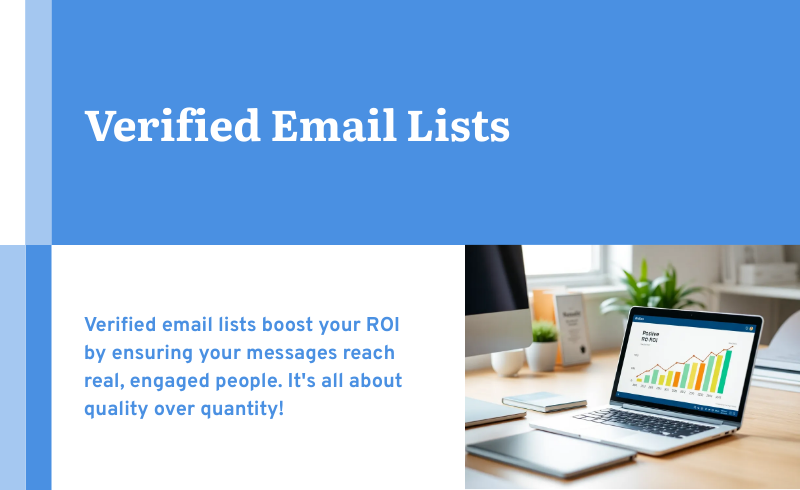
Email marketing has been around for decades, yet it remains one of the most profitable marketing channels available. And while businesses continue to pour money into paid ads, social media campaigns, and SEO initiatives, email still delivers some of the highest returns—but only when your list is clean, accurate, and verified.
If you’ve ever wondered why some businesses thrive with email while others struggle to see any meaningful results, the answer almost always comes down to the same thing:
List quality.
When you invest in verified business lists, your email marketing instantly becomes more efficient, more targeted, and more profitable. Your ROI doesn’t just improve, it compounds.
Why ROI Depends So Heavily on Email Quality
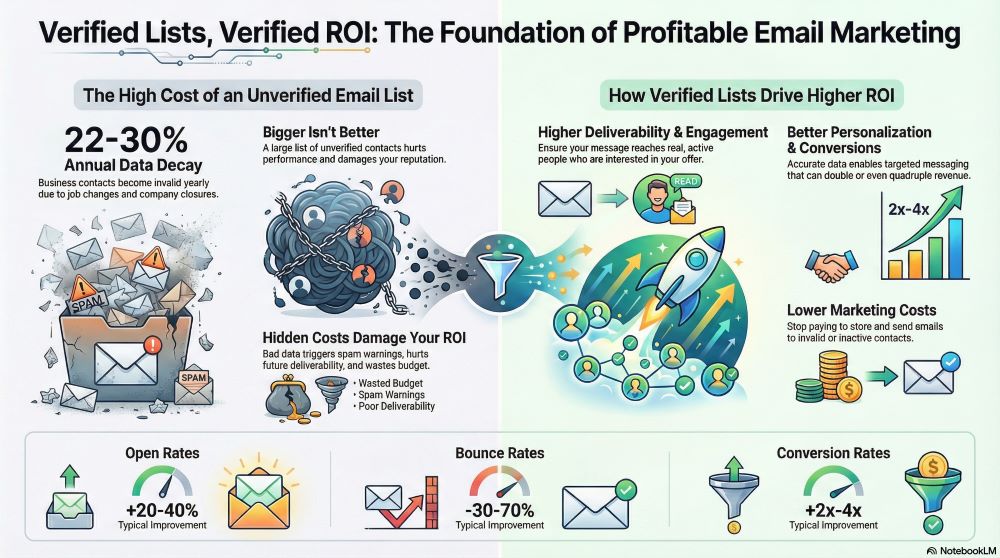
One of the biggest misconceptions in email marketing is that bigger email lists mean better results. In reality, a large list filled with invalid, outdated, or irrelevant email addresses can actually hurt your performance.
ROI depends on:
- Deliverability
- Engagement
- Targeting
- Conversion rates
- Long-term list health
- Domain reputation
If any of these elements weaken, your entire email strategy suffers. A single campaign sent to a poorly verified list can:
- Trigger spam warnings
- Damage your domain reputation
- Decrease future inbox placement
- Waste budget and resources
- Lower engagement averages
Verified business lists protect your ROI by ensuring you only communicate with real, active, relevant people. And when you eliminate “dead weight” from your list, every email you send becomes a purposeful investment and not a gamble.
What Exactly Are Verified Business Lists? (Expanded Breakdown)
A verified business list is not just a list of email addresses—it’s a refined, validated database of contacts that have undergone strict verification processes to ensure accuracy and deliverability.
A high-quality verified list typically includes:
Email Validation Layers
Modern verification tools test each email using multiple checks:
- Syntax Validation – Catches typos, missing characters, bad formatting.
- Domain Verification – Confirms the domain exists and accepts mail.
- MX Record Check – Ensures the mail server is active.
- SMTP Ping – Simulates sending an email to confirm the mailbox is real.
- Spam Trap Detection – Removes emails used by ISPs to catch senders.
- Role Account Filtering – Screens out addresses like info@, sales@, etc., which rarely convert
- Disposable Email Removal – Eliminates temporary or fake emails.
Updated Contact Details
High-quality verified lists often include:
- Name
- Company
- Job title
- Phone numbers
- Industry details
- Location
- Employee size & revenue
- Intent-based information
This accuracy makes segmentation, personalization, and lead nurturing far more effective.
Compliance-Safe Data
Reputable providers follow CAN-SPAM, GDPR, CASL, and CCPA guidelines.
This reduces legal risks and protects your brand audience.
When you invest in verified business lists, you’re investing in data you can trust—and that trust is what leads directly to higher ROI.
How Verified Business Lists Improve ROI
1. Higher Deliverability = More Eyes on Your Message
Deliverability is everything in email marketing.
If your message doesn’t reach the inbox, nothing else matters.
Unverified or low-quality lists typically result in:
- Hard bounces
- Soft bounces
- Spam flags
- Blocked domains
- Damaged sender score
Email platforms like Gmail and Outlook use these signals to decide whether your future emails go to the inbox or straight to spam.
Verified business lists improve ROI by:
- Ensuring emails land in real inboxes
- Reducing bounce rates by up to 90%
- Protecting your sender reputation
- Increasing the percentage of people actually seeing your campaigns
More visibility = better engagement = higher ROI.
It’s that simple.
2. Better Engagement from Real, Active Contacts
Even if your emails are delivered, they still need to be opened, read, and interacted with.
When you send to unverified lists, engagement inevitably drops because:
- Many emails are outdated
- Contacts have changed jobs
- Some addresses belong to inactive users
- Spam traps ruin deliverability
- Irrelevant contacts simply don’t care about your offer
Verified business lists increase engagement by ensuring your audience is:
- Active
- Relevant
- Updated
- Fit your target customer profile
This improves:
- Open rate
- Clickthrough rate
- Reply rate
- Website traffic
- Sales opportunities
Engagement is one of the biggest contributors to ROI, and verified lists make it significantly easier to achieve.
3. Lower Marketing Costs (Cleaner Lists = Cleaner Budgets)
Your email service provider (ESP) likely charges based on the number of contacts you store or the volume of emails you send.
This means:
Every invalid email directly costs you money.
By using verified business lists, you:
- Remove dead or inactive contacts
- Reduce monthly ESP fees
- Spend less on cold outreach campaigns
- Avoid paying for automated workflows that go nowhere
- Increase the ROI of every dollar spent
Marketing budgets stretch further when you stop wasting money on low-quality contacts.
4. Improved Conversion Rates (The ROI Multiplier)
Conversions are the metric most businesses care about—leads, demos, sales, sign-ups, or purchases.
Verified business lists boost conversions by improving every part of the customer journey:
- Accurate targeting leads to more relevant messaging
- More relevant messaging leads to more clicks
- More clicks mean more chances to convert
- Higher deliverability leads to more prospects seeing your offer
- Higher engagement feeds future deliverability
These improvements stack on top of each other to create a snowball effect.
Even small improvements in conversions—say from 2% to 4%—can double your revenue without increasing spending.
That’s real ROI.
5. Stronger Long-Term Revenue Growth (Compounding Returns)
Email is not a one-time transaction channel—it’s a long-term relationship builder.
Verified business lists help you grow:
- Repeat customers
- Loyal followers
- Warm leads
- Nurtured prospects
- Cross-sell and upsell opportunities
Instead of constantly chasing new leads, you’re maximizing the value of the ones you already have.
This long-term stability lifts ROI month after month because high-quality, verified lists maintain:
- Better deliverability
- Consistent engagement
- Stronger customer lifetime value
- A healthier domain reputation
Clean data compounds over time—and so do the profits.
6. Better Segmentation and Personalization
Segmentation is one of the most powerful ways to increase ROI.
But segmentation only works when your data is correct.
Verified business lists include accurate and fresh information, making it possible to segment by:
- Industry
- Job title
- Pain points
- Company size
- Buying intent
- Location
- Past behavior
- Lead score
This allows you to send messages like:
“Hey Sarah, I noticed your company is expanding your sales team. Here’s a tool that can help streamline onboarding.”
Instead of:
“Hi there, buy our product.”
The first email gets a response.
The second gets ignored.
Better personalization = higher engagement = significantly higher ROI.
7. Fewer Legal and Compliance Risks
Sending emails to bad or unverified lists increases your risk of:
- Complaints
- Blacklisting
- Fines
- Domain blocks
- Spam issues
Verified business lists help protect your business by ensuring you maintain compliance with:
- GDPR
- CAN-SPAM
- CASL
- CCPA
Compliance and ROI go hand in hand—because nothing hurts ROI faster than being flagged as a spammer.
8. More Accurate Analytics and Better Decision-Making
If 20–40% of your list is invalid, your analytics will be unreliable.
This leads to poor business decisions because you’re basing them on:
- Fake open rate data
- Inflated bounce rates
- Misleading engagement metrics
- Inaccurate A/B test results
Verified business lists fix this by giving you a clean data foundation—so your reports reflect reality, not noise.
This allows you to:
- Identify winning campaign
- Optimize subject lines
- Design better funnels
- Improve segmentation
- Scale what works
- Fix what doesn’t
Better insights = better decisions = better ROI.
Why Some Businesses Still Avoid Verification
Even though list verification has clear benefits, many businesses skip it. Here’s why—and why these assumptions are costly:
1. They assume verification is expensive.
In reality, it usually costs a few cents per email—and prevents thousands of dollars in lost performance.
2. They think data they collected themselves is automatically clean.
Even opt-in forms get typos, fake sign-ups, and outdated contacts.
3. They bought cheap lists in the past.
Cheap lists do not equal verified business lists.
Cheap data is low-quality and harmful.
Verified data is accurate, ethical, and vetted.
4. They underestimate how fragile email deliverability is.
One bad send can cripple your domain for months.
5. They don’t have a data hygiene strategy.
Data maintenance is a long-term process. Without it, ROI declines faster than most businesses expect.
How Often Should You Verify Your Business Email List?
Most experts recommend verification:
- Before your first campaign
- Every 2–6 months
- After importing any new data
- When engagement drops
- Before reactivation campaigns
- Before major sales events
Business emails decay at a rate of 22–30% every year due to job changes, company shutdowns, domain expirations, and restructuring.
Verification keeps your data clean and your ROI protected.
Buying Verified Business Lists: What to Look For
When selecting a provider, look for these must-haves:
Real-time Verification
Not lists updated “every few months.”
Hybrid AI + Human Validation
This dramatically increases accuracy.
Compliance-First Sourcing
To prevent legal trouble and spam complaints.
Spam Trap Removal
Critical for long-term deliverability.
High Deliverability Guarantees
Anything below 95% is a red flag.
Deep Data Fields
More data = better segmentation = better ROI.
Industry or Intent Filters
Improves targeting and increases response rates.
Choosing the right provider is part of your ROI strategy—it’s worth doing right.
Should You Build or Buy Verified Business Lists?
Both strategies offer benefits, but they serve different purposes.

Building Your Own List
Pros
- Higher subscriber trust
- Stronger brand relationships
- Lower long-term cost
- Subscribers expect communication
Cons
- Slow list growth
- Requires ongoing content creation
- Still needs regular verification
- Hard to scale quickly
This approach is excellent for nurturing warm leads, but not ideal when you need fast outreach or expansion.
Buying Verified Business Lists
Pros
- Instant access to thousands of contacts
- Perfect for B2B lead generation
- Great for outbound sales
- Fully verified and ready to use
- Scales your campaigns immediately
Cons
- Requires a reputable provider
- You still need personalized outreach
The best ROI comes from using both methods together.
How Verified Business Lists Fit Into a Modern ROI Strategy
High-performing companies follow a structured approach:
- Grow an internal, permission-based list.
- Supplement it with verified business lists for outbound campaigns.
- Segment contacts by job title, industry, and intent.
- Create personalized messaging for each segment.
- Automate follow-up emails to nurture interest.
- Regularly clean the list to maintain deliverability.
- Track behavior and score leads.
- Feed engaged contacts into the CRM.
- Measure ROI and optimize campaigns based on real results.
Verified business lists sit at the foundation of this strategy—because everything else depends on clean data.
Realistic ROI Improvements You Can Expect
Businesses using verified business lists often report:
- 20–40% higher open rates
- 30–70% lower bounce rates
- Up to 90% fewer spam complaints
- 25–60% more clicks
- 2x–4x higher conversion rates
- Improved LTV (lifetime value)
- Reduced acquisition costs
- Stronger deliverability over time
These are not small improvements—they represent major profit boosts.
The Bottom Line: Clean Data = High ROI
You can craft the perfect subject line, optimize your landing page, and design a beautiful email—but none of it matters if your contacts aren’t real, active, and interested.
Verified business lists are the foundation of profitable email marketing.
They protect your domain, improve engagement, increase conversions, and reduce marketing costs. If ROI is the goal—and in modern marketing it always is—verification is non-negotiable.
Verified Business Email List – FAQ’s
1. What exactly is a verified business email list?
A verified email list is a collection of B2B contacts that have been cleaned, checked, and validated to ensure accuracy and deliverability.
2. How does verification improve ROI?
By increasing deliverability, reducing bounces, improving engagement, and ensuring your messages reach real prospects.
3. How often should I verify my list?
Every 2–6 months, or whenever engagement begins to decline.
4. Are verified business lists compliant with email laws?
Yes—when sourced from reputable providers following GDPR, CAN-SPAM, and other regulations.
5. Can verification fix a low-quality list?
It removes invalid emails but cannot fix lists that are irrelevant or poorly targeted.
6. Does verification guarantee inbox placement?
It greatly improves your chances but does not replace good email practices.
7. Can I use verified lists for cold email outreach?
Yes—especially in B2B, as long as your approach is personalized and compliant.
8. Do email platforms require verification?
Many do, and most penalize high bounce rates.
9. Are bought verified lists better than building your own?
Both are valuable—bought lists offer scale, and built lists offer loyalty.
10. Why does list quality matter so much for ROI?
Because every part of email performance—deliverability, engagement, conversions—depends on accurate data.