
Choosing the right business email list provider is one of the most consequential decisions you’ll make in your B2B marketing and sales strategy. The right provider can supercharge your outbound efforts by supplying accurate, compliant, and targeted data that fuels real growth. The wrong provider can leave you dealing with bounced emails, spam complaints, wasted sales time, damaged sender reputation, and in worst-case scenarios, legal headaches.
Why Choosing the Right Email List Provider Matters More Than Ever
Email remains one of the highest-ROI marketing and sales channels. It’s fast, scalable, personalized, and measurable. But the performance of your email campaigns depends entirely on the quality of the data you use.
Sending cold emails to inaccurate or unverified data is a recipe for disaster. High bounces lead to domain blacklisting. Irrelevant contacts lead to low engagement. And poor segmentation wastes your sales team’s time.
On the other hand, a high-quality business email list provider can help you:
- Accelerate outbound pipeline creation
- Target high-intent and ICP-aligned prospects
- Support ABM and personalization efforts
- Reach decision-makers faster
- Fuel multi-channel strategies (email, LinkedIn, cold calling, retargeting)
- Scale efficiently without increasing headcount
But the inverse is also true. The wrong provider can cost you far more than the list itself:
- Damaged domain reputation
- Spam-trap hits
- Legal non-compliance issues
- Inflated bounce rates
- Revenue loss
- SDR burnout
Not all data providers are created equal, and many rely on scraped, outdated, or purchased-from-third-party data that is neither compliant nor reliable.
This guide helps you avoid those pitfalls so you can confidently build a clean, compliant, targeted outreach engine.
What Makes a Business Email List Provider Truly Trustworthy
A trustworthy email list provider is transparent, compliant, consistent, and customer-centric, operating with a level of openness that gives you confidence in both the data you’re buying and the long-term partnership you’re forming. High-quality providers do not rely on vague marketing buzzwords like “proprietary data collection methods,” “exclusive databases,” or “AI-powered enrichment” without providing concrete, verifiable explanations of what those processes actually involve. Instead, they walk you through their sourcing methods, verification workflows, data update cycles, and compliance procedures with clarity and precision.
A reputable provider understands that data is only as valuable as the trust behind it, so they prioritize transparency at every stage of the buyer journey. They clearly explain whether their data comes from public records, opt-in forms, partnerships, event registrations, first-party enrichment, or third-party aggregators, and they provide documentation to back it up. They’re willing to break down exactly how they collect, validate, and refresh their databases rather than hiding behind generic statements designed to sound impressive but ultimately tell you nothing.
Trustworthy providers also demonstrate a deep commitment to compliance. They proactively share GDPR, CCPA, CAN-SPAM, CASL, and PECR alignment details, provide Data Processing Agreements (DPAs), offer opt-out and removal mechanisms, and ensure that all of their data handling processes follow legal and ethical standards. Instead of making you chase them down for compliance proof, they anticipate your questions and supply everything you need upfront.
Consistency is another defining trait. Reliable providers don’t give you one good sample and then deliver something completely different once you purchase. They maintain high data quality across the board, update their databases regularly, and offer bounce rate guarantees backed by real verification systems, not outdated or superficial checks.
And perhaps most importantly, trustworthy providers are customer-centric. They respond to questions promptly, provide ongoing support, offer replacements for invalid contacts, and guide you through integration or onboarding if needed. They care about your long-term success, not just a one-time sale.
Key Signs of a Reliable Provider
- Transparent data sources
- Clear compliance documentation
- Regular database cleansing and verification
- Role-based filters (not just generic emails)
- High accuracy guarantees
- Responsive customer support
- Flexible segmentation
- CRM/ESP integration
- Refund or replacement policy for bad data
- Positive reviews and verifiable reputation
Trustworthiness Checklist
| Feature | Why It Matters | What Good Providers Do |
| Data Transparency | Ensures ethical, accurate sourcing | Provide detailed sourcing documentation |
| Verification Process | Protects deliverability | Multi-step verifications, SMTP checks |
| Compliance | Keeps you legally protected | Provide GDPR, CCPA, and CAN-SPAM compliance details |
| Customer Support | Helps with issues quickly | Offer email, chat, or dedicated reps |
| Segmentation | Ensures relevant targeting | Filters by role, tech stack, region, intent |
| Reputation | Indicates reliability | Reviews, case studies, testimonials |
Understanding the Different Types of Business Email Lists
Not all business email lists are built the same way. Understanding the differences helps you avoid buying the wrong type of data for your campaign goals.
1. Targeted Email Lists
These lists are filtered by:
- Industry
- Job role/title
- Company size
- Revenue
- Tech stack
- Region
- Seniority level
These are the most valuable for outreach aligned with your Ideal Customer Profile (ICP).
2. Bulk or “General” Email Lists
These large, unsegmented lists are:
- Inexpensive
- High volume
- Low accuracy
They often contain outdated or irrelevant data and are not suited for professional outreach.
3. Intent-Based Lists
Built using behavioral signals such as:
- Product research activity
- Buying intent data
- Content consumption
- Comparison pages
- Technology adoption patterns
Intent data is powerful for timing outreach when prospects are actively researching solutions.
4. Account-Based Lists
Created for Account-Based Marketing (ABM).
Includes:
- Multiple decision-makers per company
- Organizational charts
- Buying committees
Great for enterprise sales.
5. Trigger or Event-Based Lists
Based on:
- Conferences
- Webinars
- Funding rounds
- New leadership hires
- Product launches
These are perfect for time-sensitive sequences.
Comparison of Email List Types
| List Type | Best Use Case | Quality | Cost |
| Targeted | ICP-specific outreach | High | Medium–High |
| Bulk | Large-scale unsegmented marketing | Low | Low |
| Intent-Based | Buyer-ready outreach | Very High | High |
| Account-Based | ABM programs | Very High | High |
| Event-Based | Timely campaigns | Medium | Medium |
How to Evaluate Data Accuracy
1. Verification Methods
Good providers use:
- Syntax verification
- Domain validation
- MX record checks
- SMTP handshake pings
- Suppression lists
- Human verification teams
2. Bounce Rate Guarantee
High-quality providers typically guarantee < 5% bounce rate.
3. Frequency of Database Refresh
The best providers update:
- Weekly or monthly (ideal)
- Quarterly (acceptable)
Anything slower than quarterly is usually a red flag.
Questions to Ask Providers
- How often do you update your database?
- What verification methods do you use?
- What is your bounce rate guarantee?
- Do you offer replacements for invalid emails?
- Can you provide a sample before purchasing?
Why Bad Data Is Dangerous
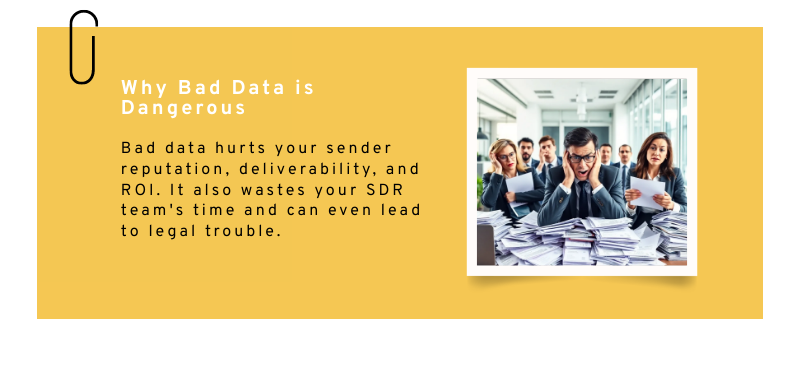
Bad data can:
- Damage your domain reputation
- Reduce deliverability long-term
- Lead to spam-trap hits
- Waste SDR time
- Lower campaign ROI
- Skew analytics
Accuracy is not a “nice-to-have.” It is the foundation of all outbound efforts.
Compliance and Legal Standards to Watch For
Because B2B data involves personal information, compliance is non-negotiable.
Here are the key regulations that reputable providers must follow:
GDPR (Europe)
Focuses on:
- Data transparency
- Right to access or be forgotten
- Lawful collection
CCPA (California & other US states)
Covers:
- Consumer privacy
- Data rights
- Opt-out requirements
CAN-SPAM (United States)
Regulates:
- Unsolicited commercial email
- Opt-out mechanisms
- Sender transparency
CASL (Canada)
One of the strictest anti-spam laws worldwide.
Compliance Proof You Should Request
- Data Processing Agreements (DPAs)
- Consent documentation
- Data origin transparency
- Removal and opt-out policies
If a provider can’t demonstrate compliance, they should not be supplying you with data at all.
Pricing Models, Costs & Hidden Fees to Watch Out For
Pricing varies significantly across the industry. Understanding the different pricing models helps you avoid overspending or paying for features you don’t need.
Common Pricing Models
1. Pay-Per-Record
Simple and predictable, but can get expensive for large lists.
2. Subscription Access
Gives ongoing access to a database, great for continuous outreach.
3. Credit-Based Models
Flexible, but sometimes confusing.
4. Tiered Plans
Offer fixed feature sets at different levels.
5. Custom Enterprise Pricing
For teams needing millions of records or unique integrations.
Hidden Fees That Low-Quality Providers May Charge
- Extra charge for verification
- CRM integration fees
- CSV export charges
- Premium segmentation upsells
- Data refresh charges
Essential Email List Features to Look For
Before purchasing from any business email list provider, make sure they offer these core capabilities:
1. Advanced Segmentation
You should be able to filter by:
- Industry
- Company size
- Revenue
- Geography
- Seniority
- Tech stack
- Buying intent
- Keywords
2. CRM/ESP Integrations
Look for compatibility with:
- HubSpot
- Salesforce
- Apollo
- Outreach
- Mailchimp
- Lemlist
- ActiveCampaign
3. Real-Time or Near Real-Time Updates
4. Bounce Rate Guarantees
5. Data Replacement Policies
6. Custom Data Builds for Niche Markets
7. Transparent Sample Data
Red Flags That Indicate a Low-Quality Email List Provider
Even if the price is attractive, avoid providers with these major warnings:
Major Red Flags
- No transparency about data origin
- Overpromising accuracy (e.g., “100% verified”)
- No compliance documentation
- Unusually low prices
- No customer reviews
- No sample data
- No refund or replacement policy
- Outdated website
- Difficult or slow customer support
If something feels off, trust your instincts.
How to Compare Multiple Email List Providers (Step-by-Step)
Here’s a systematic way to evaluate and compare your options:
Step-by-Step Comparison Framework
- Define your ICP
- Required segmentation
- Request data samples
- Run SMTP verification on samples
- Compare bounce rate guarantees
- Review compliance policies
- Evaluate available integrations
- Compare pricing transparency
- Read customer reviews
- Test customer support responsiveness
How to Maintain and Clean Your Email List After Purchase
Even the best data degrades, people change roles, companies, and email domains frequently.
Best Practices for List Hygiene
- Re-verify emails every 60–120 days
- Remove unengaged contacts
- Monitor bunce rates
- Use verification tools
- Regularly update CRM fields
- Suppress spam traps
Recommended Tools
- NeverBounce
- ZeroBounce
- MillionVerifier
- Clearout
Maintaining data is just as important as purchasing it.
How Business Email Lists Fit Into a Larger Lead Generation Strategy
A purchased list is not a standalone tool, it’s part of a multi-layered marketing and sales ecosystem.
How Email Lists Fuel This Ecosystem
- Provide contacts for ABM campaigns
- Enable hyper-personalized sequences
- Extend your outbound reach
- Support LinkedIn and phone outreach
- Enhance lookalike audience building
- Improve lead scoring
- Support content syndication
Your email list is a growth asset, but only when integrated strategically.
Choosing the Right Business Email List Provider – FAQs
1. Is it legal to purchase business email lists?
Yes, if the data is collected and used in compliance with GDPR, CAN-SPAM, CCPA, and other relevant regulations.
2. How much do B2B email lists cost?
Usually $0.20–$3.00 per contact, depending on accuracy, segmentation, and intent data.
3. What bounce rate should I expect from high-quality data?
Anything between 2%–5% is considered excellent.
4. How frequently should I clean my list?
Every 60–120 days, depending on how actively you email.
5. Can email lists support ABM?
Absolutely, account-based lists are ideal for ABM strategies.
6. What’s the difference between targeted and bulk lists?
Targeted lists match your ICP; bulk lists are unsegmented and often low-quality.
7. Should I choose subscription or pay-per-record?
Subscription is best for ongoing outreach; pay-per-record works for niche campaigns.
8. What is intent data?
Data showing buying behavior or interest signals (e.g., product research).
9. Should my email list integrate with my CRM?
Yes, integrations improve workflow, accuracy, and scalability.
10. What’s the biggest red flag when evaluating providers?
Lack of transparency in data sourcing and compliance documentation.