

B2B lead generation has gone through one of the biggest transformations in modern marketing and sales. Not long ago, the process was built on cold calls, in-person networking, and broad outreach with very little understanding of who the ideal buyer actually was.Companies relied heavily on intuition, assumptions, and sheer volume to get results. But as technology evolved, as buyers moved online, and as competition intensified across almost every industry, the rules changed completely.
Today, B2B lead generation is driven by one powerful force: data.
Modern buyers expect personalization, relevance, and value from the very first touchpoint. They research extensively before ever talking to a salesperson. They compare solutions, read reviews, and engage with content long before they appear in a CRM. This shift has made it nearly impossible for companies to succeed using outdated, guesswork-driven approaches. Instead, they must deeply understand their prospects, their behavior, challenges, priorities, and buying signals.
That is where B2B data comes in.
Data gives companies the ability to move from reactive to proactive, from broad targeting to precision segmentation, and from generic outreach to highly personalized engagement. Instead of casting a wide net and hoping something sticks, businesses can identify exactly which companies are in-market, which decision-makers are researching solutions, and which prospects are ready to move forward. It helps eliminate wasted time, strengthen sales and marketing alignment, and dramatically improve lead quality.
The rise of intent data, behavioral analytics, technographic insights, and advanced automation tools has completely reshaped the way successful B2B teams operate. These tools give organizations the power to spot buying opportunities earlier, nurture leads more effectively, and forecast revenue with far greater accuracy.
In today’s environment, data isn’t just an advantage, it’s the foundation of high-performing lead generation. Companies that embrace data-driven decision-making can scale faster, convert more efficiently, and adapt to market changes with confidence. Those that ignore it will continue to struggle with vague strategies, poor targeting, and underperforming pipelines.
How B2B Data Is Redefining the Lead Generation Landscape
Modern lead generation is radically different from the old days of cold calling, trade booths, and generic email blasts. Today’s buyers take their time researching, comparing solutions, reading reviews, and making informed decisions long before they ever speak to a salesperson. That means businesses must meet prospects where they are, with relevant, timely, value-packed information.
B2B data makes that possible.
Companies now have access to insights that reveal:
- Who their ideal customers are
- What challenges those customers face
- Which companies are in active buying cycles
- What content prospects engage with
- How close a lead may be to making a purchase
This shift from guesswork to precision targeting allows businesses to create strategies rooted in evidence rather than assumptions. Instead of wasting resources on unqualified leads, they can operate with a level of clarity that dramatically improves workflow, conversion, and ROI.
Why Lead Quality Matters More Than Lead Quantity
For years, businesses measured success by the number of leads they collected. But high lead volume means very little if most of those leads are unqualified. Modern B2B teams recognize that lead quality, not quantity, is the real driver of revenue success.
A high-quality lead typically:
- Fits your target customer profile
- Has real interest or intent
- Has the budget or authority to buy
- Engages meaningfully with content
- Shows predictable buying behavior
When companies focus on lead quality, they avoid wasting time on contacts who were never going to convert. Instead, marketing and sales align around identifying and nurturing the prospects who have the highest likelihood of becoming paying customers.
B2B data is the key to boosting lead quality. It helps filter out irrelevant prospects early and highlights the ones who are a perfect fit. With better data, businesses don’t need to chase hundreds of leads, they just need the right ones.
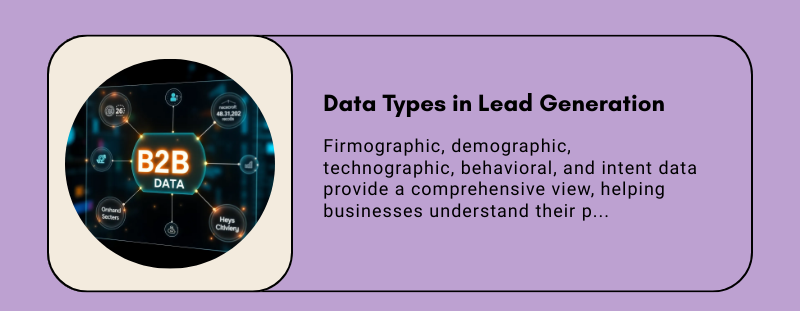
The Most Important Types of B2B Data in Lead Generation
Not all data is created equal. The strongest B2B lead generation strategies involve a mix of different data categories, each offering a different layer of insight. When combined, these data types give businesses a 360-degree view of their potential customers.
Firmographic Data
Firmographic data is company-level information, including:
- Industry
- Company size
- Revenue
- Geographic location
- Funding
- Growth trends
This helps companies decide which organizations align with their ideal customer profile.
Demographic Data
This type of data focuses on individuals within an organization, including:
- Job title
- Seniority
- Department
- Responsibilities
It’s essential for identifying decision-makers and influencers.
Technographic Data
Technographic insights show which tools, platforms, or software a company uses. This data helps businesses:
- Identify integration opportunities
- Spot competitive tool usage
- Understand operational workflows
- Tailor messaging to fit current tech stacks
For SaaS companies, technographics are incredibly important for targeting.
Behavioral Data
Behavioral signals track how prospects interact with your brand. Examples include:
- Website visits
- Blog reads and video views
- Email opens and clicks
- Webinar attendance
- Form submissions
- Time spent on key pages
Behavioral data reveals how engaged a lead is, and how quickly they may be moving through the sales funnel.
Intent Data
Intent data highlights when companies are actively researching a product or solution. This comes from:
- Search engine activity
- Review site visits
- Content downloads
- Competitor comparisons
- Topic-level research increases
Intent data is one of the most powerful forms of B2B data because it shows which leads are already “warm.” When teams know who’s actively shopping around, they can prioritize outreach more effectively.
How Data Enhances Targeting and Segmentation
One of the biggest strengths of B2B data is its ability to dramatically improve targeting and segmentation. Without data, businesses fall into the trap of sending broad, generic messages to large audiences. That not only lowers engagement, but also wastes resources.
With rich data insights, companies can segment prospects based on:
- Industry
- Company size
- Customer lifecycle stage
- Product needs
- Pain points
- Buying intent
- Behavioral triggers
For example, instead of targeting “IT managers,” you can target:
“IT managers at fast-growing biotech companies currently researching cloud security solutions.”
This level of precision results in:
- More personal messaging
- Higher engagement
- Reduced wasted ad spend
- Faster conversion
- Better alignment between marketing and sales
Data-driven segmentation ensures that every message has purpose and relevance.

Personalization Powered by B2B Data
Personalization has gone from a bonus to an expectation. Buyers want content that speaks directly to their needs and interests. Generic messaging simply doesn’t move the needle anymore.
That’s where B2B data plays a massive role.
Using data, companies can personalize:
- Email content
- Sales outreach
- Ad campaigns
- Website experiences
- Retargeting flows
- Product recommendations
- Lead nurturing sequences
Here are a few examples of how data improves personalization:
- If a visitor spends several minutes on a pricing page, automated sequences can trigger a more direct sales follow-up.
- If a prospect uses a tool your product integrates with, ads can highlight that value.
- If intent data shows a lead comparing solutions, content like case studies or ROI calculators can be delivered at the perfect time.
Personalization increases trust, boosts engagement, and makes brands feel more relevant, all of which significantly improves lead quality and pipeline health.
Lead Scoring and How Data Helps Prioritize Outreach
Lead scoring is one of the most impactful ways data improves lead generation. Instead of treating all leads the same, scoring helps businesses prioritize the leads that are most likely to convert.
Data-driven lead scoring typically includes:
- Demographic data (role fits your persona)
- Firmographic data (company matches your target criteria)
- Behavioral signals (content engagement, form fills, demo views)
- Intent indicators (search activity, category research)
When a lead meets scoring thresholds, they become a marketing-qualified lead (MQL) and move to sales.
Effective lead scoring ensures:
- Sales teams focus on high-intent prospects
- Marketing spends more time nurturing earlier-stage leads
- Funnel leakage decreases
- Sales cycles shorten
- Close rates increase
Without solid data, lead scoring is nothing more than guesswork. With the right data, it becomes one of the most reliable predictors of revenue.
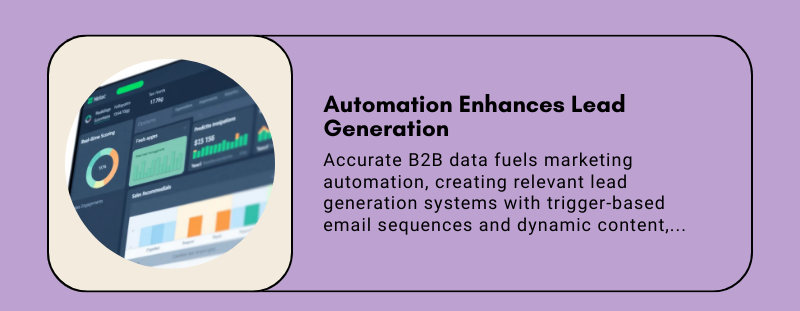
How Data Powers Automation and Lead Nurturing
Marketing automation tools are powerful, but they depend on good data to work well. When automation is fueled by accurate B2B data, companies can create smooth, highly relevant lead generation systems that work around the clock.
Data-driven automation includes:
- Trigger-based email sequences
- Dynamic content personalization
- Delayed outreach based on lead behavior
- Automatic lead routing
- AI-powered segmentation
- Real-time scoring updates
- Predictive recommendations
One example is nurture sequences. Instead of sending the same emails to everyone, data-driven automation sends different content based on each lead’s behavior. That way, leads who show interest move forward faster, while colder leads get more educational content before being handed off to sales.
This not only boosts lead quality but also helps sales teams get in touch with prospects when they’re truly ready to talk.
The Revenue Impact of Data-Driven Lead Generation
Every business cares about revenue, and data-driven lead generation has a massive impact on revenue performance. When data is integrated into every part of the lead generation process, companies see improvements across all major KPIs.
Data-driven lead generation helps businesses:
- Increase conversion rates
- Improve lead quality
- Shorten sales cycles
- Lower acquisition costs
- Improve marketing efficiency
- Enhance forecasting accuracy
- Reduce sales team burnout
- Strengthen customer retention
- Improve lifetime value
Better data = better decisions = better revenue outcomes.
When sales and marketing teams unite around shared data, they operate more efficiently and predictably, which leads to a healthier, more scalable pipeline.
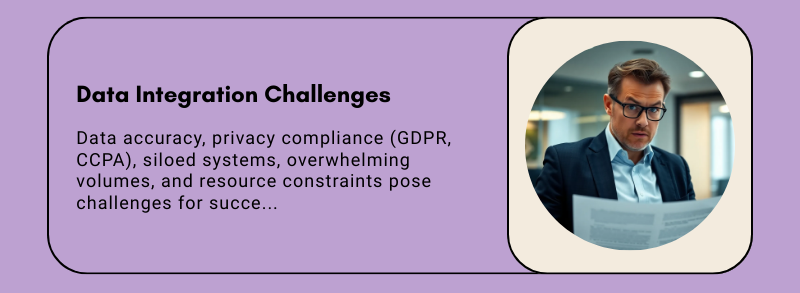
Challenges That Come With B2B Data
Although data is incredibly valuable, it doesn’t come without challenges. Successfully using B2B data means being aware of, and prepared for, the obstacles that come with it.
Data Accuracy Problems
Data decays rapidly. Job changes, company shifts, and evolving markets can make data outdated faster than you’d think.
Privacy and Compliance Issues
Businesses must comply with regulations like:
- GDPR
- CCPA
- CASL
- Other regional privacy laws
Failure to do so can be expensive.
Siloed or Unconnected Systems
When data is scattered across tools, teams lose visibility and insight.
Overwhelming Data Volumes
More data isn’t always better. Companies must filter out noise and focus on what drives action.
Resource and Budget Constraints
High-quality B2B data sources and enrichment tools require investment.
Understanding these challenges helps companies build a stronger, more sustainable data strategy.
Future Trends in Data-Driven Lead Generation
The future of B2B lead generation is set to become even more data-driven. Emerging trends show that data will continue to shape how companies attract and convert leads.
Some key trends include:
- AI-powered predictive lead scoring
- Real-time personalization across platforms
- Improved intent data accuracy
- Automated buyer journey mapping
- More advanced technographic insights
- Enhanced analytics and attribution modeling
- Deeper integration of CRM and marketing automation tools
As data sources and technologies evolve, companies will gain the ability to anticipate buyer behavior with incredible accuracy, allowing lead generation to become proactive rather than reactive.
Why Data Is the Future of B2B Lead Generation
The role of data in modern B2B lead generation cannot be overstated. As buyer expectations rise and competition intensifies, businesses need clear, accurate, and actionable insights to stay relevant and competitive. B2B data empowers teams to find the right leads, understand their needs, personalize their experience, automate smartly, and ultimately drive higher-quality outcomes.
Companies that embrace data-driven strategies see dramatic improvements in lead quality, conversion rates, and revenue predictability. On the other hand, businesses that rely on outdated methods will continue to fall behind as the industry moves toward more intelligent, insight-driven approaches.
In today’s digital-first environment, data isn’t just an advantage, it’s a requirement. The organizations that learn how to collect, analyze, and use data effectively will shape the future of B2B lead generation.
B2B Data for Lead Generation – FAQs
1. What is B2B data?
B2B data includes information that helps companies target and engage other businesses, such as firmographics, demographics, behavioral activity, technographics, and intent data.
2. Why does lead quality matter?
Lead quality ensures that sales and marketing teams spend their time on prospects who are genuinely likely to buy, improving efficiency and ROI.
3. How does data help with personalization?
Data reveals a lead’s interests, behavior, and buying stage, allowing companies to tailor messaging to their exact needs.
4. What is intent data?
Intent data shows when a company is actively researching a topic or solution, indicating strong buying intent.
5. How does lead scoring use B2B data?
Lead scoring assigns points based on firmographics, engagement, and intent signals to prioritize the best opportunities.
6. What tools rely on B2B data?
CRM systems, marketing automation platforms, sales intelligence tools, ABM platforms, and data enrichment software all use data.
7. Can small businesses benefit from B2B data?
Yes, there are many affordable data tools designed specifically for small and mid-sized companies.
8. How often should companies update their data?
Ideally continuously, but at minimum every three to six months, since data decays quickly.
9. What’s the biggest challenge with B2B data?
Keeping it accurate, compliant, and actionable while avoiding information overload.
10. How does B2B data impact sales?
It streamlines prospecting, improves lead prioritization, shortens sales cycles, and increases close rates.