


Why Personalization Boosts B2B Open Rates
In B2B marketing, attention is scarce and trust is earned slowly. Decision-makers are overwhelmed with emails every day, most of which are ignored, skimmed, or deleted within seconds. The difference between emails that disappear and emails that get opened often comes down to one critical factor: relevance.
Personalization is not about gimmicks, tricks, or clever wordplay. It is about demonstrating awareness, context, and intent. When executed correctly, personalization signals that a message was designed for a specific individual rather than generated for a generic list. That perception alone is powerful enough to consistently drive higher open rates, stronger engagement, and more meaningful long-term conversations.
For modern B2B teams focused on sustainable pipeline growth, personalization is no longer optional. It is a strategic advantage and, increasingly, a competitive necessity.
What Personalization Really Means in B2B Email
Personalization in B2B is widely misunderstood. Many teams believe they are personalizing when they insert a first-name token or company name into a template. But surface-level personalization rarely produces meaningful results because it does not meaningfully change how the email feels to the recipient. At best, it signals light customization. At worst, it feels artificial and still clearly mass-produced.
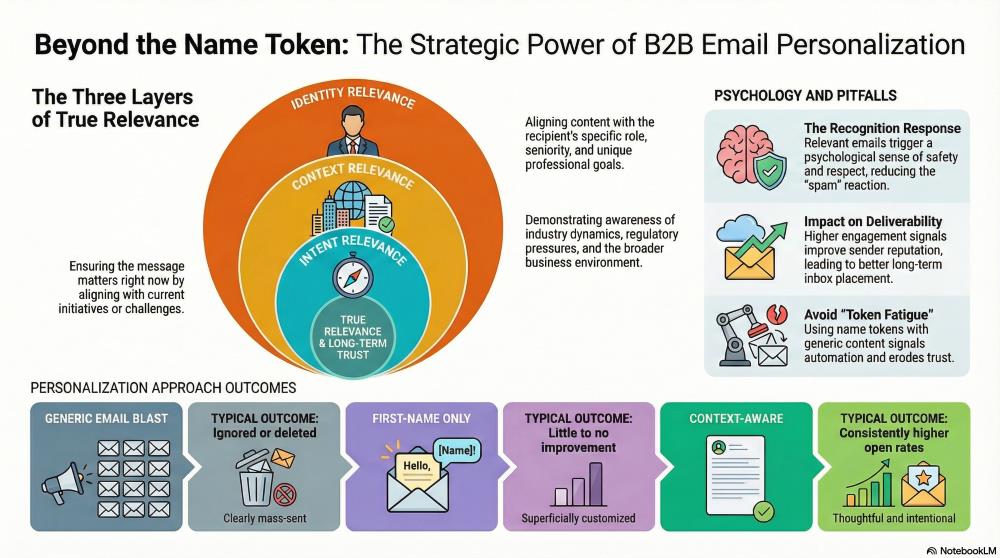
True personalization reflects relevance across three deeper layers:
- Identity relevance
Who the recipient is: their role, seniority, responsibilities, goals, and pressures. A CFO and a marketing director may work at the same company, but they live in completely different professional realities. They care about different outcomes, measure success differently, and respond to entirely different priorities. Personalization must acknowledge those distinctions if it is going to feel authentic. - Context relevance
The environment they operate in: industry dynamics, regulatory pressures, competitive landscape, organizational maturity, and current business climate. A leader in healthcare, for example, will interpret messages differently than someone in SaaS or manufacturing. Emails that reflect awareness of this broader context feel more credible because they demonstrate understanding beyond surface-level demographics. - Intent relevance
Why does this message matter right now? Timing is often more important than wording. An email that aligns with a current initiative, challenge, or moment of change will consistently outperform one that is simply well-written but poorly timed. Relevance is not just about who someone is, but when they are receiving your message.
A strong email marketing personalization case demonstrates that effective personalization is not about inserting tokens. It is about alignment between message, audience, and moment. It requires strategic thinking about who you are speaking to, what they care about, and why your message deserves attention today.
When recipients feel that an email genuinely understands their world, their behavior changes. They open more often. They read more carefully. They spend more time with the message. They are more likely to mentally categorize the sender as credible rather than promotional. And when the time is right, they are far more willing to engage because trust has already begun to form.
Why Personalization Drives Higher Open Rates
Inbox behavior is fast, habitual, and emotional. Most professionals scan subject lines for only a few seconds before making decisions about what deserves attention.
Personalization influences this process by:
- Creating familiarity in a crowded inbox
- Signaling relevance to the recipient’s role or responsibilities
- Demonstrating intentional targeting rather than mass sending
- Building recognition through consistent relevance over time
- Reducing the instinctive “this is probably noise” reaction
People are not looking for clever subject lines. They are looking for signals. Signals that an email might be useful. Signals that it might respect their time. Signals that it might not be spam.
Personalization provides those signals quickly.
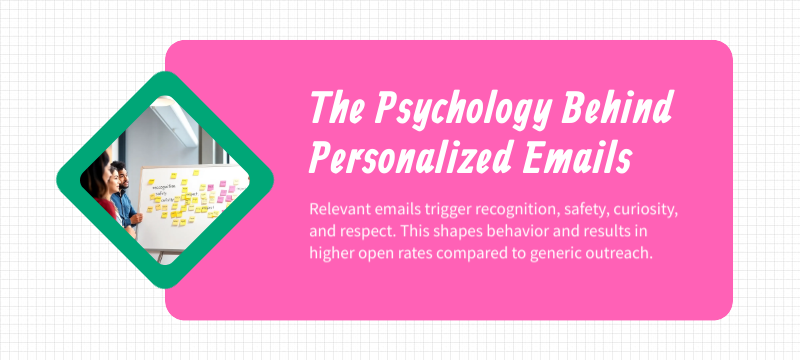
The Psychology Behind Personalized Emails
Personalization works not only as a tactic, but because it aligns with how people process information.
When an email feels relevant, it triggers several psychological responses:
- Recognition – “This applies to me.”
- Safety – “This doesn’t feel like spam.”
- Curiosity – “This might be worth opening.”
- Respect – “They actually understand my world.”
These reactions are subtle, but they shape behavior. And they explain why personalized campaigns consistently generate higher open rates than generic outreach.
The impact also compounds over time. Even if a recipient ignores the first few emails, repeated exposure to relevant subject lines builds familiarity. Familiarity builds trust. Trust increases the likelihood that when timing aligns, your email gets opened.
What Effective Personalization Actually Looks Like
Good personalization does not feel like personalization. It feels like relevance.
It often shows up in ways such as:
- Referencing industry-specific challenges
- Aligning value propositions to role-specific outcomes
- Tailoring framing for company maturity (startup vs enterprise)
- Reflecting awareness of public company developments
- Adjusting tone for seniority (strategic vs tactical)
- Using examples and language familiar to that audience
It is less about sounding clever and more about sounding aligned.
This level of personalization does not require invasive data or excessive research. It requires thoughtful segmentation, disciplined messaging, and clarity about who the audience actually is.
Personalization vs Generic Messaging
The contrast becomes clearer when you compare the experiences directly.
| Approach | How It Feels to the Recipient | Typical Outcome |
| Generic email blast | Clearly mass-sent | Ignored or deleted |
| First-name only | Superficially customized | Little to no improvement |
| Role-based messaging | Some relevance | Moderate engagement |
| Industry-specific messaging | Clearly targeted | Strong open rates |
| Context-aware personalization | Thoughtful and intentional | Consistently higher open rates |
The more the email reflects the recipient’s world, the more attention it earns.
Common Mistakes That Undermine Personalization
Many teams believe they are doing personalization while unintentionally weakening its impact. The intention is usually right, but execution often falls short because personalization is treated as a surface-level tactic rather than a strategic discipline.
Common pitfalls include:
- Using personalization tokens with generic content
Adding a first name or company name does not make an email relevant if the rest of the message could apply to anyone. When the content itself is not aligned to the recipient’s role, challenges, or context, token usage becomes cosmetic rather than meaningful. - Overusing names and company references until it feels forced
Repeating someone’s name or company multiple times can feel unnatural and scripted. Instead of building connection, it often triggers skepticism because it signals automation rather than genuine intent. - Writing highly personalized subject lines with generic email bodies
This creates a mismatch in expectation. The subject line suggests relevance, but once the email is opened, the content feels generic. This disconnect erodes trust and can make recipients less likely to open future messages. - Relying on outdated or inaccurate contact data
Incorrect job titles, outdated company information, or misaligned industry references can immediately damage credibility. Poor data quality does not just reduce effectiveness; it actively harms perception. - Using overly casual tone without any established relationship
Attempting to sound overly familiar too early can feel inauthentic. Personalization should demonstrate understanding, not artificial friendliness. - Treating personalization as copywriting instead of strategy
This is one of the most common mistakes. Personalization is not about clever wording. It is about segmentation, relevance, timing, and message alignment. Without strategy behind it, even well-written emails will underperform.
Poor personalization often feels manipulative, lazy, or overly automated. Strong personalization, by contrast, feels natural and respectful. It signals that the sender understands the recipient’s world and values their time, which is ultimately what drives stronger engagement and more sustainable performance.
How Personalization Strengthens Long-Term Performance
The greatest value of personalization is not short-term metrics. It is long-term perception.
When personalization is applied consistently:
- Your brand becomes associated with relevance
- Prospects begin to recognize your emails
- Engagement improves gradually rather than in spikes
- Trust forms before any sales conversation begins
- Future campaigns benefit from stronger engagement history
This is why personalization is foundational to sustainable performance. It shapes how your brand is perceived over months, not just how one email performs on one day.
A Practical Email Personalization Case Framework
High-performing teams rarely rely on improvisation. They use structure.
A scalable email personalization case often includes:
- Segmentation by role (e.g. finance leaders vs marketing leaders)
- Segmentation by industry (e.g. SaaS vs healthcare vs manufacturing)
- Adjustments by funnel stage (cold, warm, re-engaged)
- Behavioral signals (opens, clicks, visits, downloads)
- Content themes aligned to each segment’s priorities
This allows teams to personalize at scale without needing individual manual research for every contact.
Personalization Signals That Influence Open Rates Most
Not all personalization elements carry equal weight.
High-impact signals include:
- Subject lines aligned to role-specific priorities
- Industry language that feels native to the recipient
- Clear alignment with business outcomes
- Framing that reflects familiarity with their world
- Avoidance of overly promotional phrasing
Lower-impact signals include:
- First name alone
- Company name alone
- Emojis without relevance
- Artificial friendliness
Open rates rise when relevance rises, not when cleverness increases.
The Relationship Between Personalization and Deliverability
Personalization also affects technical performance.
Inbox providers monitor engagement signals such as:
- Opens
- Reads
- Replies
- Deletions without opening
- Spam complaints
When personalization increases engagement, sender reputation improves. Improved reputation leads to better inbox placement. Better inbox placement supports higher open rates across future sends.
In this way, personalization influences both human perception and algorithmic judgment.
Personalization Across the Funnel
Personalization is not just for cold outreach. It plays a different role at every stage.
In early-stage outreach, personalization builds credibility.
In mid-funnel nurture, personalization builds familiarity.
In late-stage engagement, personalization reinforces trust.
Post-sale, personalization strengthens retention and expansion.
This is why strong personalization strategies often touch every lifecycle stage rather than existing only in outbound campaigns.
How Personalization Compounds Over Time
One of the most overlooked aspects of personalization is compounding impact.
Early emails may not generate dramatic results. But over time:
- Familiarity increases
- Brand recognition grows
- Trust accumulates
- Engagement becomes more consistent
Recipients begin to recognize your sender name. They become more comfortable opening your emails. Even if they are not ready today, they are more likely to open when timing changes.
This is how personalization supports long-term pipeline rather than short-term spikes.
Building a Sustainable Personalization Strategy
Personalization works best when treated as infrastructure, not experiment.
Strong strategies usually include:
- Clear segmentation definitions
- Messaging frameworks for each segment
- Consistent review of performance data
- Iteration based on engagement trends
- Alignment between marketing and sales language
- Realistic scaling rather than hyper-customization
The goal is consistency, not perfection. Consistent relevance consistently outperforms occasional brilliance.
Personalization as a Trust Signal
In B2B environments, where inboxes are crowded and skepticism toward unsolicited outreach is high, that signal carries real weight. Decision-makers are constantly filtering out noise, scanning for relevance, and protecting their attention. When an email feels genuinely tailored, it immediately stands apart from the dozens of generic messages competing for the same space.
Personalization does more than increase opens. It shapes perception. It subtly tells the recipient that the sender has taken the time to understand their role, their business, and their priorities. That effort builds credibility before a conversation ever begins.
This is what differentiates thoughtful brands from noisy ones. Noisy brands broadcast messages. Thoughtful brands demonstrate awareness. One feels like an interruption. The other feels like an invitation.
Over time, this effect compounds. Recipients begin to recognize certain senders as consistently relevant. They open more often. They skim less. They engage more intentionally. The sender’s reputation in the inbox improves, and trust becomes an asset rather than an obstacle.
That is why personalization remains one of the most reliable drivers of higher open rates across nearly every industry, audience, and channel. Not because it is a gimmick, but because it aligns with a fundamental human behavior: we pay attention to what feels relevant, respectful, and genuinely designed for us.
Frequently Asked Questions
1. Does personalization really increase open rates in B2B?
Yes. When grounded in relevance and context, personalization consistently correlates with higher open rates.
2. Is using the recipient’s first name enough?
No. Name-only personalization rarely moves performance meaningfully.
3. What matters more: subject line or body personalization?
Subject lines drive opens. Body relevance drives trust. Both are essential.
4. Can personalization work at scale?
Yes. With strong segmentation and frameworks, personalization scales effectively.
5. Does personalization improve reply rates as well?
Yes. Relevant emails are more likely to generate thoughtful responses.
6. What is the biggest personalization mistake teams make?
Confusing token usage with genuine relevance.
7. How much data is needed for effective personalization?
Often just role, industry, and basic context can make a significant impact.
8. Can personalization feel intrusive?
Yes, if it uses overly personal or non-obvious data. Strong personalization stays professional.
9. Does personalization impact deliverability?
Indirectly, yes. Higher engagement improves sender reputation and inbox placement.
10. Is personalization more important for cold or nurture emails?
Both. It improves cold performance and strengthens long-term relationships.