


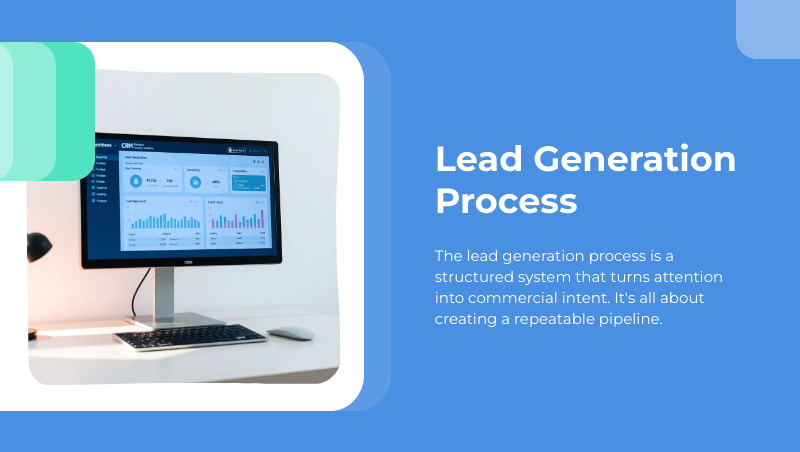
What the lead generation process actually is in modern business
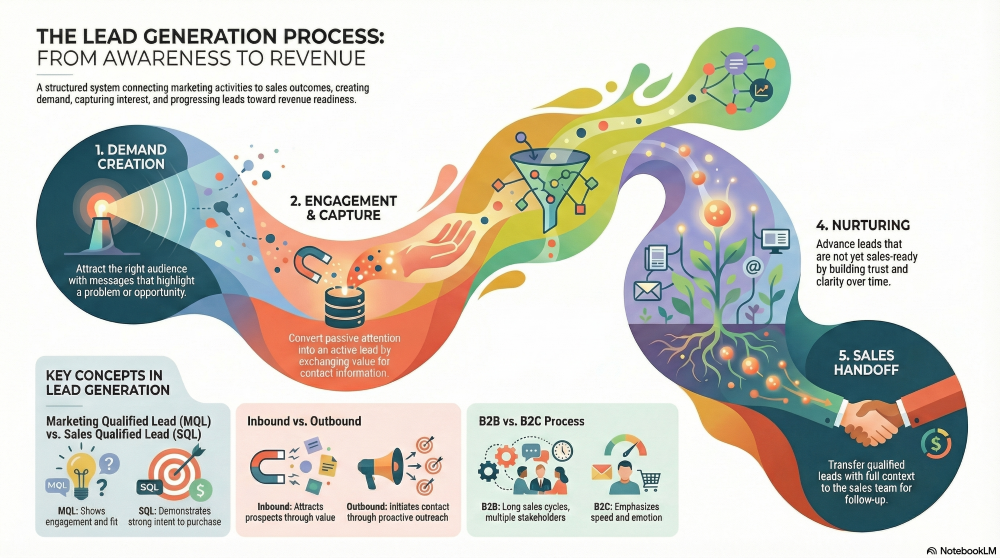
The lead generation process is the structured system used to create demand, identify potential buyers, capture their information, and progress them toward revenue readiness. It connects marketing activity to sales outcomes by transforming anonymous attention into qualified commercial intent. When designed correctly, the process operates as a repeatable pipeline rather than a series of isolated campaigns.
Modern b2b lead generation is not defined by channels or tactics alone. It is defined by how effectively attention, intent, and readiness are identified, measured, and advanced across stages without friction or waste.
Why lead generation is a process, not a campaign or tactic
Lead generation functions as a process because results depend on sequence, dependency, and feedback loops rather than single actions. Traffic without capture, capture without qualification, or qualification without sales alignment produces volume without value. A process framework prevents these disconnects by enforcing structure and accountability at each stage.
Organizations that treat lead generation as a one-off effort typically experience volatility and poor conversion quality. A process-oriented model creates predictability, scalability, and continuous improvement.
How the lead generation process is typically structured end to end
The lead generation process is most effectively structured as a progression from demand creation to revenue readiness. Each stage has a distinct objective and success criteria, and failure at one stage cascades downstream. Clear stage boundaries reduce ambiguity and improve decision-making.
At a high level, the process includes demand creation, engagement and capture, qualification, nurturing, handoff, and optimization. While naming conventions vary, functional responsibilities remain consistent across industries.
How demand is created before any lead exists
Demand creation establishes awareness and relevance before any identifying information is captured. It focuses on reaching the right audience with messages aligned to problems, priorities, or buying triggers. Without demand creation, lead generation becomes extractive rather than value-driven.
Effective demand creation prioritizes clarity over volume. Messaging is designed to attract decision-makers who recognize a problem, not casual browsers with no purchase intent.
What demand creation is responsible for delivering
Demand creation delivers attention with intent signals attached. It ensures the right people arrive with the right expectations.
- Audience alignment with commercial relevance
- Problem or opportunity recognition
- Context for why engagement is worth the time
- Early trust through clarity and consistency
How engagement bridges attention and conversion
Engagement transforms passive attention into active consideration. It confirms relevance and encourages the user to take a next step without forcing commitment prematurely. Strong engagement reduces friction by making progression feel natural rather than transactional.
Engagement assets are evaluated by clarity, specificity, and alignment with the user’s decision stage. Overly generic engagement produces poor capture rates and low-quality leads.
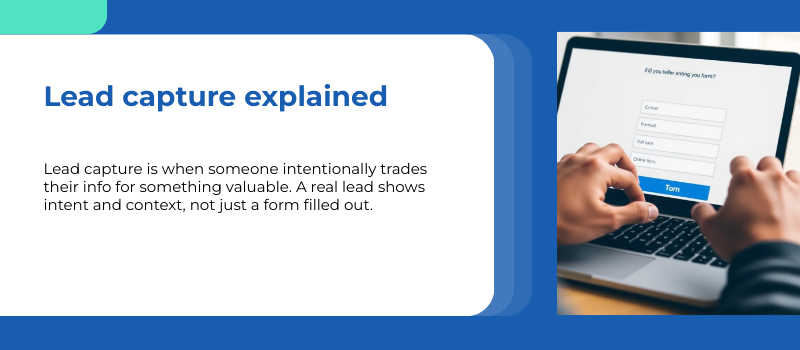
How lead capture works and what qualifies as a lead
Lead capture occurs when identifying information is intentionally exchanged for value. A lead is not defined by a form submission alone, but by the presence of identifiable intent and traceable context. Capture mechanisms formalize interest and allow progression into managed workflows.
The quality of a lead is determined by what is captured, when it is captured, and why the user agreed to provide it.
What separates effective capture from noise
Effective capture balances information depth with perceived value. It avoids collecting data that cannot be acted upon.
- Clear value exchange
- Minimal friction aligned to intent strength
- Contextual alignment with the asset or offer
- Immediate acknowledgment and next step clarity
How lead qualification prevents wasted sales effort
Lead qualification determines whether a captured lead is ready for sales engagement or requires further development. It protects sales capacity by filtering out leads that lack authority, timing, need, or fit. Qualification is a decision system, not a scorecard in isolation.
Poor qualification inflates pipeline volume while degrading close rates and sales trust. Strong qualification improves forecast accuracy and sales efficiency.
Common qualification dimensions used across industries
Qualification frameworks vary, but most evaluate similar core signals.
- Problem relevance or urgency
- Organizational or individual fit
- Decision authority or influence
- Timing and readiness to act
How lead nurturing advances readiness without pressure
Lead nurturing advances leads that are not yet sales-ready by increasing clarity, confidence, and alignment over time. It replaces aggressive follow-up with structured progression. Nurturing exists to mature intent, not to create it artificially.
Well-designed nurturing reduces lead decay and improves downstream conversion rates. Poor nurturing increases unsubscribe rates and erodes trust.
How marketing-qualified and sales-qualified leads differ in practice
Marketing-qualified leads indicate engagement and fit based on predefined thresholds. Sales-qualified leads indicate readiness for direct sales interaction based on stronger intent signals. The distinction exists to align expectations between teams.
Blurring this boundary creates friction and accountability gaps. Clear definitions enable clean handoffs and accurate reporting.
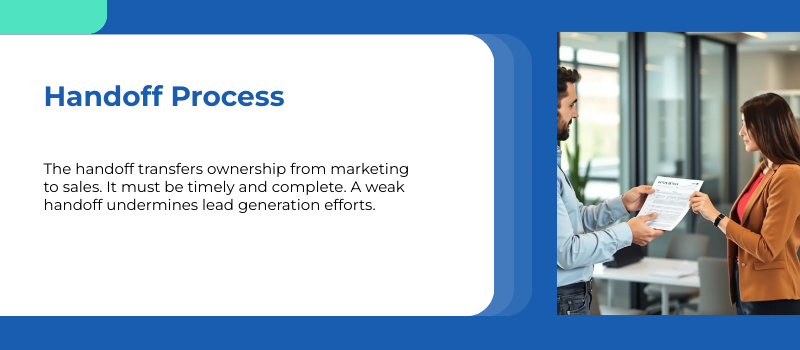
How the handoff between marketing and sales should function
The handoff process transfers ownership, context, and responsibility from marketing to sales. It must be timely, complete, and standardized to prevent information loss. A weak handoff undermines even strong lead generation efforts.
Successful handoffs provide sales with visibility into why the lead exists, what problem is recognized, and what engagement has already occurred.
Information that should always accompany a sales handoff
Sales effectiveness depends on context, not just contact details.
- Source and triggering activity
- Content or messaging consumed
- Qualification rationale
- Recommended next action
How inbound and outbound lead generation differ operationally
Inbound lead generation attracts prospects through value-driven discovery. Outbound lead generation initiates contact through proactive outreach. Both can coexist within a single process when roles and expectations are clear.
Inbound tends to produce warmer leads with longer cycles. Outbound tends to produce faster feedback with higher rejection rates. Process design must account for these differences.
How metrics should be mapped to each stage of the process
Measurement validates whether the process is functioning as intended. Metrics should align with stage objectives rather than vanity indicators. Stage-specific measurement enables targeted optimization instead of broad experimentation.
When metrics are misaligned, teams optimize for activity rather than outcomes.
Examples of stage-aligned measurement logic
Each stage answers a different performance question.
- Demand creation measures relevance and reach
- Capture measures clarity and conversion efficiency
- Qualification measures readiness accuracy
- Nurturing measures progression velocity
- Sales handoff measures acceptance and follow-up
How optimization actually improves lead generation outcomes
Optimization is the continuous refinement of assumptions, sequencing, and thresholds based on observed performance. It is not limited to creative changes or channel shifts. Structural changes often produce larger gains than surface-level adjustments.
Optimization succeeds when feedback loops are short and ownership is clear. It fails when changes are made without isolating cause and effect.
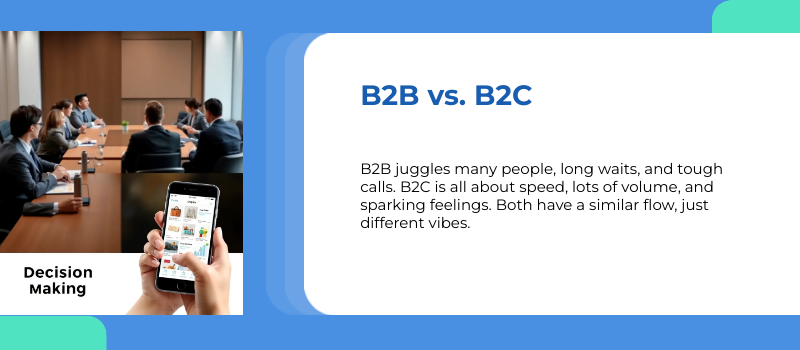
How B2B and B2C lead generation processes diverge
B2B lead generation emphasizes multiple stakeholders, longer decision cycles, and higher qualification thresholds. B2C lead generation emphasizes speed, volume, and emotional triggers. The underlying process structure remains similar, but execution priorities change.
Applying a B2C approach to B2B environments typically increases noise. Applying a B2B approach to B2C environments typically increases friction.
Common breakdowns that weaken the lead generation process
Most lead generation failures occur at transition points rather than within stages. Gaps between teams, unclear definitions, and misaligned incentives degrade performance. These issues compound over time if left unaddressed.
Volume-focused strategies often mask these breakdowns until revenue impact becomes unavoidable.
How lead generation maturity changes process design
Early-stage organizations prioritize speed and learning. Mature organizations prioritize efficiency, predictability, and scalability. Process design must evolve accordingly rather than remaining static.
Mature lead generation systems emphasize quality control, segmentation, and lifecycle management. Immature systems emphasize acquisition and experimentation.
How automation fits into the lead generation process
Automation supports execution but does not replace strategy or judgment. It increases consistency, speed, and scalability when applied to defined workflows. Automation amplifies flaws when processes are unclear.
Automation should follow process clarity, not precede it.

How lead management differs from lead generation
Lead generation creates and qualifies demand. Lead management governs how leads are tracked, routed, progressed, and reported after capture. Confusing the two results in operational blind spots.
Effective lead generation depends on strong lead management infrastructure. Weak lead management negates strong generation efforts.
How process clarity improves revenue alignment
Process clarity aligns marketing, sales, and operations around shared definitions and expectations. It reduces internal friction and improves trust between teams. Alignment increases conversion efficiency without increasing spend.
Revenue alignment is an outcome of process discipline, not a cultural initiative alone.
How segmentation sharpens the lead generation process
Segmentation increases lead generation efficiency by aligning messaging, offers, and qualification logic to distinct buyer groups. It replaces broad assumptions with targeted relevance, improving both conversion rates and sales acceptance. Without segmentation, even well-designed processes degrade into averages that serve no one particularly well.
Effective segmentation is behavioral and contextual rather than purely demographic. It reflects differences in needs, urgency, constraints, and buying dynamics.
Common segmentation dimensions used in mature processes
Segmentation frameworks vary, but durable models rely on factors that influence purchasing behavior.
- Problem type or use case
- Organizational size or complexity
- Buying role or seniority
- Industry-specific constraints
- Stage of awareness or readiness
How lifecycle stages prevent premature sales engagement
Lifecycle stages define where a lead sits within the broader buyer journey. They prevent forcing sales conversations before sufficient clarity or intent exists. Lifecycle discipline protects brand trust and sales productivity simultaneously.
Leads that are prematurely routed to sales often disengage permanently. Lifecycle staging ensures engagement intensity matches buyer readiness.
How data quality determines lead generation effectiveness
Data quality directly impacts routing accuracy, personalization, and reporting credibility. Incomplete, outdated, or inconsistent data creates downstream inefficiencies that compound over time. Strong lead generation systems treat data quality as a process responsibility, not a cleanup task.
Reliable data enables confident decision-making at every stage of the process. Poor data obscures performance and misguides optimization.
Data practices that support durable lead generation
Sustainable systems emphasize consistency and actionability over volume.
- Standardized field definitions
- Required context at capture
- Regular normalization and validation
- Clear ownership for data integrity
How compliance and consent shape modern lead generation
Compliance requirements influence how leads can be captured, stored, and contacted. Consent is not a formality; it defines the legitimacy of future engagement. Processes that ignore this reality face operational and reputational risk.
Well-designed lead generation systems integrate consent into capture and progression logic rather than treating it as a legal afterthought.
How attribution clarifies what actually drives leads
Attribution explains how leads originate and which activities contribute to progression. It prevents over-investment in visible but ineffective channels. Accurate attribution supports resource allocation decisions grounded in outcomes rather than assumptions.
Attribution models should reflect buying reality rather than theoretical journeys. Overly complex models often reduce clarity rather than improve it.
How lead velocity reveals process health
Lead velocity measures how quickly leads move between stages. It exposes friction, misalignment, and qualification errors that static metrics miss. Velocity trends often surface issues before conversion rates decline.
Healthy velocity reflects clarity and alignment. Stalled velocity signals confusion or mismatch.
How feedback loops strengthen the lead generation process
Feedback loops connect outcomes back to assumptions. They enable learning without overreacting to short-term fluctuations. Feedback ensures the process evolves as markets, buyers, and products change.
The most valuable feedback often comes from sales interactions, not dashboards alone. Structured feedback transforms anecdote into signal.
How cross-functional ownership prevents lead leakage
Lead generation spans marketing, sales, and operations. Without clear ownership boundaries, responsibility diffuses and issues persist. Cross-functional alignment requires explicit roles rather than shared accountability language.
Clear ownership ensures every stage has a steward responsible for outcomes and improvement.
How lead scoring supports, but does not replace, judgment
Lead scoring prioritizes attention by ranking leads based on predefined signals. It accelerates triage but cannot fully represent buying nuance. Overreliance on scoring leads to false confidence and misrouted effort.
Scoring works best when paired with clear qualification rules and human review at transition points.
How process documentation improves consistency at scale
Documentation translates intent into repeatable execution. It ensures continuity across team changes and growth phases. Undocumented processes rely on institutional memory that degrades over time.
Effective documentation focuses on decision rules and handoffs rather than exhaustive procedural detail.
How scaling changes the lead generation process
Scaling increases volume, complexity, and risk simultaneously. Processes that worked at low volume often fail under scale due to hidden dependencies. Scaling requires revisiting thresholds, ownership, and tooling assumptions.
Scalable lead generation prioritizes resilience over speed. It anticipates failure modes rather than reacting to them.
How to evaluate whether a lead generation process is working
Process effectiveness is evaluated by downstream impact rather than upstream activity. A functioning process produces predictable pipeline contribution and consistent sales acceptance. Volume alone is not evidence of success.
Strong evaluation combines quantitative signals with qualitative feedback from execution teams.
Frequently Asked Questions – The Lead Generation Process
How to generate leads step by step?
Lead generation progresses from demand creation to engagement, capture, qualification, nurturing, and sales handoff. Each step builds on the previous one and must be intentionally designed to avoid leakage.
Which are the four steps of the lead generation process?
Most models condense the process into attraction, capture, qualification, and conversion. These steps represent functional outcomes rather than fixed tactics.
What is the proper workflow order for lead generation?
The proper order begins with demand creation, followed by engagement, capture, qualification, nurturing, and sales handoff. Reversing or skipping steps reduces efficiency and lead quality.
How much should you pay for lead generation?
Lead generation cost depends on industry, deal size, and sales cycle length. Sustainable investment is defined by downstream conversion and revenue efficiency rather than cost per lead alone.
What is the difference between lead generation and demand generation?
Demand generation creates awareness and interest without requiring identification. Lead generation captures and qualifies that interest once intent is present.
What makes a lead high quality?
A high-quality lead demonstrates clear problem relevance, fit, and readiness relative to the organization’s offering. Quality is contextual and process-defined.
Is inbound or outbound lead generation better?
Neither approach is universally better. Effectiveness depends on audience behavior, sales motion, and timing requirements.