

How AI Enables Businesses to Scale Marketing Without Linear Cost Growth
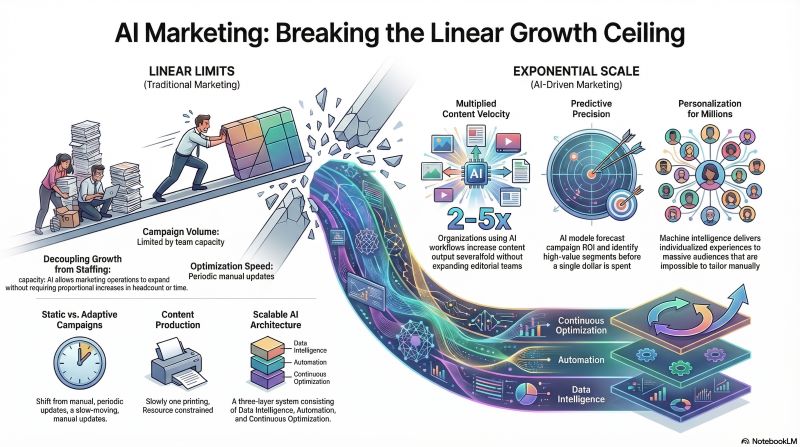
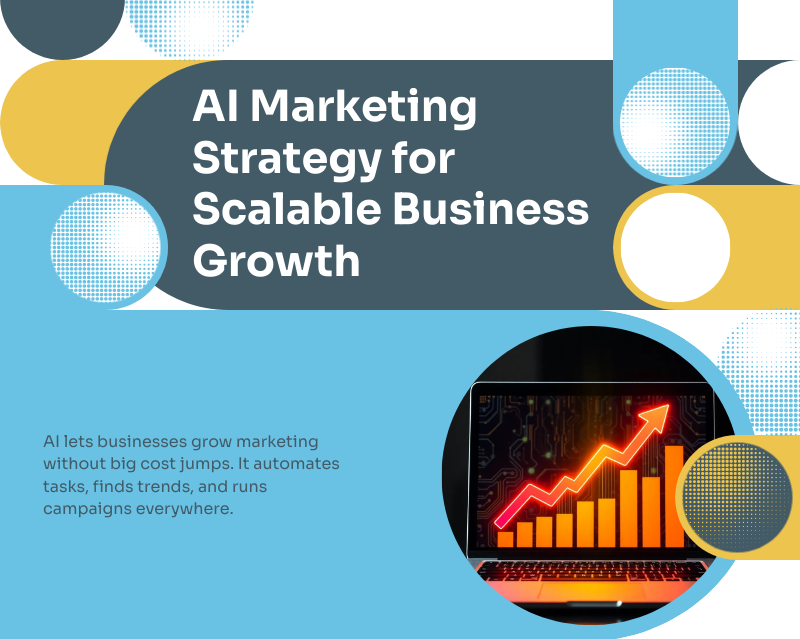
Artificial intelligence allows marketing operations to expand without requiring proportional increases in staffing, time, or operational complexity. AI systems automate repetitive tasks, surface predictive insights from large datasets, and execute campaigns across multiple channels simultaneously.
Traditional marketing growth required adding more personnel, more manual analysis, and more campaign management capacity. AI removes those limitations by allowing machines to analyze patterns, generate assets, optimize campaigns, and coordinate marketing activity at scale. Businesses that adopt AI-driven marketing frameworks can expand audience reach, increase personalization, and accelerate campaign velocity while maintaining operational efficiency.
Marketing scale, in practical terms, means the ability to increase demand generation, brand reach, and conversion performance without increasing marketing overhead at the same rate. AI transforms this from a staffing challenge into a systems challenge.
Why Traditional Marketing Structures Limit Business Growth
Conventional marketing teams often struggle with scale because the underlying processes are labor intensive. Campaign planning, content production, reporting, and optimization require human time, which creates a ceiling on how much activity a team can manage.
Several structural limitations commonly emerge:
- Manual campaign optimization slows improvement cycles
- Data analysis becomes overwhelming as datasets grow
- Content production bottlenecks restrict publishing velocity
- Personalization becomes difficult across large audiences
- Reporting delays limit decision speed
- Cross-channel coordination becomes fragmented
As marketing programs grow more complex, the workload multiplies. Without automation and machine-assisted intelligence, teams spend increasing amounts of time managing systems rather than driving strategy.
AI addresses these limitations by turning large volumes of marketing data into actionable insight and automating execution layers that previously required manual effort.
AI-Driven Marketing Systems Create Continuous Optimization Loops
AI marketing systems function as continuous feedback engines that improve campaign performance over time. Instead of static campaigns that require manual adjustments, AI tools constantly analyze performance signals and refine strategy automatically.
A scalable AI marketing architecture typically includes three interconnected components:
| Component | Function | Growth Impact |
| Data Intelligence Layer | Aggregates customer, campaign, and behavioral data | Enables predictive decision making |
| Automation Layer | Executes campaigns and operational tasks | Reduces manual workload |
| Optimization Layer | Learns from performance patterns | Improves results continuously |
When these layers operate together, marketing programs become adaptive rather than static. Campaigns refine targeting, messaging, and timing based on real-world response patterns.
The result is a marketing system that becomes more efficient as it scales.
Predictive Analytics Improves Marketing Decisions Before Campaigns Launch
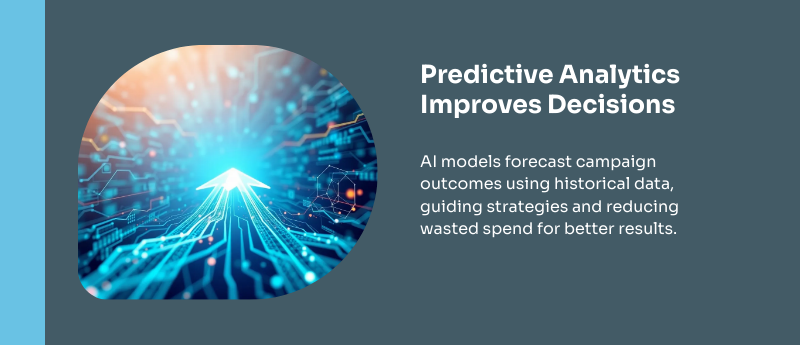
Predictive analytics allows marketing leaders to anticipate customer behavior before launching campaigns. AI models evaluate historical engagement patterns, purchase signals, and behavioral trends to forecast outcomes and guide strategic decisions.
Instead of relying on intuition or retrospective analysis, teams can identify which segments are most likely to convert, which channels deliver the highest engagement, and which messaging resonates with specific audiences.
Predictive capabilities enable several critical improvements:
- Identification of high-value audience segments
- Forecasting campaign ROI before deployment
- Determining optimal timing for outreach
- Anticipating churn or disengagement risk
- Aligning marketing efforts with sales pipeline behavior
These insights reduce wasted marketing spend and concentrate resources on the opportunities most likely to produce revenue growth.
Content Production Becomes Scalable Through AI-Assisted Creation
Content production has historically been one of the most significant bottlenecks in marketing expansion. Producing articles, content syndication, social media content, advertising copy, and video assets requires substantial time from writers, designers, and editors.
AI-assisted content systems dramatically accelerate this process.
Modern marketing organizations use AI to:
- Generate first-draft marketing copy
- Create social media variations from core messaging
- Draft long-form educational content
- Produce product descriptions at scale
- Repurpose content across multiple formats
- Localize messaging for different geographic markets
Human expertise remains essential for strategy, brand voice, and editorial oversight. However, AI dramatically increases production capacity, allowing teams to maintain consistent content velocity across multiple channels simultaneously.
Organizations that implement structured AI content workflows often increase output severalfold without expanding editorial teams.
Marketing Personalization at Scale Requires Machine Intelligence
Personalized marketing experiences increase engagement, but manually tailoring content for thousands or millions of customers is impossible without automation.
AI enables scalable personalization by dynamically adjusting messaging, offers, and content based on behavioral signals.
Common personalization capabilities include:
- Dynamic website content that adapts to visitor behavior
- Product recommendations based on browsing history
- Personalized email messaging sequences
- Behavioral retargeting across advertising channels
- Automated customer lifecycle campaigns
These capabilities transform marketing from a broadcast model into an individualized experience engine. Instead of sending identical messaging to every prospect, AI allows businesses to deliver relevant experiences tailored to each user’s interests and intent signals.
The result is improved engagement, higher conversion rates, and stronger long-term customer relationships.
AI Marketing Automation Eliminates Operational Bottlenecks
Automation platforms powered by artificial intelligence handle many operational tasks that previously required manual intervention.
Campaign scheduling, email deployment, lead scoring, and audience segmentation can all be managed automatically based on predefined logic and machine-learning insights.
A well-designed automation infrastructure typically handles:
- Email campaign orchestration
- Lead nurturing workflows
- Customer lifecycle communication
- Advertising bid adjustments
- Audience segmentation updates
- Performance monitoring alerts
This automation allows marketing teams to focus on strategy, experimentation, and creative development instead of repetitive campaign management tasks.
Operational efficiency increases dramatically once these systems are in place.
Evaluating Where AI Delivers the Greatest Marketing Impact
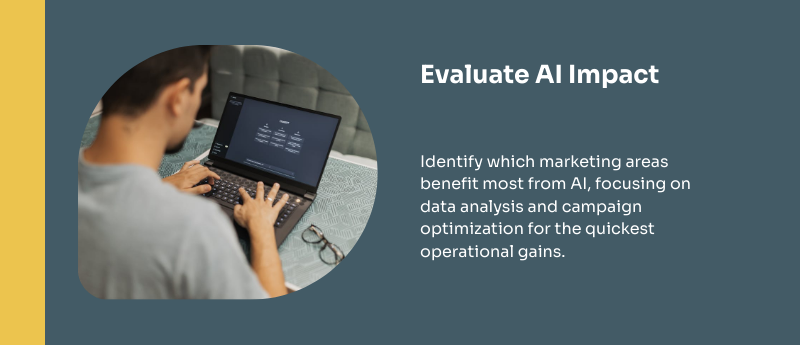
Not every marketing function benefits equally from artificial intelligence. Strategic adoption requires identifying the areas where automation and machine learning create the most leverage.
The following evaluation framework helps determine where AI investment produces the strongest results.
| Marketing Function | AI Impact Level | Reason |
| Data analysis | Very High | AI processes large datasets far faster than humans |
| Audience segmentation | High | Machine learning identifies patterns humans miss |
| Content production | High | AI accelerates drafting and repurposing |
| Campaign optimization | Very High | Algorithms continuously refine performance |
| Strategic planning | Moderate | Human judgment remains essential |
| Brand storytelling | Moderate | Creativity and nuance still require human oversight |
Businesses that begin AI adoption in high-impact areas typically see the fastest operational gains.
Building an AI-Enabled Marketing Infrastructure
Scaling marketing with AI requires more than adopting isolated tools. Sustainable growth depends on building an integrated infrastructure that connects data, automation, and content systems.
A robust AI marketing stack typically includes the following elements:
Customer Data Platform
Centralized customer data provides the foundation for AI-driven insights. Behavioral data, purchase history, engagement signals, and demographic information must be unified into a single system.
AI-Powered Marketing Automation
Automation platforms execute campaigns across channels while incorporating machine learning insights into targeting and timing.
Content Generation Systems
AI-assisted writing and creative tools increase content velocity while enabling efficient repurposing across marketing channels.
Predictive Analytics Engines
Predictive models evaluate customer behavior patterns to guide marketing investment decisions.
Performance Intelligence Dashboards
AI-driven dashboards surface emerging trends, anomalies, and growth opportunities in real time.
Without integrated infrastructure, AI tools remain fragmented and deliver limited strategic value.
Operational Risks When Scaling Marketing With AI
AI adoption introduces operational considerations that businesses must manage carefully. Poor implementation can create inefficiencies, brand inconsistency, or compliance issues.
Common risks include:
- Over-automation that removes human oversight
- Inconsistent brand voice across AI-generated content
- Data privacy vulnerabilities in automated systems
- Inaccurate predictive models due to poor data quality
- Fragmented tool ecosystems that do not integrate properly
Mitigating these risks requires clear governance structures, editorial oversight, and strong data management practices.
AI should function as a strategic augmentation layer rather than a replacement for human judgment.
Organizational Changes Required for AI-Driven Marketing
Scaling marketing through artificial intelligence often requires changes in organizational structure and workflow design.
Traditional marketing teams are often organized around channels such as email, social media, advertising, and content. AI-driven organizations increasingly shift toward systems-based structures.
Key structural changes include:
Data-Centric Decision Making
Marketing strategies increasingly rely on predictive insights rather than historical reporting.
Cross-Channel Integration
AI tools often operate across channels simultaneously, reducing the need for siloed teams.
Technical Marketing Roles
Marketing teams increasingly include specialists in automation, analytics, and AI systems management.
Faster Experimentation Cycles
AI enables rapid testing of messaging, audiences, and campaign formats.
These changes allow organizations to move faster while maintaining strategic clarity.
Comparing Traditional Marketing Growth to AI-Driven Scaling
The difference between conventional marketing expansion and AI-enabled scaling is significant.
| Factor | Traditional Marketing | AI-Driven Marketing |
| Campaign volume | Limited by team capacity | Virtually unlimited |
| Personalization | Minimal | Highly individualized |
| Optimization speed | Periodic manual updates | Continuous improvement |
| Data analysis | Manual reporting cycles | Real-time intelligence |
| Content production | Resource constrained | Rapid and scalable |
Organizations that transition to AI-enabled systems often discover that marketing capacity expands dramatically without proportional increases in cost.
Measuring Business Growth from AI Marketing Adoption
Marketing leaders evaluate AI success through measurable business outcomes rather than technology adoption alone.
Important performance indicators include:
- Customer acquisition cost reduction
- Marketing-generated revenue growth
- Conversion rate improvements
- Campaign execution speed
- Lead qualification accuracy
- Content production efficiency
AI-driven marketing should ultimately contribute to revenue expansion, improved efficiency, and stronger customer engagement.
The technology itself is not the goal; the business outcomes it enables define its value.
Long-Term Competitive Advantages of AI Marketing Systems
Businesses that implement AI marketing infrastructure early often develop durable competitive advantages. These advantages compound over time as systems accumulate more data and refine predictive models.
Long-term benefits include:
- Faster insight generation from customer behavior
- Higher campaign efficiency due to continuous learning
- Stronger personalization capabilities
- Rapid content production capacity
- Improved alignment between marketing and sales
As these capabilities mature, organizations gain the ability to respond quickly to market shifts and customer expectations.
The competitive gap between AI-enabled marketing organizations and traditional teams often widens with time.
People Also Ask – Scaling Businesses with Marketing AI
How can AI improve marketing performance?
AI improves marketing performance by analyzing large datasets, identifying behavioral patterns, automating campaign execution, and optimizing messaging in real time. These capabilities allow businesses to reach audiences more effectively and adjust campaigns continuously.
What marketing tasks can AI automate?
AI can automate audience segmentation, email marketing workflows, advertising bid management, content drafting, campaign reporting, and customer lifecycle messaging. Automation reduces manual workload while increasing campaign consistency.
Is AI replacing marketing professionals?
AI is augmenting marketing professionals rather than replacing them. Strategic planning, brand storytelling, and creative direction still require human expertise, while AI handles data analysis and operational execution.
What businesses benefit most from AI marketing?
Businesses with large customer datasets, multiple marketing channels, and ongoing content needs benefit significantly from AI-driven marketing systems. E-commerce, SaaS, financial services, and B2B lead generation organizations often see strong results.
How long does it take to implement AI marketing systems?
Implementation timelines vary depending on infrastructure complexity. Businesses with strong data integration and automation platforms can begin seeing operational improvements within months.
Do small businesses benefit from AI marketing tools?
Small businesses can benefit from AI by automating repetitive marketing tasks and improving targeting efficiency. Many modern marketing platforms incorporate AI capabilities that scale to organizations of any size.
What is the biggest challenge in adopting AI for marketing?
Data quality is often the most significant challenge. AI systems depend on accurate, structured customer data to generate reliable insights and predictions.