

The Foundation of Effective B2B Lead Generation
Generating B2B leads requires aligning messaging, channels, and offer strategy with how organizations evaluate solutions. Buyers expect clarity, relevance, and evidence of business value before entering a sales conversation. Lead generation succeeds when each touchpoint reduces friction and supports decision-making.
Companies that build their systems around qualification standards, segmented outreach, and continuous optimization produce a more predictable pipeline. The objective is not volume alone but a sustained flow of prospects who match defined revenue profiles. Strong programs rely on systematic frameworks rather than sporadic activity.
Understanding Buyer Intent and Qualification
Precise qualification determines whether lead generation supports long-term revenue outcomes. High-performing teams define their Ideal Customer Profile at the organizational, functional, and behavioral level. This standard ensures outreach focuses on companies that can purchase, adopt, and benefit from the offering.
Clear qualification criteria strengthen targeting across inbound and outbound channels. When messaging reflects a buyer’s operational challenges, conversion rates rise. Effective teams align qualification with buying committee roles, expected triggers, prior technologies, and readiness indicators.
Structuring the B2B Lead Generation Engine
A complete system integrates awareness, engagement, capture, and nurturing into a single pipeline. Each stage must support the next without relying on isolated tactics. Lead generation improves when organizations reduce silos between marketing, sales, analytics, and operations.
Successful systems share several characteristics:
- Clear audience segmentation and message mapping
- Offers tailored to intent stage
- Coordinated channel distribution
- Defined handoff rules between teams
- Consistent performance measurement across the funnel
This structure allows organizations to maintain stability even as markets fluctuate.
Inbound Strategies That Generate High-Intent Leads
Search Visibility and Organic Demand Capture
Search plays a primary role in generating B2B leads because buyers begin research independently. Companies that structure content around problem-definition queries, solution evaluation, and industry-specific needs attract visitors with clear intent.
Pages that provide clarity on use cases, workflows, and expected outcomes typically outperform product-centric content. When search visibility is supported by well-organized internal linking and consistent topical coverage, prospects develop familiarity with the brand before initial outreach. Strong SEO systems reduce acquisition costs and produce sustained compounding results.
Content Assets That Advance the Buying Process
High-performing lead generation programs use content to simplify complex decisions. Effective assets provide insights into the buyer’s operational environment and demonstrate an understanding of risk, cost, and required capabilities.
Common formats that perform well include:
- Framework explanations for solving industry problems
- Comparison resources addressing alternative approaches
- Templates, checklists, and practical tools
- Unbiased breakdowns of implementation considerations
These assets attract inbound leads because they support objective decision-making. Prospects share them internally, strengthening exposure to entire buying committees.
Gated Content and Lead Capture Mechanics
Lead capture succeeds when the offer aligns with a problem the buyer is actively attempting to solve. Gating is most effective when the value exchange is immediate and substantial. Decision-support tools, calculators, and operational templates typically outperform generic ebooks.
Capture forms require minimal friction. Fields should reflect information that directly improves qualification or routing. When the handoff between marketing automation and sales engagement is precise, speed-to-lead increases, improving conversion to opportunity.
Webinars and Event-Based Engagement
Webinars, roundtables, and virtual workshops attract buyers seeking clarity on a specific challenge. These formats support multi-stakeholder attendance, enabling organizations to influence decision groups simultaneously. Live interactions reveal objections, timelines, and organizational constraints.
Event-based leads typically carry higher intent because attendance requires commitment. When follow-up sequences reflect discussion points rather than generic messaging, the transition from event to sales conversation is smoother and more productive.
Outbound Strategies for Controlled Pipeline Expansion
Targeted Prospecting and List Development
Outbound programs succeed when built on precision rather than volume. Effective prospecting begins with clean, segmented datasets that reflect buying triggers, organizational structure, and relevant technologies. Lists must align with ICP requirements rather than broad industry categories.
Targeted lists enable tailored messaging and reduce waste in cold outreach campaigns. When aligned with intent data, website visitor identification, or firmographic indicators, outbound teams can prioritize prospects showing early buying signals.
Cold Email That Generates Responses
Cold email works when messages respect the recipient’s time and present a clear reason for engagement. The most effective outreach relies on relevance over personalization depth. Messages that demonstrate awareness of operational friction, cost inefficiencies, or strategic gaps tend to earn attention.
Strong email sequences share several traits:
- One core point per message
- Direct, specific subject lines
- Clear relevance to the buyer’s responsibilities
- Minimal formatting
- Logical progression between sequence steps
Cold email is most productive when supported by offer-based engagement rather than generic introduction attempts.
Cold Calling and Conversation-Driven Discovery
Cold calling remains effective for reaching segments that prefer direct communication. Calls that focus on understanding the prospect’s current system, constraints, or priorities tend to create more productive outcomes. A clear, concise opening sets the tone for a professional conversation.
Teams perform best when they treat calls as discovery channels rather than pitch opportunities. When paired with intent data and email outreach, calling increases response likelihood and accelerates meeting booking.
LinkedIn Outreach and Social Selling
LinkedIn supports visibility across professional audiences. Social selling works when content positions the organization as a knowledgeable participant in industry conversations. Buyers respond to insights that reflect challenges matched to their operational reality.
Connection requests and messaging must demonstrate immediate relevance. Short, value-driven messages that reference business challenges outperform transactional pitches. Consistent thought leadership strengthens brand recall when buyers enter later research phases.
Paid Advertising for Scalable Lead Flow
Paid advertising provides reach in competitive markets where organic discovery alone is insufficient. Effective campaigns focus on problem-based search terms, targeted LinkedIn segments, and retargeting frameworks.
Paid campaigns perform well when they support mid-funnel education rather than direct conversion attempts. Ads that offer tools, diagnostic assets, or assessment resources build qualified traffic. When ad targeting aligns with CRM signals and account lists, the channel becomes efficient and measurable.
Advanced Strategies That Strengthen Lead Quality
Account-Based Marketing (ABM)
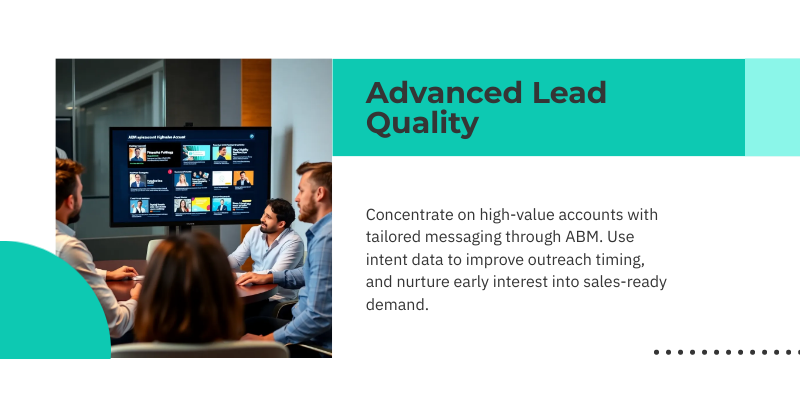
ABM concentrates resources on the highest-value accounts. These programs require coordinated messaging across marketing and sales teams. ABM works when each touchpoint reinforces the account’s priorities and connects the offering to strategic outcomes.
Personalization in ABM refers to aligning content with account-level initiatives rather than individual preferences. Teams succeed when they deliver insights that would matter to the organization’s leadership. When executed well, ABM increases close rates and compresses sales timelines.
Intent Signals and Behavioral Predictors
Intent data strengthens lead generation by identifying organizations researching relevant topics. When signals indicate shifted priorities or active evaluation, outreach timing improves. This reduces wasted effort and increases the likelihood of engagement.
Behavioral indicators—such as repeated website visits, content interactions, or comparison-related activity—help teams assign leads to appropriate nurturing tracks. When intent is combined with qualification criteria, programs produce more reliable forecasts.
Lead Nurturing and Sequence Architecture
Nurturing converts early-stage interest into sales-ready demand. Programs work when communication supports the buyer’s internal prioritization. Rather than repeating marketing messages, effective nurturing provides operational clarity.
Strong nurturing systems include:
- Segmented email cadences based on pain point or industry
- Progressive educational resources
- Logical gating of advanced assets
- Clear thresholds for sales involvement
Organizations benefit when nurturing sequences integrate with CRM data and update based on observed behavior.
Conversion Optimization and Funnel Performance Management
Lead generation programs improve when organizations examine every point of friction. Conversion optimization includes landing page relevance, form structure, message clarity, and speed-to-response. Small inefficiencies compound across the funnel, significantly reducing output.
Measuring conversion at each stage—impression to click, visitor to lead, lead to meeting, meeting to opportunity—enables targeted improvements. High-performing teams treat optimization as ongoing infrastructure work rather than campaign maintenance.
Operational Infrastructure That Supports Lead Generation
CRM Systems and Data Consistency
Reliable lead generation depends on accurate customer data. CRMs must reflect real-time activity, lead status, engagement behavior, and qualification notes. When data integrity is weak, routing slows and opportunity development becomes inconsistent.
Organizations that enforce strict data hygiene maintain stronger forecasting accuracy. Consistency improves collaboration between marketing, sales, and leadership by reducing ambiguity around lead disposition.
Marketing Automation Platforms
Automation systems support scalable nurturing, segmentation, scoring, and handoff. Their effectiveness depends on thoughtful architecture and ongoing refinement. Automated programs must align with buyer journey stages and business goals.
Automation is most effective when processes support human decision-making rather than replace it. The goal is to surface the right information at the right moment while keeping communication relevant and precise.
Performance Measurement and Iteration
Lead generation strengthens when organizations follow a closed-loop measurement system. This includes tracking acquisition sources, cost efficiency, conversion quality, and sales acceptance. Programs that rely solely on top-of-funnel volume struggle to improve over time.
Teams benefit from evaluating:
- Which channels deliver sales-qualified leads
- Which messages produce meetings
- Which offers produce pipeline
- Which industries and roles convert downstream
The objective is to reallocate resources toward high-performing segments and eliminate ineffective activity.
How Reach Marketing Supports B2B Lead Generation
Reach Marketing provides data-driven support for organizations seeking structured, scalable B2B lead generation. The company operates a proprietary database, enrichment tools, and multi-channel execution capabilities that align with complex targeting requirements. Their programs integrate direct marketing, content-driven campaigns, automation workflows, and analytics systems.
Reach Marketing also assists organizations with data hygiene, segmentation, and list development, ensuring outreach is built on accurate and relevant information. Their platform connects marketing and sales functions by centralizing activity and performance measurements. These capabilities support organizations seeking to improve lead quality and increase operational consistency.
Barriers That Weaken B2B Lead Generation
Misaligned Messaging and Buyer Priorities
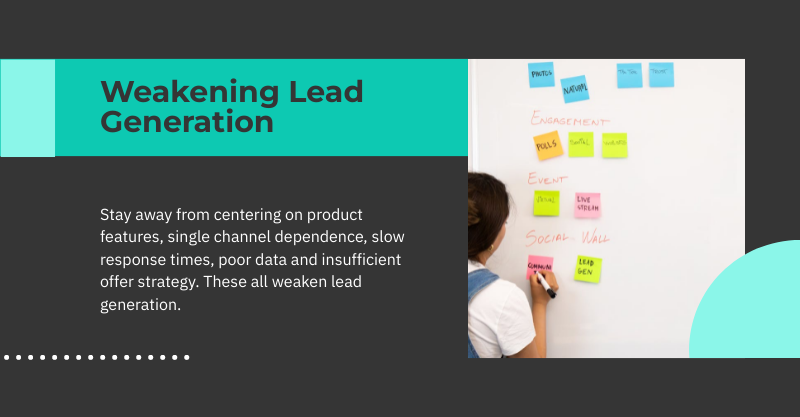
When messaging centers on product features rather than business outcomes, buyers disengage. Effective lead generation reflects an understanding of industry challenges, workflow gaps, and strategic initiatives. Organizations that refine their message architecture see improved pipeline velocity.
Over-Reliance on a Single Channel
Programs that depend exclusively on paid ads, cold outreach, or SEO experience volatility. Multi-channel lead generation stabilizes results by reaching buyers across various stages of intent. Diversification reduces risk and expands exposure to key accounts.
Lack of Speed in Lead Response
Slow response times significantly reduce conversion potential. Buyers evaluating complex solutions expect timely follow-up. Organizations benefit from defined routing rules, automated alerts, and coordinated communication across teams.
Poor Data Quality and Fragmented Systems
Inaccurate contact records, outdated firmographics, or disconnected platforms weaken the entire funnel. High-performing teams maintain strict data standards and evaluate systems regularly. Strong infrastructure prevents friction and supports scale.
Insufficient Offer Strategy
Leads convert when the offer aligns with the urgency and complexity of the prospect’s need. Generic offers underperform because they fail to differentiate the solution. Organizations that develop clear diagnostic assets and relevant tools produce stronger engagement.
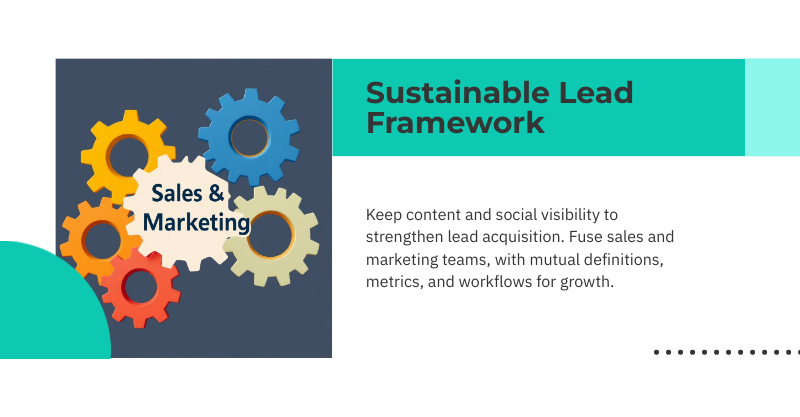
Building a Sustainable B2B Lead Generation Framework
Long-Term Audience Development
Consistent visibility strengthens future lead acquisition. Buyers often enter markets months before contacting vendors. Organizations that maintain a strong presence through content, social thought leadership, and search visibility position themselves for long-term advantage.
Audience development requires patience and disciplined execution. Over time, prospects recognize the brand as a trusted resource. This recognition reduces friction and increases the likelihood of inbound inquiries.
Integration Between Sales and Marketing
Alignment between teams increases the accuracy of qualification and improves lead progression. Sales teams provide insights into objections and buying patterns, while marketing teams produce content that advances prospects through evaluation.
Shared definitions, metrics, and workflows eliminate confusion and support consistent growth. When both teams operate from the same data and guidelines, lead generation becomes predictable and scalable.
How to Generate B2B Leads – FAQ
What is the most effective way to generate B2B leads?
The most effective approach combines inbound demand capture, outbound prospecting, and continuous optimization. Programs perform best when messaging aligns with buyer priorities.
How do companies qualify B2B leads?
Companies define qualification based on industry, company size, budget alignment, buying authority, timeline, and relevant operational needs before routing leads to sales.
Do cold emails still work for B2B lead generation?
Cold emails remain effective when messages are concise, relevant, and tied to the prospect’s responsibilities. Clear value and strong timing drive higher response rates.
How does SEO support B2B lead generation?
SEO attracts buyers conducting early research. Search visibility generates high-intent inbound leads by answering operational and strategic questions.
What role does ABM play in lead generation?
ABM focuses resources on high-value accounts through tailored messaging and coordinated outreach. It strengthens engagement across entire buying committees.
How important is intent data for B2B leads?
Intent signals improve targeting by identifying organizations actively researching relevant topics. This increases outreach efficiency and accelerates pipeline creation.
Why do some B2B lead generation programs underperform?
Underperformance often results from poor data quality, misaligned messaging, slow response times, or reliance on a single acquisition channel.