
Elon Musk’s approach to attention reveals how demand is created without traditional marketing
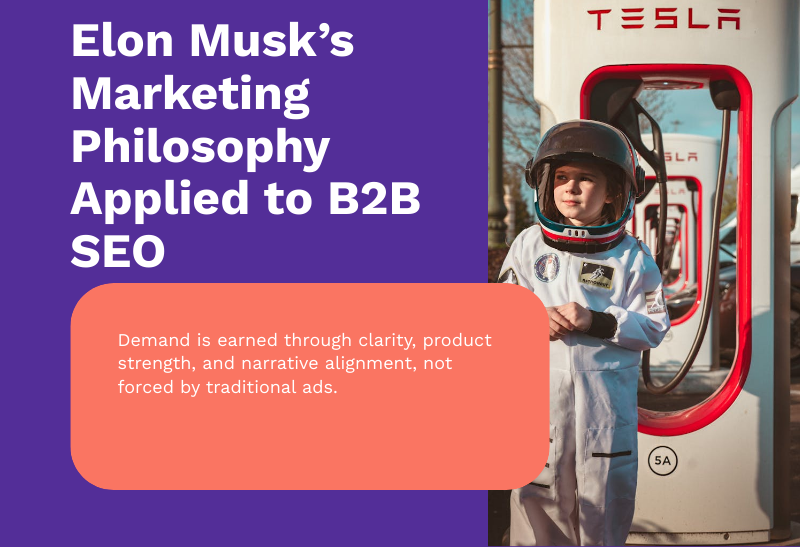
Elon Musk operates on a principle that demand should be earned through clarity, product strength, and narrative alignment rather than forced through traditional advertising. His stance—minimizing reliance on paid marketing while maximizing product visibility—demonstrates that attention follows perceived value, not promotional pressure.
This philosophy translates directly into B2B SEO and website marketing. When content, messaging, and positioning are clear and differentiated, visibility compounds organically. When they are not, no amount of optimization compensates for weak positioning.
The implication is structural. SEO is not a distribution channel for generic content. It is a system that amplifies clarity at scale.
SEO becomes a demand engine when it reflects product clarity instead of keyword targeting
SEO produces qualified demand only when it mirrors how buyers evaluate solutions, not how marketers label them. Keyword-first strategies often fragment messaging and attract misaligned traffic.
A clarity-first SEO model organizes content around decision logic:
- The operational problem being solved
- The measurable outcomes delivered
- The constraints or trade-offs involved
- The differentiators that influence selection
- The proof mechanisms that validate claims
Each page functions as a decision-support asset. This reduces ambiguity and shortens evaluation cycles.
Why keyword alignment alone underperforms
Keyword alignment without contextual depth attracts surface-level engagement. Visitors may arrive, but they do not progress.
Clarity-based content, by contrast, anticipates objections, defines outcomes, and addresses uncertainty directly. This creates momentum within the session rather than passive consumption.
Website marketing systems convert attention into pipeline when friction is intentionally removed
Website marketing determines whether attention becomes action. Simplicity, directness, and structural clarity reduce hesitation.
High-performing sites remove friction across every interaction point. They do not rely on persuasion; they rely on clarity and ease.
Key friction points that must be eliminated:
- Vague calls-to-action that fail to communicate next steps
- Overloaded navigation that disrupts decision flow
- Generic landing experiences that ignore user context
- Excessive form requirements that delay engagement
- Unclear differentiation that creates hesitation
When friction is reduced, conversion becomes a natural extension of intent.
Friction compounds across the user journey
Minor inefficiencies accumulate. A slightly unclear message combined with a slightly complex form creates a disproportionate drop in conversion.
Effective website marketing identifies and removes these compound barriers systematically.

B2B lead generation improves when authority is demonstrated instead of claimed
Authority is established through execution, not messaging. In B2B environments, credibility is evaluated through depth, specificity, and consistency.
Effective authority-building includes:
- Detailed explanations of use cases and scenarios
- Transparent discussion of limitations and trade-offs
- Structured content that reflects real operational complexity
- Consistent reinforcement of positioning across pages
This approach builds trust before direct interaction, allowing prospects to progress independently.
Demonstrated expertise accelerates internal buy-in
B2B buyers rarely act alone. Content that reflects expertise helps internal stakeholders align faster, reducing friction during decision-making.
Topic ecosystems outperform isolated content by guiding buyer progression
A structured content ecosystem provides continuity across the buyer journey. Isolated pages create gaps that users must fill themselves.
Effective ecosystems include:
- Pillar content defining the broader problem space
- Supporting content addressing specific constraints or scenarios
- Comparative content enabling evaluation
- Decision-stage content facilitating action
Internal linking reflects progression, not hierarchy.
Content pathways should mirror decision pathways
Users move from problem recognition to solution validation to selection. Content should mirror this sequence, reducing cognitive load.
Strategic differentiation matters more than volume in competitive markets
Volume without differentiation accelerates irrelevance. Distinct positioning creates leverage.
Differentiation requires:
- A clear point of view that challenges conventional assumptions
- Language that reflects how buyers think and operate
- Outcome-driven messaging rather than feature descriptions
- Consistency across all touchpoints
When differentiation is strong, each page reinforces the same narrative, increasing memorability and trust.
Conversion pathways must align with how B2B buyers actually make decisions
B2B decisions involve multiple stakeholders, varying timelines, and non-linear progression. Conversion pathways must accommodate this complexity.
A flexible pathway includes:
- Educational entry points for early-stage exploration
- Validation assets for internal discussions
- Conversion options aligned with readiness levels
- Role-specific pathways for different stakeholders
Rigid funnels fail because they assume uniform intent.
Multi-threaded decision processes require multiple entry points
Different stakeholders engage at different stages. Effective systems provide relevant entry points for each role without forcing a linear sequence.

Measuring SEO success requires pipeline alignment rather than traffic growth
Traffic alone does not indicate effectiveness. Measurement must reflect business impact.
Key evaluation metrics include:
| Metric Type | What It Indicates | Strategic Value |
| Qualified Organic Sessions | Alignment with target audience | Validates positioning |
| Conversion Rate by Intent | Effectiveness of page structure | Identifies friction points |
| Lead Quality | Sales readiness of inbound leads | Measures real impact |
| Pipeline Contribution | Revenue influence of SEO | Aligns marketing with business goals |
These metrics align SEO with revenue outcomes rather than activity levels.
Operational consistency determines whether strategy compounds or stalls
Consistency enables compounding. Without it, progress resets with each initiative.
Operational consistency includes:
- Iterative refinement of messaging based on performance
- Continuous expansion of topic coverage within defined frameworks
- Regular evaluation of conversion pathways
- Alignment between marketing, sales, and product teams
Execution discipline determines long-term outcomes.
Iteration outperforms periodic overhaul
Frequent, targeted improvements produce more reliable gains than large, infrequent changes.
Misaligned messaging is the primary cause of underperforming SEO programs
Messaging misalignment creates disconnects between traffic and conversion. Users arrive with specific expectations and leave when those expectations are not met.
Common sources of misalignment include:
- Overly abstract language that lacks operational meaning
- Feature-heavy messaging that ignores outcomes
- Inconsistent positioning across pages
- Failure to address real buyer concerns
Correcting messaging often produces immediate performance improvements.
Website structure influences how efficiently users reach conversion points
Structure determines navigation efficiency. Poor structure increases cognitive load and reduces progression.
Effective structure includes:
- Clear content hierarchy aligned with user intent
- Logical navigation that reflects decision pathways
- Minimal redundancy across pages
- Direct access to high-value content
Users should not need to search within the site to find relevant information.
Structural clarity reduces decision fatigue
When users can easily locate relevant content, they are more likely to continue progressing rather than disengage.

Content depth determines whether users progress or disengage
Depth signals credibility. Shallow content fails to support decision-making.
Effective content depth includes:
- Detailed explanations of processes and outcomes
- Specific examples that reflect real-world application
- Clear articulation of constraints and limitations
- Structured comparisons where relevant
Depth must be balanced with clarity to maintain usability.
Lead capture strategy must balance accessibility with qualification
Lead capture should not create unnecessary barriers, but it must maintain lead quality.
Effective strategies include:
- Progressive forms that reduce initial friction
- Contextual gating based on content value
- Clear explanation of what happens after submission
- Alternative engagement options for different readiness levels
Overly aggressive gating reduces engagement, while overly passive capture reduces quality.
High-intent search behavior reveals how B2B buyers actually enter the funnel
B2B buyers consistently enter the funnel through problem-oriented and solution-validation queries rather than branded searches. These entry points are typically framed around operational challenges, performance improvement, or vendor comparison rather than product names.
Common entry patterns include:
- Defining a problem (“what is B2B lead generation”)
- Evaluating approaches (“SEO for lead generation strategy”)
- Comparing solutions (“best way to generate B2B leads online”)
- Validating decisions (“how to improve website conversion rate”)
These queries reflect a progression from uncertainty to evaluation. SEO strategies that fail to align with this progression capture fragmented traffic rather than structured demand.
Effective systems anticipate these entry points and build content that meets buyers exactly where they are, rather than forcing them into predefined narratives.
Long-tail keyword strategy drives higher conversion because it reflects decision specificity
Long-tail queries consistently produce higher conversion potential because they reflect specificity of need rather than general curiosity. These queries often include qualifiers such as industry, use case, or outcome.
This distinction matters because specificity signals readiness.
Examples of high-conversion query structures include:
- “B2B SEO strategy for SaaS companies”
- “how to generate qualified B2B leads through SEO”
- “website marketing strategy for lead generation”
- “improve B2B website conversion rate”
Long-tail queries inherently carry clearer intent, which allows content to deliver more precise answers. This alignment reduces ambiguity and increases the likelihood of progression toward conversion.
Precision outperforms volume in B2B environments
Broad queries attract wide audiences but dilute relevance. Specific queries attract smaller audiences but concentrate intent.
In B2B marketing, concentration of intent consistently outperforms scale of reach.

“What is” and “how to” queries function as the foundation of scalable demand generation
Informational queries represent the earliest stage of demand creation. These queries are not passive—they indicate active problem recognition.
Examples include:
- “what is B2B lead generation”
- “how does SEO generate leads”
- “how to build a website marketing strategy”
These entry points create the foundation for demand generation by introducing structured understanding. Demand generation itself is the process of building awareness, validating relevance, and guiding evaluation toward a solution.
Organizations that ignore these queries for being “too top-of-funnel” forfeit control over early-stage perception. Organizations that address them effectively shape how buyers define problems and evaluate solutions from the outset.
Early-stage clarity reduces downstream friction
When foundational understanding is established early, later-stage conversion becomes more efficient. Buyers require less persuasion because the framework for decision-making has already been established.
Conversion-focused website marketing must align with evaluation-stage queries
Evaluation-stage queries signal that buyers are actively narrowing options. These queries are structurally different from informational searches and require different content responses.
Common evaluation queries include:
- “best B2B lead generation strategies”
- “SEO vs PPC for B2B lead generation”
- “how to improve website conversion rates”
At this stage, content must shift from explanation to validation.
Effective response structures include:
- Direct comparisons of approaches
- Clear articulation of trade-offs
- Operational implications of each option
- Defined criteria for decision-making
Website marketing systems must recognize this shift and provide content that reduces uncertainty rather than introducing new information.
Common misconceptions about SEO and B2B lead generation limit performance
Misconceptions introduce structural inefficiencies that compound over time.
Key misconceptions include:
- Treating SEO as a traffic channel rather than a demand system
- Assuming more content automatically improves results
- Prioritizing keywords over clarity
- Relying on gated assets without building trust first
- Viewing website marketing as design rather than infrastructure
Correcting these issues improves performance without increasing output.
People Also Ask
How does SEO support B2B lead generation?
SEO supports B2B lead generation by aligning content with buyer intent and guiding users toward structured conversion pathways.
What makes a B2B website effective for lead generation?
An effective B2B website removes friction, communicates value clearly, and supports multiple decision pathways.
Why is product clarity important for SEO?
Product clarity ensures alignment between user expectations and content, improving both engagement and conversion.
How do you measure success in B2B SEO?
Success is measured through qualified traffic, conversion rates, lead quality, and contribution to pipeline.
What is the role of content in website marketing?
Content functions as a decision-support system that educates, validates, and drives progression toward action.
Why do many SEO strategies fail in B2B?
Many fail due to misalignment between intent, messaging, and conversion structure.
How can companies improve website conversion rates?
Conversion rates improve when friction is reduced and pathways align with real decision-making behavior.