
Content syndication gets a bad rap when it’s treated like a “volume play.” The best programs are the opposite: they’re built around clear targeting, clean data, strong assets, and a tight handoff to sales.
This guide is a practical blueprint for building a b2b content syndication program (especially via email) that consistently produces leads your team can work—without burning budget or patience.
What b2b content syndication really is (and what it isn’t)
At its simplest, content syndication is the distribution of your gated asset—white paper, guide, checklist, report, webinar on-demand—to a relevant audience you don’t already own.
- It is a way to reach qualified buyers earlier in the journey.
- It is a way to generate net-new leads at scale when organic is slow.
- It isn’t a magic button that replaces product marketing, sales follow-up, or a solid offer.
Treat it as a distribution channel, not a replacement for strategy.
Why email-based content syndication works for lead generation
Email is direct. It’s fast. And it’s measurable.
When content is emailed to a permission-based audience, you get three big advantages:
- Clear engagement signal: a click and download says “this topic matters.”
- Speed to lead: the gap between interest and capture can be minutes.
- Targeting control: you can focus on titles, industries, company sizes, regions, and more.
The value isn’t “email” as a tactic—it’s email plus targeting plus verified data plus a meaningful asset.
Start with one outcome: what should this program produce?
Before you pick an asset or an audience, define the outcome in plain language. Examples:
- “Generate 250 engaged leads in logistics and manufacturing IT within 60 days.”
- “Build a net-new list of security decision makers for Q1 pipeline.”
- “Fill the top of funnel for a new product category and learn which vertical responds.”
Then decide which metric is the success marker:
- Cost per lead (CPL)
- Cost per marketing qualified lead (CPMQL)
- Sales accepted leads (SALs)
- Meetings set
- Pipeline influenced
If you can’t name the outcome, your targeting will sprawl, your creative will drift, and the reporting will disappoint.
Choose an asset that earns the click
Not every gated asset is syndication-ready. The best performers are:
- Highly specific (a real problem for a real persona)
- Immediately useful (templates, checklists, calculators, playbooks)
- Credible (original perspective, data, customer proof, expert interviews)
- Skimmable (clear headings, quick wins in the first few pages)
Assets that struggle:
- Overly broad “ultimate guides” with no point of view
- Webinar recordings without a strong, punchy promise
A fast test: if you wouldn’t personally trade an email address for it, prospects won’t either.
Build targeting that mirrors your best customers
Content syndication performs best when it mirrors the ICP you already know converts.
Start with:
- Industry / vertical
- Company size (employee count or revenue band)
- Geography
- Role and seniority
- Department/function
- Common tech stack signals (if available)
Then narrow further with intent-friendly filters:
- Companies investing in a related initiative
- Roles that own the problem (not just “influencers”)
- Sub-verticals where your differentiation is strongest
Tip: the tighter you target, the more your headline and landing experience matter—because you’re trading volume for relevance.
Decide what “qualified” means in a syndication context
For most syndication programs, “qualified” is engagement-based:
- A prospect downloads the asset (or completes the gated action)
- The prospect matches your targeting criteria
That’s it.
Avoid overcomplicating qualification upfront. Instead, build a clean process:
- Engaged lead → routed fast
- Follow-up sequence → adds context
- Sales feedback loop → refines targeting
This is how the program improves over time.
Write email creative that feels like a helpful invite, not a pitch
Syndication emails perform when they read like this:
- “Here’s something useful”
- “Here’s why it matters”
- “Here’s what you’ll get”
- “Here’s one clear next step”
Structure that works:
- A single promise (one sentence)
- A short list of takeaways (3 bullets max)
- One CTA
Example copy block (adapt to your offer):
- “Download the guide to reduce onboarding time by 20–30% with a repeatable workflow.”
- “Inside: a rollout checklist, sample timeline, and stakeholder map.”
- CTA: “Get the guide”
Landing page basics that keep conversion high
Even if distribution happens through a partner, your landing destination still matters.
Must-haves:
- Same headline as the email
- 3–5 key takeaways
- Short form (ask only what you need)
- Privacy/permission language that’s easy to understand
- Mobile-friendly page speed
If your form asks for too much, you’ll see it in conversion rates—and you’ll blame the channel when it’s the form.
Operational checklist for a lead-ready program
Before launch
- Finalize ICP filters and exclusions
- Confirm data permission standards
- Align on lead fields (what you’ll receive)
- Align on lead delivery method (CRM, secure file, etc.)
- Set follow-up SLAs (how fast you’ll contact leads)
- Create reporting cadence (weekly works well)
During the flight
- Monitor lead volume vs. target
- Watch quality signals (bouncebacks, wrong titles, bad fits)
- Review creative performance (open/click if available)
- Adjust targeting if a subsegment underperforms
After
- Hold a short retro
- Keep the winners (segments, headlines)
- Retire what didn’t convert
How to follow up so leads don’t go cold
The biggest missed opportunity in syndication is slow follow-up.
A practical follow-up approach:
- Day 0 (same day): “Here’s the asset + 1 question”
- Day 2: “Most common next step after this guide”
- Day 5: “Related resource + quick use case”
- Day 9: “Offer a short call or demo (optional)”
- Day 14: “Last touch: keep the door open”
Sales doesn’t need to “hard sell” these leads. The goal is to continue the conversation the asset started.
Common pitfalls (and quick fixes)
| Common pitfall | Quick fix |
|---|---|
| Targeting is too broad | Start with two verticals and two role bands for the first flight. |
| The asset is too generic | Reposition with a sharper promise and clear takeaways. |
| Leads aren’t contacted fast | Set an SLA and automate routing. |
| Quality feedback is vague (“bad leads”) | Require specific notes: wrong role, wrong industry, wrong size, no response, etc. |
A realistic expectation for results
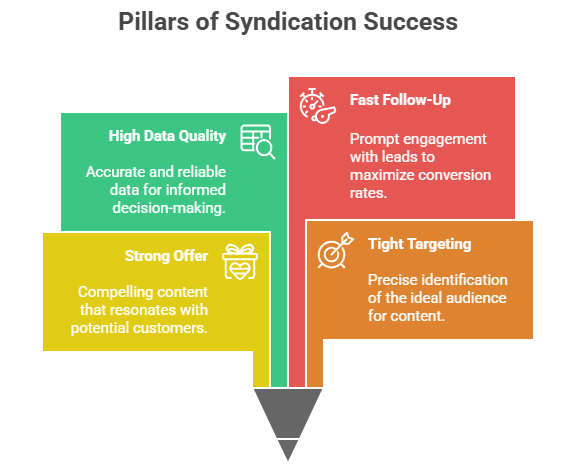
Content syndication is a reliable channel when:
- the offer is strong
- targeting is tight
- data quality is high
- follow-up is fast
It can fill the top of funnel, support pipeline goals, and help your team learn which messages resonate—especially when paired with retargeting and nurture.
If you want a simple next step: pick one great asset, one tight ICP, and run a 30–45 day pilot with clear reporting. Then iterate.