
What defines effective B2B lead generation in 2026
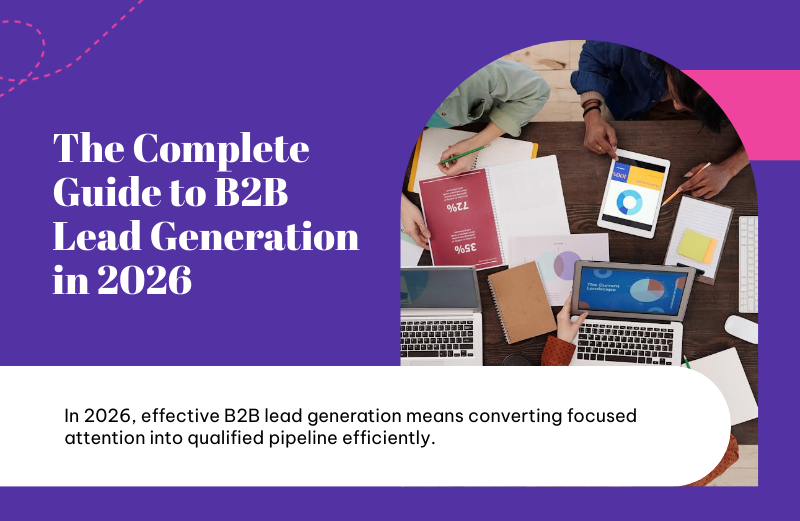
B2B lead generation in 2026 is defined by the ability to consistently convert targeted attention into qualified pipeline while maintaining efficiency across long, multi-stakeholder buying cycles. Average website conversion rates remain between 2% and 5%, but high-performing programs exceed this by aligning messaging, targeting, and offer structure with clear buyer intent.
Performance is no longer measured by raw lead volume. It is measured by how effectively leads progress through qualification stages and ultimately convert into revenue. Most B2B funnels still follow a predictable pattern: a small percentage of visitors convert into leads, a fraction of those become marketing-qualified, and only a subset advance to sales-qualified opportunities.
This layered conversion structure means that small inefficiencies at the top of the funnel compound significantly downstream. A marginal increase in visitor-to-lead conversion can produce disproportionately larger gains in pipeline and closed revenue when applied across the entire funnel.
How extended buying cycles reshape lead generation strategy
Modern B2B buying cycles often extend beyond 9–12 months, requiring lead generation programs to operate as long-term influence systems rather than short-term acquisition tactics. Buyers rarely convert after a single interaction and instead move through a structured evaluation process involving multiple stakeholders.
Typical buying groups now include 6–10 decision-makers, each evaluating different aspects of a solution. This complexity requires content, messaging, and outreach to address technical validation, financial justification, and operational impact simultaneously.
Buyers also engage with multiple content assets before entering a sales conversation. In most cases, a prospect will consume between five and seven pieces of content before becoming a qualified lead. This behavior reinforces the need for consistent, high-quality touchpoints throughout the funnel.
Operational implications include:
- Lead nurturing becomes as critical as lead acquisition
- Attribution must account for multiple interactions over time
- Early-stage engagement must be designed to educate, not convert
Lead generation systems that fail to accommodate these realities tend to produce low-quality leads and inconsistent pipeline performance.
Which B2B lead generation channels produce the highest ROI
Channel effectiveness in B2B lead generation is determined by intent alignment, cost efficiency, and downstream conversion performance rather than top-of-funnel volume alone.
Search-driven acquisition remains one of the most reliable sources of high-intent leads, often contributing over 40% of total lead volume in mature programs. These leads typically demonstrate stronger conversion rates due to active problem awareness.
LinkedIn continues to dominate B2B social environments. A significant majority of B2B marketers rely on LinkedIn for lead generation due to its targeting precision and professional context. Conversion rates from LinkedIn lead forms can reach 10–15% when campaigns are properly structured.
Paid media channels vary widely in performance:
| Channel | Typical Conversion Rate | Strategic Role |
| Search Ads | 3–7% | High-intent capture |
| LinkedIn Ads | 5–15% | Targeted outreach |
| Display/Meta Ads | 1–3% | Awareness and retargeting |
Email and outbound channels introduce different dynamics. Cold outreach typically converts at lower rates, often around 1% for meeting bookings, but can be highly scalable when targeting is precise.
The highest-performing lead generation strategies combine multiple channels to capture demand at different stages of the buying process rather than relying on a single source.
What a strong B2B conversion rate looks like across the funnel
A strong B2B conversion rate varies by context, but consistent benchmarks provide a framework for evaluation. Website conversion rates typically fall between 1.8% and 2.5%, while high-performing environments reach 3–5% or higher.
Landing pages and gated assets outperform general site pages due to focused intent. Median landing page conversion rates sit around 6–7%, with top performers exceeding 10% through optimized design and messaging.
A typical B2B funnel converts at the following rates:
| Funnel Stage | Average Conversion Rate |
| Visitor → Lead | 2–3% |
| Lead → MQL | ~30% |
| MQL → SQL | ~10–15% |
| SQL → Opportunity | 30–50% |
| Opportunity → Customer | 20–30% |
These benchmarks highlight the importance of maintaining efficiency at each stage. A breakdown in any single step significantly impacts overall pipeline performance.
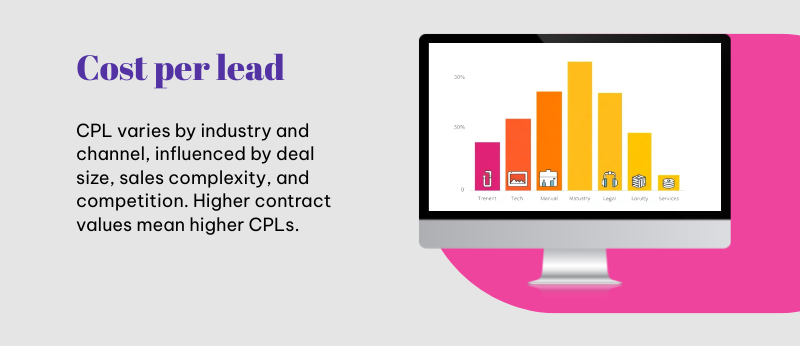
Why cost per lead varies significantly by industry and channel
Cost per lead (CPL) in B2B environments is influenced by deal size, sales complexity, and competitive dynamics. Industries with higher contract values and longer sales cycles naturally sustain higher CPLs.
Typical CPL ranges include:
- B2B SaaS: $150–$300
- Manufacturing: $300–$400
- IT services: $400–$500
- Legal and specialized services: $600+
Channel selection also impacts cost structure:
- Paid LinkedIn leads often exceed $400 per lead
- Search-driven leads range between $200–$500
- Organic channels typically deliver lower CPL but require longer ramp time
Lower CPL does not equate to better performance. Leads acquired at a higher cost often convert at higher rates and move through the pipeline more efficiently.
Effective evaluation of CPL requires alignment with:
- Customer lifetime value
- Close rate
- Sales cycle duration
Without this context, CPL becomes a misleading metric.
How content strategy drives measurable lead generation outcomes
Content plays a central role in B2B lead generation by enabling prospects to self-educate and validate decisions before engaging with sales. High-performing content aligns directly with buyer intent at different stages of the funnel.
Certain formats consistently outperform others:
- Webinars frequently achieve conversion rates near 30–40% due to high engagement
- Whitepapers and technical guides convert between 12–20%
- Case studies significantly influence late-stage decision-making
Content effectiveness depends on its role within the buyer journey:
- Early-stage content builds awareness and problem definition
- Mid-stage content supports evaluation and comparison
- Late-stage content reduces risk and validates decisions
A fragmented content strategy produces inconsistent engagement. Structured content ecosystems that guide prospects through each stage generate more predictable lead flow and higher-quality opportunities.
Which operational systems separate top-performing B2B teams
Operational infrastructure has become a primary differentiator in B2B lead generation performance. High-performing organizations rely on tightly integrated systems that connect marketing, sales, and analytics functions.
Key system components include:
- CRM platforms with real-time data synchronization
- Marketing automation tools for lead nurturing
- Lead routing systems that ensure immediate follow-up
- Scheduling tools that reduce friction in booking meetings
Speed of response is a critical factor. Leads contacted within minutes of submission convert at significantly higher rates than those contacted hours later. Automated routing and scheduling systems enable this level of responsiveness at scale.
Lead-to-meeting conversion rates further illustrate this gap. Modern systems achieve booking rates exceeding 50–60%, while traditional processes fall significantly lower due to delays and inefficiencies.
Why multi-channel strategies outperform single-channel approaches
Multi-channel lead generation strategies outperform single-channel approaches by capturing demand across different touchpoints and stages of the buyer journey.
B2B buyers do not operate within a single platform. They move between search engines, social networks, email, and direct outreach as they evaluate solutions. A multi-channel approach ensures consistent visibility throughout this process.
Advantages of multi-channel strategies include:
- Increased touchpoint frequency
- Improved brand recall during evaluation
- Reduced reliance on any single acquisition source
- Greater resilience to channel performance fluctuations
Programs that integrate search, paid media, outbound, and content-driven acquisition consistently produce more stable and scalable pipeline growth.
How lead quality directly impacts revenue outcomes
Lead quality has become the defining factor in B2B lead generation success. High-quality leads convert faster, require fewer resources, and produce more predictable revenue outcomes.
Characteristics of high-quality leads include:
- Alignment with ideal customer profiles
- Demonstrated intent through engagement behavior
- Clear organizational need for the solution
- Ability to influence or make purchasing decisions
Low-quality leads create operational inefficiencies. Sales teams spend more time qualifying prospects, conversion rates decline, and sales cycles extend unnecessarily.
Prioritizing lead quality over volume results in:
- Higher close rates
- Shorter sales cycles
- Improved revenue predictability
This shift requires more precise targeting, stronger messaging, and better qualification criteria.
How account-based strategies change B2B lead generation outcomes
Account-based lead generation increases efficiency by focusing resources on high-value targets rather than broad audience capture. Instead of generating large volumes of unqualified leads, this approach concentrates effort on specific organizations that match ideal customer profiles.
Conversion performance within account-based programs is consistently higher because outreach, messaging, and content are tailored to known business challenges. Engagement rates improve when messaging reflects industry-specific pain points, organizational structure, and decision-making priorities.
Operationally, account-based strategies require tighter coordination between marketing and sales teams. Target account lists must be clearly defined, and engagement must be tracked across multiple stakeholders within each organization. This creates a more complex system but produces significantly higher-quality pipeline.
Key advantages of account-based lead generation include:
- Higher conversion rates at each funnel stage
- Improved deal sizes due to better targeting
- Reduced wasted spend on low-fit prospects
- Stronger alignment between marketing and sales
This approach is particularly effective in industries where deal values are high and buying groups are complex.
What role personalization plays in improving lead conversion rates
Personalization directly increases engagement and conversion by aligning messaging with the specific needs of each prospect. Generic messaging struggles to resonate in environments where buyers expect relevance and precision.
Personalized experiences can include:
- Industry-specific landing pages
- Role-based messaging tailored to decision-makers
- Dynamic content that reflects prior engagement behavior
- Customized outreach sequences
These adjustments significantly improve key performance metrics. Personalized email campaigns often achieve higher open and response rates, while tailored landing pages convert more effectively than generic alternatives.
At scale, personalization requires structured data and automation. Systems must track user behavior, segment audiences, and dynamically adjust messaging in real time. Without this infrastructure, personalization efforts become inconsistent and difficult to maintain.
The impact of personalization is cumulative. Small improvements in engagement at multiple touchpoints result in higher overall conversion rates across the funnel.
Why lead nurturing systems determine long-term pipeline growth
Lead nurturing systems are responsible for converting early-stage interest into qualified opportunities over time. Without structured nurturing, a large percentage of leads never progress beyond initial engagement.
Effective nurturing programs focus on delivering relevant content at the right stage of the buyer journey. This includes:
- Educational content for early-stage prospects
- Comparative and technical content for evaluation stages
- Proof-based content for decision support
Timing and consistency are critical. Sporadic or misaligned communication reduces engagement, while structured sequences maintain momentum and guide prospects toward conversion.
Nurturing systems also help identify readiness signals. Engagement patterns—such as repeated visits, content downloads, or webinar participation—indicate increasing intent and allow for timely sales intervention.
Organizations with strong nurturing systems consistently generate more pipeline from the same volume of leads compared to those relying solely on initial conversion.
How landing page optimization directly impacts lead volume
Landing page performance is one of the most controllable variables in B2B lead generation. Small improvements in conversion rates can significantly increase total lead volume without increasing traffic.
High-performing landing pages share several characteristics:
- Clear and specific value propositions
- Minimal form friction with optimized field requirements
- Strong visual hierarchy guiding user attention
- Trust signals such as testimonials or client logos
Form design plays a particularly important role. Reducing the number of required fields often increases conversion rates, though it may impact lead qualification. The balance between volume and quality must be carefully managed.
Testing and iteration are essential. Continuous experimentation with headlines, layouts, and calls to action allows organizations to identify incremental improvements that compound over time.
Landing page optimization is one of the highest-leverage activities within a lead generation program because it directly affects the conversion of existing traffic.
What metrics matter most when scaling B2B lead generation
Scaling lead generation requires focusing on metrics that directly correlate with revenue rather than surface-level indicators. Many programs fail to scale effectively because they prioritize engagement metrics over pipeline impact.
The most critical metrics include:
- Cost per qualified opportunity
- Conversion rates between funnel stages
- Pipeline velocity (time from lead to close)
- Customer acquisition cost relative to lifetime value
- Channel-specific revenue contribution
These metrics provide a more accurate view of performance because they reflect both efficiency and outcome. High lead volume with poor conversion rates does not translate into sustainable growth.
Tracking these metrics requires integrated systems and consistent data collection. Without reliable data, decision-making becomes reactive and inefficient.
Organizations that align their measurement framework with revenue outcomes are better positioned to scale lead generation efforts predictably.
How outbound and inbound strategies complement each other
Outbound and inbound lead generation strategies serve different but complementary roles within a complete system. Inbound channels capture existing demand, while outbound efforts create new opportunities by initiating conversations.
Inbound strategies typically include:
- Search-driven acquisition
- Content marketing
- Organic engagement channels
Outbound strategies include:
- Cold email outreach
- Targeted LinkedIn messaging
- Direct prospecting efforts
The integration of these approaches creates a more balanced pipeline. Inbound channels provide a steady flow of high-intent leads, while outbound efforts expand reach and engage prospects earlier in the buying cycle.
Organizations that rely exclusively on inbound often experience inconsistent lead flow, while those focused only on outbound may face scalability challenges. Combining both approaches creates a more resilient and predictable system.
Why continuous optimization is required for sustained performance
B2B lead generation systems require ongoing optimization to maintain and improve performance over time. Static strategies quickly lose effectiveness as market conditions, competition, and buyer expectations evolve.
Continuous optimization involves:
- Testing messaging and positioning
- Refining targeting criteria
- Improving conversion pathways
- Adjusting channel allocation based on performance
Even small improvements can have a significant impact when applied consistently. Increasing conversion rates by a fraction of a percentage at multiple stages results in meaningful pipeline growth.
Optimization should be treated as an ongoing process rather than a one-time initiative. Organizations that embed testing and iteration into their operations consistently outperform those that rely on fixed strategies.
What common mistakes limit B2B lead generation performance
Several recurring mistakes prevent organizations from achieving consistent lead generation results.
Overemphasis on lead volume
Focusing on volume without qualification leads to inflated pipeline metrics that do not convert into revenue.
Misalignment between marketing and sales
When lead definitions differ between teams, conversion rates decline and pipeline efficiency suffers.
Delayed follow-up processes
Slow response times significantly reduce the likelihood of converting leads into opportunities.
Channel dependency
Relying heavily on a single channel exposes programs to performance volatility.
Lack of funnel visibility
Without clear measurement at each stage, inefficiencies remain hidden and unresolved.
Addressing these issues requires a structured approach that prioritizes alignment, speed, and measurement.
How to evaluate and prioritize B2B lead generation investments
Evaluating lead generation investments requires a multi-dimensional approach that extends beyond surface-level metrics.
Key evaluation criteria include:
- Cost per qualified opportunity
- Conversion rates across funnel stages
- Sales cycle velocity
- Revenue contribution by channel
- Scalability of acquisition strategies
A structured evaluation framework ensures that resources are allocated toward strategies that produce measurable business outcomes rather than short-term engagement.
What role data and analytics play in modern lead generation systems
Data and analytics are central to optimizing B2B lead generation performance. High-performing organizations rely on detailed measurement to identify inefficiencies and guide decision-making.
Critical data points include:
- Conversion rates at each funnel stage
- Channel-level performance metrics
- Engagement patterns across content assets
- Lead scoring and qualification data
Advanced analytics enable continuous optimization. By identifying where prospects drop off in the funnel, organizations can refine messaging, improve targeting, and increase overall conversion efficiency.
Data-driven lead generation is not a one-time implementation. It is an ongoing process of testing, measurement, and refinement.
FAQ: B2B Lead Generation in 2026
What is a good B2B lead conversion rate?
A strong B2B conversion rate typically falls between 3% and 5%, with top-performing programs exceeding 8% depending on context.
How much does a B2B lead cost in 2026?
Costs vary widely by industry, but most B2B leads range between $150 and $600 depending on complexity and channel.
Which channel is best for B2B lead generation?
Search and LinkedIn are consistently effective, though optimal performance depends on targeting and execution.
How long does it take to convert a B2B lead?
Most B2B sales cycles extend beyond 9–12 months due to complex decision-making processes.
What is the average B2B funnel conversion rate?
Typical funnels convert 2–3% of visitors into leads, with decreasing conversion rates at each subsequent stage.
How many touchpoints are needed to convert a B2B buyer?
Most buyers engage with five to seven pieces of content before initiating a sales conversation.
Are webinars effective for B2B lead generation?
Yes, webinars remain one of the highest-performing formats, often achieving conversion rates near 30–40%.