
AI-driven B2B lead generation replaces manual prospecting with adaptive acquisition systems
AI-driven B2B lead generation transforms acquisition from isolated campaigns into continuous, adaptive systems that identify, capture, and develop qualified buyers at scale. Instead of relying on static targeting criteria or periodic outreach, AI-enabled infrastructure continuously evaluates behavioral signals, engagement patterns, and conversion outcomes to refine acquisition precision.
This shift fundamentally alters how pipeline is created. Traditional lead generation is episodic and labor-intensive, while AI-driven systems operate continuously, increasing efficiency and consistency without proportional increases in staffing or budget.
The structural advantages of AI-enabled acquisition include:
- Continuous optimization of targeting criteria based on real conversion outcomes
- Automatic prioritization of high-likelihood prospects
- Reduced dependence on manual list building and cold outreach
- Improved efficiency of downstream nurturing workflows
- Increased scalability without proportional operational complexity
- Greater predictability in pipeline contribution over time
The result is a transition from campaign-driven acquisition to infrastructure-driven pipeline creation.
Content syndication functions as a scalable external acquisition layer for qualified prospects
Content syndication expands reach beyond owned channels by distributing valuable content assets across established professional audiences. This enables organizations to access relevant buyers without requiring prior brand awareness or direct audience ownership.
Syndication operates as a top-of-funnel acquisition mechanism that introduces new prospects into the pipeline by exchanging valuable informational content for contact engagement. These contacts enter acquisition systems with demonstrated topical interest, improving downstream qualification efficiency.
Unlike traditional advertising, content syndication emphasizes informational exchange rather than promotional interruption. This distinction produces structurally higher-quality acquisition because engagement is voluntary and topic-driven.
Content syndication provides several operational advantages:
- Immediate access to large, relevant professional audiences
- Faster audience expansion compared to organic-only growth
- Improved prospect qualification through content-driven engagement
- Reduced reliance on cold outreach channels
- Consistent inflow of new acquisition opportunities
- Lower friction entry points for early-stage buyers
This makes syndication an effective mechanism for introducing new potential buyers into the acquisition system.
Email lists represent the most durable and controllable lead generation asset
Email databases provide direct, persistent access to prospects without dependency on third-party platforms or algorithmic visibility constraints. This makes email lists structurally different from externally controlled acquisition channels.
Owned contact databases accumulate long-term value because they support repeated engagement, progressive qualification, and conversion over extended time horizons. Unlike paid acquisition channels, email databases do not require repeated payment to maintain accessibility.
The durability of email infrastructure provides several strategic advantages:
- Direct communication without intermediary platforms
- Compounding value as database size and quality increase
- Lower long-term cost per acquisition
- Greater control over messaging and segmentation
- Improved retention and lifetime value development
- Reduced exposure to external platform policy changes
This transforms email lists from tactical outreach tools into foundational acquisition infrastructure.
AI enhances targeting precision by analyzing behavioral and engagement signals continuously
AI improves lead generation effectiveness by identifying patterns in engagement behavior that indicate purchase intent. These signals include content consumption, engagement frequency, response timing, and interaction depth.
Traditional targeting relies heavily on static attributes such as company size or job title. AI systems supplement this with behavioral analysis, allowing identification of prospects whose actions demonstrate actual interest.
This enables acquisition systems to focus effort and resources where conversion probability is highest.
AI-driven targeting capabilities include:
- Identification of high-intent engagement patterns
- Automatic segmentation based on behavioral similarity
- Continuous refinement of targeting models
- Early detection of emerging buying signals
- Prioritization of high-value prospects
- Reduction of wasted outreach to low-probability contacts
This increases both efficiency and conversion consistency.
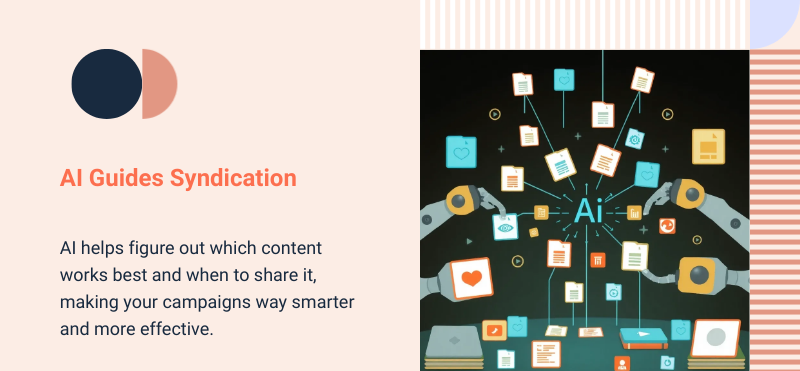
Syndicated content becomes more effective when AI guides distribution and follow-up prioritization
AI enhances syndication performance by identifying which types of content attract the highest-value prospects and adjusting distribution priorities accordingly. This improves both acquisition quality and downstream conversion rates.
Traditional syndication approaches often distribute content broadly without feedback-driven refinement. AI-enabled syndication introduces continuous performance learning, allowing systems to optimize for outcomes rather than activity.
This optimization improves acquisition efficiency across multiple dimensions.
Key areas of AI-driven syndication optimization include:
- Identification of highest-performing content formats
- Audience targeting refinement based on engagement patterns
- Prioritization of high-value syndication channels
- Improved timing and sequencing of content distribution
- Enhanced follow-up prioritization based on behavioral signals
This transforms syndication into a continuously improving acquisition channel rather than a static distribution mechanism.
Pipeline scalability depends on integration between acquisition, qualification, and nurturing systems
Pipeline growth becomes scalable only when acquisition, evaluation, and nurturing operate as an integrated system rather than disconnected activities. Fragmented workflows create inefficiencies that limit growth potential and reduce conversion efficiency.
AI enables integration by connecting behavioral signals across multiple acquisition and engagement channels. This allows qualification and nurturing processes to adapt dynamically based on real engagement data.
Integrated systems provide measurable operational advantages:
| Capability | Fragmented Systems | Integrated AI-Driven Systems |
| Lead prioritization | Manual, delayed | Continuous, automated |
| Targeting refinement | Periodic adjustments | Continuous improvement |
| Nurturing efficiency | Generic sequences | Behavior-driven personalization |
| Conversion predictability | Highly variable | Increasingly stable |
| Operational scalability | Limited by staffing | Scales without proportional hiring |
| Pipeline visibility | Partial and delayed | Comprehensive and real-time |
This integration transforms lead generation from a volume-driven activity into a precision-driven system.
Email nurturing converts early-stage interest into qualified pipeline over time
Most B2B prospects are not immediately ready to purchase when first acquired. Email nurturing provides a mechanism to develop readiness over time by maintaining engagement and providing relevant information aligned with prospect interests.
This gradual development increases conversion efficiency by engaging prospects at appropriate stages of their decision process. Without nurturing, many viable opportunities remain unrealized due to timing mismatch.
AI improves nurturing effectiveness by adapting engagement based on individual behavioral patterns.
Effective nurturing systems incorporate:
- Progressive information delivery aligned with engagement level
- Behavioral-based segmentation
- Adaptive engagement timing
- Re-engagement of previously inactive contacts
- Prioritization of high-intent prospects
- Automated qualification signal identification
This transforms early-stage acquisition into realized pipeline contribution.
Predictable lead generation emerges from system-level optimization rather than individual campaigns
Predictability results from continuous system operation rather than periodic campaign execution. Campaign-based acquisition introduces variability that limits forecasting reliability and growth planning.
AI-driven systems reduce variability by continuously adjusting targeting, acquisition, and nurturing processes based on real-time performance feedback.
This creates structural improvements in pipeline stability.
System-driven acquisition produces:
- Consistent inflow of new prospects
- Reduced dependence on individual campaign performance
- Improved forecasting reliability
- Greater resilience to channel performance fluctuations
- Increasing efficiency over time
- Improved pipeline coverage across buying stages
This operational consistency supports more reliable growth planning.
Content and email infrastructure compound acquisition value over time
Unlike one-time campaigns, infrastructure-based acquisition systems increase effectiveness as they accumulate data, behavioral insights, and audience relationships. Each interaction improves system intelligence and future targeting accuracy.
This compounding effect creates increasing efficiency and effectiveness without proportional increases in cost or effort.
Infrastructure compounding occurs through:
- Expansion of owned audience databases
- Accumulation of engagement and behavioral data
- Improved targeting accuracy over time
- Increased nurturing efficiency
- Reduced marginal acquisition cost
- Improved conversion predictability
This produces long-term structural advantages over campaign-driven acquisition approaches.
AI improves email marketing performance by optimizing timing, messaging, and segmentation automatically
AI enhances email marketing effectiveness by continuously analyzing engagement outcomes and adjusting delivery parameters to maximize response and conversion rates. Traditional email marketing relies heavily on static schedules and generalized messaging, which limits engagement efficiency across diverse audiences.
Behavioral variability among B2B buyers makes uniform messaging ineffective. AI resolves this by identifying patterns unique to individual contacts and segments, allowing communication strategies to align with actual engagement behavior rather than assumed preferences.
This optimization improves performance across several dimensions:
- Identification of optimal send times based on individual engagement patterns
- Dynamic adjustment of messaging based on engagement history
- Automatic suppression of low-engagement contacts to preserve sender reputation
- Prioritization of highly engaged recipients for accelerated nurturing
- Improved subject line and content alignment with recipient interests
- Continuous refinement of segmentation models based on behavioral feedback
These improvements increase engagement efficiency while reducing fatigue and disengagement.

Lead quality improves when acquisition systems prioritize engagement signals over static demographic criteria
Lead quality increases significantly when acquisition prioritization reflects demonstrated interest rather than relying exclusively on company attributes or job titles. Demographic targeting identifies theoretically relevant audiences, but engagement signals identify active buyers.
AI enables acquisition systems to distinguish between passive contacts and actively engaged prospects by analyzing behavior patterns that correlate with purchase readiness.
This distinction improves downstream efficiency by focusing resources where they produce the highest conversion return.
Behavioral qualification indicators include:
- Frequency and depth of content engagement
- Recency of interaction activity
- Consistency of engagement over time
- Interaction with high-intent content types
- Response to nurturing communication
- Multi-channel engagement correlation
These indicators provide more accurate readiness assessment than static attributes alone.
The integration of syndication and email infrastructure accelerates audience ownership development
Content syndication introduces new contacts into the acquisition ecosystem, while email infrastructure converts these contacts into owned audience relationships. This integration accelerates the transition from external audience exposure to internal audience ownership.
Without effective integration, syndication produces isolated contacts that do not contribute fully to long-term acquisition infrastructure. Email systems convert these contacts into persistent assets capable of repeated engagement and progressive qualification.
This integration produces several strategic outcomes:
- Faster growth of owned contact databases
- Improved conversion efficiency from syndicated contacts
- Reduced dependence on repeated third-party acquisition
- Greater long-term acquisition control
- Improved audience relationship continuity
- Enhanced qualification visibility across contact lifecycle
This process transforms syndication from a transactional acquisition method into an infrastructure-building mechanism.
AI reduces acquisition inefficiencies by eliminating redundant outreach and improving prioritization
Traditional acquisition processes often expend resources on contacts with low conversion probability due to limited visibility into behavioral readiness. AI reduces this inefficiency by continuously prioritizing contacts based on conversion likelihood.
This prioritization ensures that sales and marketing resources focus on the most promising opportunities while maintaining nurturing engagement with earlier-stage prospects.
Operational improvements enabled by AI prioritization include:
| Operational Area | Without AI Prioritization | With AI Prioritization |
| Sales outreach efficiency | Low precision targeting | High precision targeting |
| Resource allocation | Broad, inefficient distribution | Focused, high-value allocation |
| Lead response timing | Delayed or inconsistent | Optimized and immediate |
| Conversion efficiency | Lower conversion rates | Higher conversion rates |
| Operational scalability | Limited by manual review | Scales automatically |
This improves both operational efficiency and revenue generation potential.
Email databases enable progressive prospect development across extended buying cycles
B2B buying cycles often extend across months or years due to budget planning, evaluation requirements, and organizational decision complexity. Email infrastructure provides the mechanism to maintain engagement across these extended timelines.
Without persistent engagement mechanisms, acquisition efforts frequently fail to convert prospects whose readiness develops later. Email nurturing preserves acquisition value by maintaining visibility and engagement continuity.
This capability provides structural advantages:
- Sustained engagement throughout extended decision timelines
- Improved readiness visibility through engagement tracking
- Reduced need for repeated reacquisition efforts
- Higher overall conversion yield from acquisition investment
- Improved alignment between engagement timing and purchase readiness
- Enhanced long-term audience value realization
This increases lifetime conversion potential across acquisition cohorts.
AI-driven segmentation enables more precise alignment between messaging and buyer readiness
Segmentation accuracy improves when classification reflects behavioral patterns rather than static attributes alone. AI enables segmentation models that adapt continuously as engagement behavior evolves.
This allows messaging strategies to align more precisely with prospect readiness and interests.
Segmentation improvements enabled by AI include:
- Automatic identification of readiness stages
- Behavioral clustering of similar prospects
- Continuous refinement of segment definitions
- Improved relevance of communication content
- Reduction of irrelevant messaging exposure
- Enhanced conversion efficiency across segments
This improves both engagement quality and conversion performance.
Acquisition systems become more resilient when supported by diversified lead generation infrastructure
Resilient acquisition systems avoid dependence on any single channel or tactic. Integration of content syndication, email infrastructure, and AI optimization creates diversified acquisition capability that reduces vulnerability to channel-specific disruptions.
Diversification improves both stability and scalability of pipeline generation.
Diversified infrastructure provides several operational benefits:
- Reduced reliance on individual acquisition channels
- Improved stability of lead generation volume
- Greater adaptability to changing acquisition environments
- Improved risk mitigation across acquisition strategies
- Enhanced long-term acquisition sustainability
- Greater operational control over pipeline generation
This reduces acquisition volatility and improves planning reliability.
Marketing AI enables continuous performance improvement without proportional increases in operational complexity
Operational scalability improves when performance optimization occurs automatically rather than requiring manual intervention. Marketing AI enables continuous system improvement without increasing operational burden.
This allows acquisition systems to scale efficiently while maintaining or improving performance quality.
Continuous improvement mechanisms include:
- Automatic performance analysis and adjustment
- Continuous refinement of targeting criteria
- Dynamic adaptation of nurturing workflows
- Behavioral feedback-driven optimization
- Improved efficiency over time without manual intervention
- Increasing conversion performance as data accumulates
This enables sustainable acquisition scaling.
Risk factors emerge when lead generation infrastructure lacks integration or intelligence
Acquisition inefficiencies and pipeline instability often result from fragmented systems or lack of adaptive optimization. These limitations restrict scalability and reduce acquisition effectiveness.
Common infrastructure risks include:
| Risk Category | Operational Consequence | Strategic Impact |
| Fragmented acquisition channels | Inefficient lead utilization | Reduced pipeline efficiency |
| Lack of behavioral visibility | Poor prioritization | Lower conversion rates |
| Over-reliance on manual processes | Limited scalability | Higher operational cost |
| Weak nurturing infrastructure | Lost conversion opportunities | Reduced ROI |
| Limited audience ownership | Dependence on external platforms | Reduced acquisition control |
Mitigating these risks requires integrated, intelligent acquisition systems.
Long-term pipeline scalability depends on infrastructure maturity rather than campaign frequency
Pipeline scalability reflects the capability of acquisition systems to operate continuously and efficiently without requiring constant manual intervention. Infrastructure maturity enables sustained acquisition performance independent of individual campaign execution.
This maturity develops through integration of AI optimization, content acquisition mechanisms, and persistent audience infrastructure.
Mature acquisition infrastructure provides:
- Continuous prospect acquisition capability
- Increasing efficiency over time
- Improved conversion predictability
- Reduced marginal acquisition cost
- Greater operational scalability
- Stronger long-term pipeline stability
This transforms lead generation into a durable growth engine.
AI-Driven B2B Lead Generation – People Also Ask (FAQ)
What is AI-driven B2B lead generation?
AI-driven B2B lead generation uses artificial intelligence to identify, acquire, prioritize, and nurture prospects based on behavioral and engagement data. This improves targeting accuracy, efficiency, and scalability.
How does content syndication generate B2B leads?
Content syndication generates leads by distributing informational content through external platforms, allowing organizations to capture contact engagement from relevant professional audiences.
Why are email lists important for B2B lead generation?
Email lists provide direct, persistent access to prospects, enabling ongoing engagement, nurturing, and conversion without dependence on third-party platforms.
How does AI improve email marketing performance?
AI improves email marketing by optimizing send timing, messaging relevance, segmentation accuracy, and engagement prioritization based on behavioral analysis.
What makes lead generation scalable?
Lead generation becomes scalable when acquisition, qualification, and nurturing systems operate continuously and integrate effectively, reducing dependence on manual effort.
How does AI improve lead quality?
AI improves lead quality by identifying behavioral signals that indicate purchase readiness, allowing prioritization of prospects most likely to convert.
What role does nurturing play in lead generation?
Nurturing maintains engagement with prospects over time, increasing conversion likelihood as purchase readiness develops.
Why is audience ownership important in B2B marketing?
Audience ownership allows direct communication, reduces reliance on external platforms, and increases long-term acquisition efficiency and control.