
What AI consulting actually means for modern organizations
AI consulting is the structured practice of identifying, designing, and operationalizing artificial intelligence systems that solve real business problems at scale. The discipline focuses on aligning data, technology, and workflows so AI capabilities integrate directly into daily operations rather than existing as isolated experiments. Effective AI consulting emphasizes outcomes, governance, and long-term adaptability over novelty.
Unlike ad hoc AI adoption, consulting-led AI initiatives are anchored to business priorities such as growth efficiency, customer intelligence, and operational resilience. Strategic alignment prevents fragmented tools and redundant automation layers. The result is AI that compounds value over time instead of degrading performance through unmanaged complexity.
Why AI consulting has become inseparable from marketing automation
AI consulting has become foundational to marketing automation because modern marketing systems generate more data and decision points than manual logic can manage. Predictive modeling, intelligent segmentation, and adaptive content orchestration now determine competitive advantage. Consulting ensures these capabilities are deployed coherently rather than bolted onto existing platforms.
Marketing automation without AI plateaus quickly due to static rules and rigid workflows. AI consulting introduces learning systems that evolve with customer behavior, channel dynamics, and market conditions. This shift transforms automation from task execution into continuous optimization.
How AI consulting differs from generic automation services
AI consulting differs from generic automation services by focusing on intelligence rather than process replication. Traditional automation mirrors existing workflows, while AI consulting rethinks how decisions are made and optimized across systems. The distinction lies in learning, adaptability, and outcome ownership.
This comparison highlights the practical differences:
| Dimension | Generic Automation | AI Consulting |
| Decision logic | Static rules | Adaptive models |
| Optimization | Manual tuning | Continuous learning |
| Data usage | Transactional | Predictive and contextual |
| Scope | Task-level | System-level |
| Longevity | Degrades over time | Improves with use |
Organizations that conflate automation with AI often overinvest in tools without unlocking intelligence. AI consulting addresses this gap by redesigning decision frameworks.
Core responsibilities within an AI consulting engagement
AI consulting engagements center on translating business intent into deployable intelligence systems. Consultants operate at the intersection of strategy, data architecture, and execution. The work spans planning, implementation, and long-term stewardship.
The responsibilities typically include:
- Identifying high-impact AI use cases aligned to revenue, efficiency, or risk reduction
- Assessing data readiness, quality, and governance constraints
- Designing AI-enabled workflows across platforms and teams
- Overseeing model deployment, integration, and monitoring
- Establishing accountability, compliance, and ethical guardrails
Each responsibility supports durability, ensuring AI systems remain useful as conditions change.
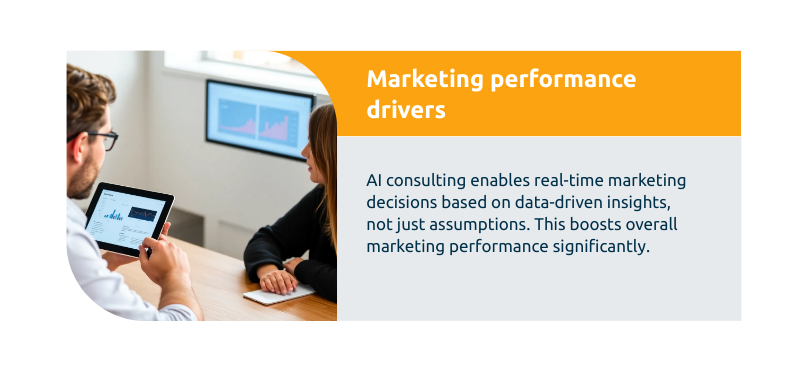
AI consulting use cases that drive marketing performance
AI consulting drives marketing performance by enabling decisions that adjust in real time rather than reacting after results are known. Intelligent systems continuously evaluate signals across channels, audiences, and content. This allows marketing teams to allocate effort where marginal gains are highest.
Common high-impact use cases include:
- Predictive lead generation scoring that prioritizes conversion probability
- Dynamic audience segmentation based on behavior patterns
- Content personalization informed by intent and lifecycle stage
- Budget optimization across paid and owned channels
- Customer churn and lifetime value forecasting
These use cases outperform static automation because they learn from outcomes rather than enforcing assumptions.
Data readiness as the limiting factor in AI consulting success
Data readiness is the primary determinant of whether AI consulting delivers measurable value. Models cannot compensate for fragmented, inconsistent, or poorly governed data. Consulting engagements often reveal that foundational data work matters more than algorithm selection.
Critical data readiness elements include:
- Unified customer and account identifiers
- Consistent event tracking across platforms
- Clear data ownership and stewardship rules
- Accessible historical data for training models
- Defined quality thresholds and validation processes
AI consulting addresses these gaps early to prevent downstream failure.
Strategic planning versus model deployment in AI consulting
AI consulting distinguishes strategic planning from model deployment because long-term value depends more on design choices than on technical execution. Planning defines where intelligence belongs in the organization and how it compounds over time. Deployment executes those decisions within operational constraints.
Strategic planning typically addresses:
- Which decisions should be automated versus augmented
- How AI outputs influence human workflows
- Where feedback loops reinforce learning
- How performance is measured and governed
Deployment follows as an implementation of strategy, not a substitute for it.
Governance and risk management in AI consulting
AI consulting embeds governance to ensure intelligent systems remain accountable, explainable, and compliant. Without guardrails, AI systems introduce operational, reputational, and regulatory risk. Consulting frameworks define boundaries before scale accelerates exposure.
Key governance considerations include:
- Model transparency and auditability
- Bias detection and mitigation processes
- Data privacy and access controls
- Escalation paths for model errors
- Periodic performance and drift reviews
Governance enables confidence in AI-driven decisions rather than slowing innovation.
What determines ROI in AI consulting initiatives
ROI in AI consulting depends on adoption, integration, and decision leverage rather than model sophistication. High-performing initiatives target decisions that repeat frequently and influence outcomes materially. Marginal improvements at scale generate disproportionate returns.
Determinants of ROI typically include:
- Frequency of the decision being optimized
- Financial impact of improved accuracy
- Degree of automation versus human override
- Speed of feedback and learning cycles
- Alignment with revenue or cost drivers
AI consulting maximizes ROI by selecting leverage points, not by chasing technical novelty.
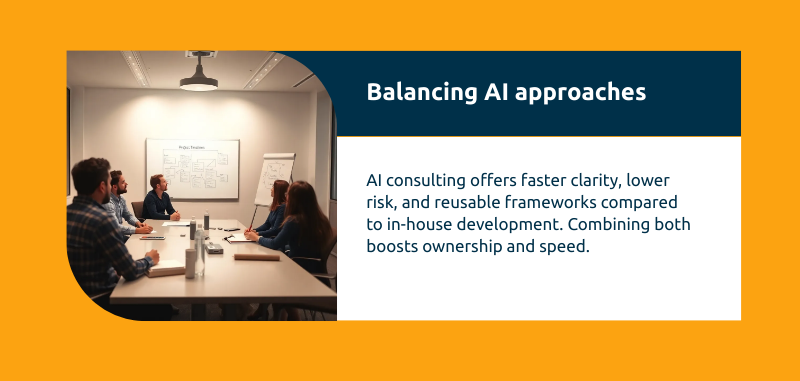
AI consulting versus in-house AI development in practice
AI consulting differs from in-house AI development by accelerating clarity, reducing experimentation risk, and transferring repeatable frameworks. Internal teams often struggle with prioritization and governance while learning foundational patterns. Consulting compresses this learning curve.
This comparison illustrates the tradeoff:
| Consideration | In-House Development | AI Consulting |
| Time to value | Extended | Accelerated |
| Risk exposure | High during learning | Managed through frameworks |
| Cross-industry insight | Limited | Broad |
| Governance maturity | Often reactive | Designed upfront |
| Scalability | Gradual | Planned |
Many organizations blend both approaches to balance ownership with speed.
The role of AI consulting in martech stack alignment
AI consulting aligns fragmented martech stacks by introducing intelligence layers that coordinate tools rather than adding more platforms. Modern stacks often suffer from overlapping capabilities and disconnected data flows. Consulting reframes the stack around decisions instead of features.
Effective alignment focuses on:
- Centralizing decision logic rather than duplicating rules
- Reducing data latency between systems
- Clarifying platform responsibilities
- Eliminating redundant automation
- Enabling cross-channel intelligence
This approach stabilizes complexity while improving performance.
Why proof-of-concept AI fails without consulting discipline
Proof-of-concept AI fails when experimentation is disconnected from operational reality. Small-scale pilots often ignore integration, governance, and adoption barriers. AI consulting prevents this by designing for scale from the outset.
Common proof-of-concept failure modes include:
- Manual data preparation that cannot scale
- Isolated models with no production integration
- Undefined ownership post-launch
- No feedback loops for improvement
- Unclear success metrics
Consulting discipline converts experimentation into operational capability.
Skills and capabilities central to AI consulting effectiveness
AI consulting effectiveness depends on combining technical fluency with business judgment. Consultants must translate abstract capabilities into concrete decisions and workflows. Pure technical expertise without context limits impact.
Core capability areas include:
- Applied machine learning and analytics
- Data architecture and integration
- Marketing operations and automation logic
- Change management and adoption planning
- Risk, ethics, and governance design
This blend ensures AI systems influence outcomes, not just infrastructure.
Evaluating AI consulting partners beyond credentials
Evaluating AI consulting partners requires examining decision ownership rather than surface-level expertise. Effective partners focus on outcomes, integration, and sustainability. Credentials alone do not indicate delivery quality.
Evaluation criteria that matter include:
- Ability to articulate business-first use cases
- Experience integrating AI into existing systems
- Approach to governance and risk
- Transparency around model limitations
- Commitment to knowledge transfer
These signals predict long-term value more reliably than brand recognition.
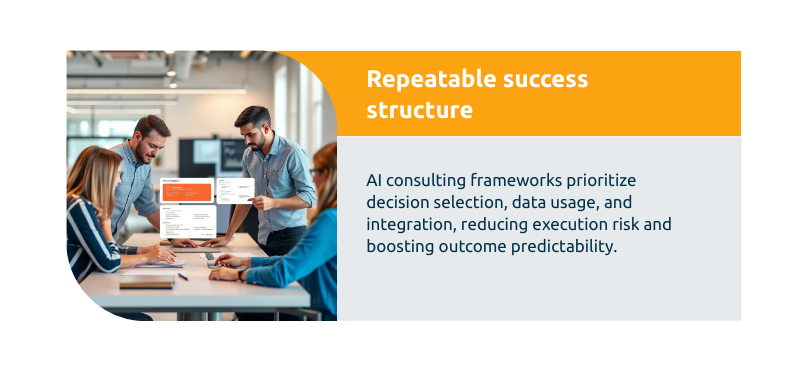
AI consulting frameworks that guide repeatable success
AI consulting frameworks provide structured methods for moving from opportunity identification to scaled deployment without relying on ad hoc experimentation. Mature frameworks prioritize decision selection, data leverage, and operational integration over isolated model development. This structure reduces execution risk while improving predictability of outcomes.
A practical AI consulting framework typically emphasizes:
- Business decision mapping to isolate high-leverage use cases
- Data flow validation to ensure model inputs remain reliable
- Automation boundaries that clarify human versus machine responsibility
- Feedback mechanisms that enable continuous learning
- Governance checkpoints that prevent uncontrolled system drift
Framework-driven consulting avoids reinvention on every initiative and supports long-term scalability.
Generative AI consulting versus predictive AI consulting
Generative AI consulting and predictive AI consulting serve distinct but complementary purposes within modern organizations. Generative AI focuses on content creation, interaction, and synthesis, while predictive AI concentrates on forecasting outcomes and optimizing decisions. Confusing the two leads to misaligned expectations and poor deployment choices.
This comparison clarifies the distinction:
| Dimension | Generative AI Consulting | Predictive AI Consulting |
| Primary function | Content and interaction | Forecasting and optimization |
| Typical outputs | Text, images, summaries | Scores, probabilities, signals |
| Marketing use cases | Messaging, personalization | Lead scoring, churn prediction |
| Risk profile | Brand and compliance | Revenue and operational impact |
| Value driver | Speed and scale | Accuracy and efficiency |
AI consulting aligns both approaches under a unified decision architecture rather than treating them as separate initiatives.
AI implementation consulting and execution readiness
AI implementation consulting focuses on converting strategic intent into operational systems that perform reliably under real conditions. Execution readiness determines whether AI initiatives generate value or stall during rollout. Consulting ensures readiness across technology, teams, and processes before scale.
Execution readiness is typically evaluated through:
- Platform compatibility and integration depth
- Model monitoring and performance thresholds
- Workflow adoption across teams
- Exception handling for model uncertainty
- Ownership clarity post-deployment
Implementation without readiness planning often results in stalled pilots and abandoned systems.
AI consulting pricing models and engagement structures
AI consulting pricing varies based on scope, risk exposure, and outcome ownership rather than model complexity alone. Engagements structured around value delivery outperform time-based arrangements when objectives are well-defined. Pricing models signal how responsibility is shared.
Common AI consulting engagement structures include:
- Fixed-scope strategy and roadmap engagements
- Phased implementation tied to milestones
- Retainer-based optimization and governance support
- Hybrid models combining planning and execution
Clear alignment between pricing structure and business outcomes improves accountability on both sides.
When AI consulting delivers competitive advantage
AI consulting delivers competitive advantage when intelligence compounds faster than competitors can replicate. Advantage emerges from systems that learn continuously, integrate deeply, and influence decisions at scale. One-off AI features rarely sustain differentiation.
Competitive advantage is strongest when AI consulting enables:
- Faster response to market and customer signals
- More accurate allocation of marketing resources
- Reduced dependency on manual optimization
- Consistent decision quality across teams and channels
Organizations that embed AI consulting into operating models create advantages that persist beyond individual tools or platforms.
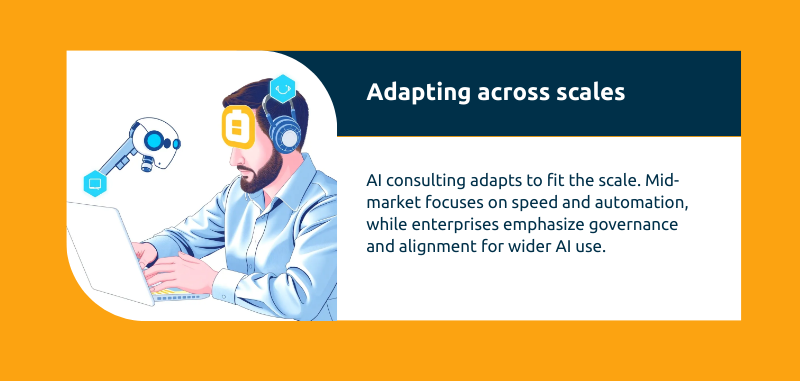
AI consulting for mid-market and enterprise organizations
AI consulting adapts differently across organizational scale. Mid-market organizations prioritize speed, focus, and practical automation. Enterprise organizations emphasize governance, integration, and cross-functional alignment.
Key differences include:
| Aspect | Mid-Market | Enterprise |
| Primary constraint | Resources | Complexity |
| AI focus | Efficiency and growth | Scale and governance |
| Integration depth | Selective | Extensive |
| Decision cadence | Fast | Distributed |
Consulting frameworks adjust to these realities to maintain relevance.
How AI consulting reshapes marketing team structure
AI consulting reshapes marketing teams by shifting effort from execution to oversight and strategy. Intelligent systems absorb repetitive decision-making, freeing teams to focus on creative and strategic work. Roles evolve rather than disappear.
Typical structural changes include:
- Increased reliance on analytics-driven planning
- New ownership models for AI outputs
- Tighter collaboration between marketing and data teams
- Reduced manual campaign management
- Expanded focus on experimentation and learning
This evolution improves resilience and adaptability.
The long-term trajectory of AI consulting in marketing
AI consulting is moving toward embedded intelligence rather than standalone initiatives. Future engagements will focus on continuous optimization rather than discrete projects. Intelligence becomes infrastructure.
This trajectory favors organizations that invest early in governance, data quality, and decision design. AI consulting increasingly rewards operational maturity over experimentation volume.
Frequently asked questions about AI consulting
What does an AI consultant do?
An AI consultant identifies high-impact opportunities for artificial intelligence, designs systems that support those decisions, and oversees implementation, governance, and optimization.
How is AI consulting different from marketing automation?
AI consulting focuses on learning and decision intelligence, while marketing automation typically executes predefined rules and workflows.
Is AI consulting only for large enterprises?
AI consulting applies to organizations of all sizes, with scope and complexity adjusted to resources, data maturity, and objectives.
What skills are required for AI consulting?
AI consulting requires a mix of data science, systems integration, business strategy, and governance expertise.
How long does an AI consulting engagement take?
Engagement length varies, but value-driven initiatives prioritize early operational impact followed by iterative improvement.
What are common risks in AI consulting projects?
Common risks include poor data quality, unclear ownership, weak governance, and misalignment between models and business decisions.
Does AI consulting replace internal teams?
AI consulting complements internal teams by accelerating capability development and reducing experimentation risk rather than replacing ownership.