
The B2B landscape has never been more competitive, and the pressure on companies to generate high-quality leads has never been more intense. Buyers today are overwhelmed with choices, flooded with marketing messages, and more selective than ever before. They expect speed, relevance, accuracy, and value at every touchpoint. Meanwhile, sales and marketing teams face shrinking budgets, higher KPIs, and the constant challenge of doing more with fewer resources.
Traditional lead generation simply can’t keep up anymore. Manually scraping lists, sending broad cold emails, or relying on intuition to qualify leads might have worked a decade ago, but today, these methods can’t deliver the scale or precision required to compete.
This is where AI in lead generation steps in, not as a shortcut, but as a fundamental evolution of how B2B companies research, identify, qualify, nurture, and convert leads.
AI doesn’t just automate tasks. It understands patterns. It can analyze millions of data points, predict buyer behaviors, personalize communication at scale, and optimize campaigns in ways humans simply can’t, at least not without massive time and resources.
The rise of AI tools in B2B marketing reflects a larger trend: businesses are shifting from reactive, manual workflows to proactive, intelligent, self-optimizing systems.
Why AI Has Become Essential in B2B Lead Generation
AI isn’t just a trend, it has become the foundation for modern, scalable lead-generation systems. Several industry shifts have made AI not just helpful but necessary.
1. Buyer Behavior Has Changed Dramatically
Today’s B2B buyers:
- Conduct independent research
- Compare competitors without talking to sales
- Read reviews, whitepapers, and case studies on their own
- Avoid outreach from unpersonalized sales efforts
This autonomy makes it harder than ever for sales teams to get visibility into where leads are in the funnel. AI solves this by tracking behavior signals and scoring intent automatically.
2. Lead Generation Has Become a Data Problem
Companies have more data than ever:
- CRM data
- Website analytics
- Email engagement
- Firmographics and technographics
- Third-party intent sources
But the sheer volume is impossible for humans to analyze manually. AI gives meaning to the chaos.
3. Speed Now Determines Competitive Advantage
The first company to understand a prospect’s needs, and respond with relevant value, often wins the deal. AI reduces lag time across every stage of the funnel, giving companies the speed edge they need.
4. Efficiency Has Become a Survival Requirement
The days of massive sales teams doing manual prospecting are fading. AI reduces overhead costs while improving output, making it essential for modern scalability.
How AI Transforms the B2B Lead Generation Workflow (Expanded)
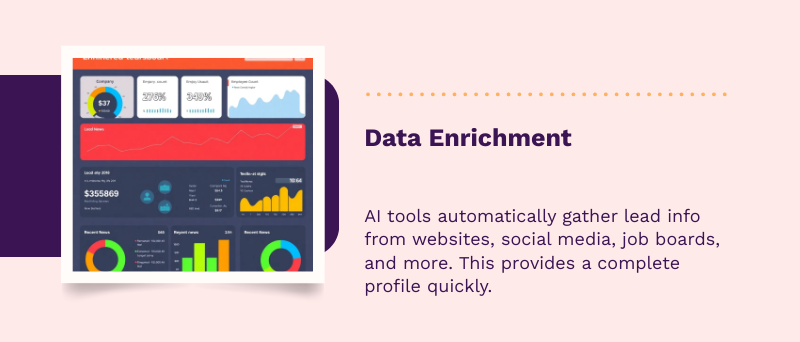
1. Smarter Lead Research and Data Enrichment
Before AI, B2B lead research required:
- Checking LinkedIn profiles
- Looking up company info
- Validating emails
- Googling industry updates
- Manually adding details into a CRM
This process could take 10–30 minutes per lead.
AI tools now complete this work in seconds.
What AI Adds to Leads Automatically
AI pulls together a complete lead profile using data from:
- Websites
- Social media
- Job boards
- Public filings
- Tech stack databases
- Buying intent platforms
- CRM records
It can enrich info such as:
- Company revenue
- Employee count
- Technology usage
- Recent news or funding
- Prospect responsibilities
- Pain points based on industry
| Task | Manual Process | AI-Powered Process | Impact |
| Lead profiling | Research each source individually | Auto-extract + enrich from multiple sources | Less grunt work, more accuracy |
| Email validation | Trial-and-error | Real-time verification | Reduced bounce rates |
| Identifying decision-makers | Manual searching | AI maps org structures | Faster targeting |
| Adding to CRM | Manual entry | Auto-sync | No missing data |
AI ensures you’re not working from outdated or incomplete information—which dramatically improves lead quality.
2. Predictive Lead Scoring
Not all leads deserve equal attention, but manual scoring is often subjective.
AI predictive scoring uses machine learning to determine which leads:
- Are ready to buy
- Fit the ideal customer profile
- Show meaningful engagement
- Align with successful past deals
Benefits of Predictive Scoring
- Reduces time wasted on unqualified leads
- Helps sales prioritize conversations that matter
- Improves marketing-to-sales alignment
- Creates a more accurate pipeline forecast
- Eliminates human bias
AI sees patterns that humans often miss, such as:
- Frequency of visits to solution pages
- Engagement with competitor comparisons
- High-value keywords used in searches
- Industry-specific buying cycles
This leads to more accurate prioritization and higher conversion rates.
3. Automated Outreach and Follow-Up
AI-powered outreach goes far beyond basic automation. It dynamically adjusts messaging based on prospect behavior.
What AI Outreach Tools Can Do
- Personalize email sequences
- Suggest best send times
- Trigger messages based on engagement
- Rewrite emails for tone and intent
- Analyze email responses
- Adjust sequences automatically
Example Workflow
- Prospect downloads a whitepaper
- AI scores the lead as high intent
- Outreach sequence begins
- If the lead opens but doesn’t click, AI sends a lighter touch
- If they click a pricing link, AI triggers a sales rep alert
- If they stop engaging, AI pauses the sequence
This creates a responsive, personalized system that feels human, but scales like automation.
4. AI Chatbots and Conversational Marketing
Modern AI chatbots feel almost like real sales reps; they respond instantly, provide helpful info, and guide leads deeper into the funnel.
AI chatbots can:
- Qualify leads with dynamic questions
- Understand natural language
- Provide product recommendations
- Pull data from your CRM in real time
- Connect prospects directly to sales reps
- Operate 24/7
5. Intent Data + AI for Hyper-Targeted Prospecting
Intent data is one of the strongest predictors of purchase readiness.
AI analyzes:
- Competitor page visits
- Review site searches
- Engagement with industry keywords
- Content consumed
- Technographic changes
Expanded Use Cases
- Create highly targeted ad campaigns
- Prioritize accounts showing “pain point” signals
- Identify companies about to enter a purchase cycle
- Alert sales teams when prospects are “heating up”
This allows outreach to be perfectly timed, when interest is highest.
6. Content Automation and Personalization
AI is revolutionizing B2B content workflows from end to end.
AI Can Help Create:
- Blogs
- Outreach emails
- Social posts
- Landing pages
- Industry-specific case studies
- Personalized product messaging
7. AI-Powered Analytics and Optimization
AI doesn’t just report metrics, it interprets them.
It can identify:
- Why campaigns underperform
- Which content resonates most
- Where leads drop off in the funnel
- What messaging converts best
- Which keywords drive the highest intent
| Area | Traditional Approach | AI-Driven Approach | Benefit |
| Funnel insights | Monthly reviews | Instant analysis | Faster optimization |
| A/B testing | Manual setup | Auto-test + auto-optimize | Maximizes ROI |
| Forecasting | Past trends | Predictive modeling | More accurate |
| Lead quality reporting | Subjective | Data-driven | Better alignment |
AI gives B2B teams clarity, direction, and confidence.
Benefits of Using AI in Lead Generation
1. Higher Lead Quality
AI tools filter out noise and focus on truly qualified prospects.
2. Faster Qualification Times
AI shortens the time between research and outreach dramatically.
3. Better Personalization
AI tailors messaging to industry, persona, stage, and intent, at scale.
4. Lower Acquisition Costs
Automation reduces manual labor, ad waste, and misaligned campaigns.
5. Accurate, Clean Data
AI continuously updates CRM fields, preventing data decay.
6. Predictable, Scalable Results
AI systems get smarter over time, leading to compounding growth.
Challenges and Considerations
1. Data Quality Issues
AI is powerful, but it’s not magical. It needs high-quality, accurate data to perform effectively.
2. Risk of Over-Automation
Too much automation can make your company feel robotic. Human oversight is essential.
3. Internal Adoption
Not every team member will immediately embrace new technology.
4. Privacy and Compliance
AI strategies must follow:
- GDPR
- CCPA
- CAN-SPAM
- Internal data governance
5. Cost of Implementation
While cost-effective long-term, setup may require upfront investment.
Best Practices for Using AI Tools
1. Start Small and Scale Gradually
Choose one area, like lead scoring or outreach, and improve it first.
2. Keep Humans Involved
AI should enhance, not replace, your team’s judgment.
3. Audit Your Data Regularly
Data hygiene is the cornerstone of AI success.
4. Personalize Everything
Generic automation kills credibility. Use AI intelligently.
5. Track Performance and Iterate
AI improves with feedback, so continuous monitoring is key.
How AI Strengthens Alignment Between Sales and Marketing Teams
One of the biggest obstacles in B2B lead generation has always been the disconnect between sales and marketing teams. Marketing often argues that sales isn’t following up properly, while sales claims the leads aren’t qualified. This tension slows down growth, creates inefficiencies, and makes it harder to generate consistent revenue.
AI smooths out this friction by creating shared visibility, cleaner data, and a more unified understanding of the buyer journey.
1. AI Creates a Single Source of Truth
Before AI, each team might work with different interpretations of “a good lead.”
Marketing relied on engagement metrics.
Sales relied on intuition and conversations.
AI changes this by giving both teams a shared data foundation:
- Real-time behavior tracking
- Predictive scoring
- Intent analysis
- CRM-enriched insights
When both teams operate from the same intelligence, disagreements decrease, and productivity increases.
2. Improved Lead Scoring = Fewer Misaligned Leads
Using AI for lead scoring ensures that the leads passed to sales are:
- Highly qualified
- Ready for deeper conversations
- Actively showing purchase intent
This reduces the number of leads that sales rejects and increases trust in marketing’s efforts.
Instead of arguing about lead quality, teams can focus on refining strategy.
3. Better Visibility Into the Buyer Journey
AI platforms show sales exactly:
- Which content prospects engage with
- How long they stay on certain pages
- What emails they opened
- What problems they’re researching
- Where they may be stuck
This gives sales a major advantage, they walk into conversations already understanding the prospect’s pains and priorities.
Marketing benefits too. They learn what content performs best and which campaigns drive the highest-converting leads.
4. Automated Hand-Offs Reduce Delays
AI tools can automatically:
- Assign leads
- Trigger notifications
- Create tasks
- Move leads between funnel stages
This eliminates the common handoff issues like:
- Delayed follow-ups
- Lost leads
- Miscommunication between teams
When workflows happen automatically, no lead slips through the cracks.
5. AI Provides Shared Metrics for Both Teams
Instead of focusing on separate KPIs, AI tools help both teams track:
- Lead conversion rates
- Pipeline contribution
- Engagement patterns
- Ideal customer profiles
- Successful outreach channels
- Attribution paths
This creates common goals and shared accountability.
Sales sees the value of marketing’s work. Marketing sees how their content affects revenue. Both teams become partners instead of separate silos.
6. AI Helps Build More Consistent Messaging
AI tools analyze which messages perform best at each stage of the funnel.
Marketing can use this to refine campaigns.
Sales can use it to tailor conversations.
The result?
Prospects receive a seamless, consistent experience no matter who they’re interacting with.
7. Better Team Morale and Higher Productivity
When alignment improves:
- Sales spends less time on unqualified leads
- Marketing feels recognized and validated
- Both teams communicate more effectively
- Company culture improves
- Revenue grows faster
AI isn’t just improving workflows, it’s improving team relationships. And when sales and marketing collaborate smoothly, the entire revenue engine becomes more powerful.
AI Tools Changing B2B Lead Generation
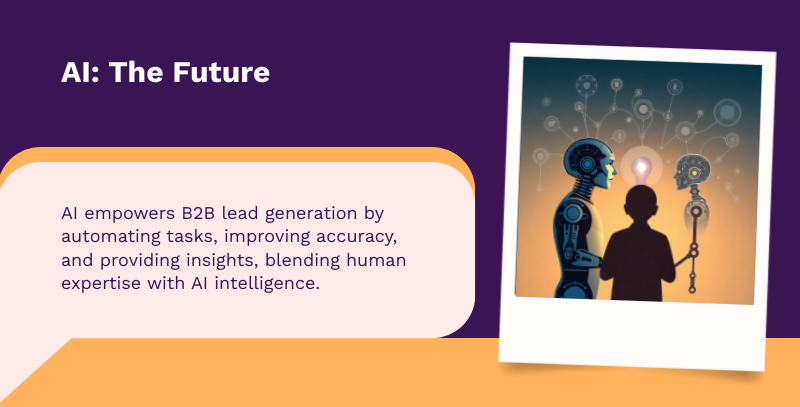
AI tools are transforming the way B2B companies discover, attract, and convert leads. By automating repetitive tasks, improving data accuracy, optimizing outreach, and providing real-time insights, AI helps businesses scale their lead-generation efforts with unprecedented precision and efficiency.
But the real power of AI doesn’t come from replacing humans, it comes from empowering them. When AI handles the heavy lifting, your team can focus on what truly matters: creativity, strategy, innovation, and authentic human connection.
The future of B2B lead generation belongs to companies that blend human expertise with AI-driven intelligence. Those who embrace this shift will build stronger pipelines, close deals faster, and rise above the competition in a marketplace where relevance and speed define success.
AI Tools for B2B Lead Generation – FAQ
1. How exactly does AI improve lead generation?
It automates research, identifies high-intent leads, personalizes outreach, analyzes behavior, and optimizes campaigns in real time.
2. Is AI difficult to implement for small or mid-sized businesses?
Not anymore. Most tools now offer easy onboarding, templates, and integrations designed for SMBs.
3. Does AI replace sales reps?
No, AI supports reps by removing low-value tasks so they can focus on relationship building and closing deals.
4. What types of B2B companies benefit most from AI lead generation?
SaaS, enterprise tech, consulting firms, manufacturers, agencies, basically any business with a structured sales cycle.
5. Which AI tools are most effective for B2B outreach?
Tools for email sequencing, personalization, lead scoring, chatbots, and data enrichment typically deliver the biggest impact.
6. Can AI help reduce customer acquisition costs?
Yes, by improving lead quality, reducing manual hours, and eliminating ad spend waste.
7. How does AI improve personalization?
It tailors messaging by analyzing intent, engagement, industry, role, and pain points.
8. Will AI make my outreach sound generic?
Only if used poorly. With smart prompts and human oversight, AI can feel more personalized than manual writing.
9. What is the biggest risk of using AI for lead generation?
Overreliance, companies must balance automation with authentic human engagement.
10. How can I get started using AI in my B2B lead-generation strategy?
Begin with one workflow, like lead scoring or email outreach, test results, refine, then expand into additional automations.